
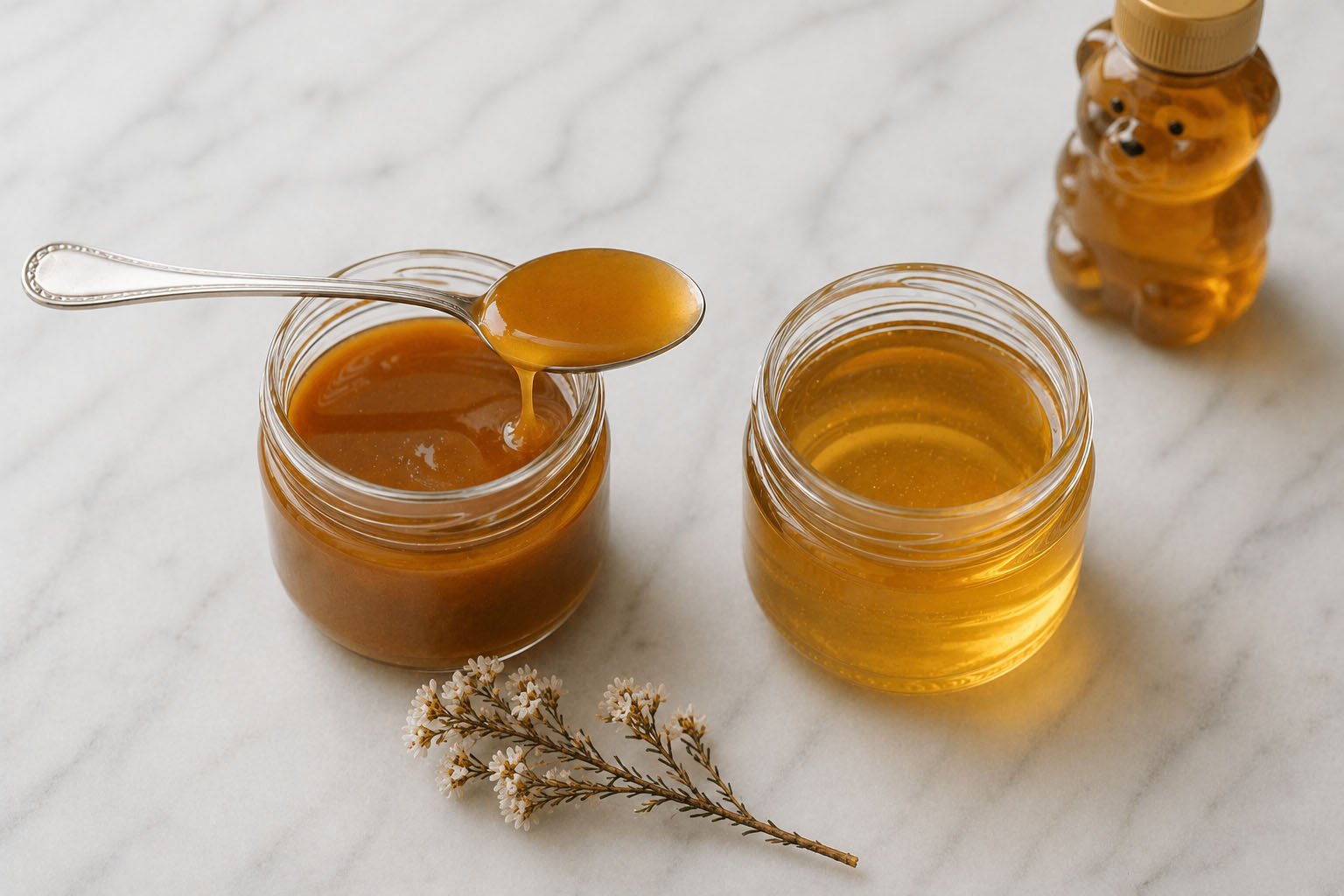
Key Points: Manuka Honey vs Regular Honey
- The honey in your cabinet and the $60 jar at the health food store are genuinely different products. What makes them different is a compound called MGO that regular honey contains in trace amounts and manuka honey contains in quantities up to 100 times higher.
- Regular honey is better for cooking and baking. High heat destroys the beneficial compounds in manuka honey and eliminates any advantage over the cheaper option.
- Manuka honey is better for cold preparations, warm drinks, topical skin use, and the daily wellness spoonful where the MGO content delivers something regular honey cannot.
- Most regular commercial honey has been pasteurized and filtered, which removes some natural enzymes and pollen. A good quality raw honey from a local beekeeper is a much closer comparison to manuka than the bear bottle from the supermarket.
- The honest answer to “is manuka honey better?” is: for specific uses, yes. For everyday sweetening and cooking, no. Knowing which is which saves you money and gets you better results from both.
You have probably seen manuka honey sitting on the shelf next to regular honey and wondered what the difference actually is. One jar costs $4. The other costs $60. They are both honey. They are both made by bees. So what exactly is going on?
The difference is real and specific, and understanding it is the most useful thing you can do before deciding whether to buy a jar. This guide explains exactly what sets manuka honey vs regular honey apart, when each one is worth using, and when the expensive jar is simply not necessary.
What Is Regular Honey?
Most honey sold in supermarkets is what is called multifloral or blended honey. Bees collect nectar from a variety of different flowers, the honey is harvested, and it is then typically pasteurized (heated) and filtered to create a smooth, clear, consistent product with a long shelf life. The most common varieties in American supermarkets are clover honey, wildflower honey, and generic blended honey sold under store brands.
Pasteurization makes commercial honey look appealing on a shelf. It removes crystallization, kills wild yeasts, and creates a uniform color and texture. It also removes or reduces some of the natural enzymes, pollen, and beneficial compounds that are present in honey straight from the hive. The bear bottle of supermarket honey is a convenient, inexpensive sweetener. It is not the same product as raw honey from a beekeeper, which retains those natural compounds.
This distinction matters because when most people compare manuka honey to regular honey, they are actually comparing it to the processed bear bottle. A fair comparison would put manuka against a good quality raw honey from a trusted local producer. That comparison is a much closer call, and we cover it in detail in our manuka honey vs raw honey guide.
What Is Manuka Honey?
Manuka honey is a monofloral honey made by bees that forage the manuka bush (Leptospermum scoparium), a plant native to New Zealand and parts of southeastern Australia. Reputable UMF-certified producers keep it raw throughout production and handling, and what makes it genuinely different from all other honey is a compound called methylglyoxal, or MGO.
MGO is present in trace amounts in most honeys. In manuka honey it can be present at concentrations up to 100 times higher, depending on the grade of the jar. That concentration is responsible for the potent and stable antibacterial properties that have made manuka honey the subject of significant scientific research and given it a place in clinical wound dressings, high-end skincare, and daily wellness routines around the world.
It is also graded and certified through a system called UMF (Unique Manuka Factor) that tests for four compounds simultaneously: MGO for potency, Leptosperin for botanical authenticity, DHA for shelf life, and HMF for freshness. No other honey has an equivalent independent certification system. Regular honey is classified based on color, pollen content, geographic origin, or beekeeper records, all of which are more subjective than the objective chemical testing behind a UMF rating.
Manuka Honey vs Regular Honey: How They Actually Compare
| Factor | Manuka Honey | Regular Honey |
|---|---|---|
| Source | Single source: manuka bush in New Zealand and Australia | Multiple floral sources depending on variety and region |
| MGO Concentration | 83 to 1,200+ mg/kg depending on UMF grade | 0.4 to 24 mg/kg in most varieties |
| Antibacterial Potency | High and stable. MGO activity remains effective even in the presence of body fluids | Moderate. Relies primarily on hydrogen peroxide, which body fluids can neutralize |
| Certification | UMF and MGO grading. Independently tested and verified | No universal standard. Quality varies significantly by producer and variety |
| Processing | Always raw from reputable producers. Pasteurization would disqualify UMF certification | Most commercial honey is pasteurized and filtered. Raw and unfiltered varieties are increasingly available but less common at mass-market retailers |
| Taste | Rich, earthy, slightly caramel-like with a hint of bitterness. Complex and distinctive | Varies by floral source. Generally milder, sweeter, and less complex |
| Texture | Thick and viscous, almost spreadable. Does not pour freely | Variable. Commercial honey is typically thin and pourable. Raw honey varies by source |
| Price | $25 to $150+ for 8.8oz depending on UMF grade | $3 to $15 for a comparable jar of commercial honey. Quality raw honey $10 to $25 |
| Cooking and Baking | Not recommended at high heat. Benefits are lost. Use as finishing drizzle only | Ideal. Performs well at high heat as a sweetener and flavor agent |
| Topical Use | Strongly supported. UMF 15+ for face masks and skin treatments | Some benefit but less potent and less stable than manuka for topical applications |
What Regular Honey Does Well
Regular honey is a genuinely good food that gets undersold in conversations about manuka. A good quality raw honey from a trusted local beekeeper has meaningful antioxidant content, natural enzymes, pollen, and some antibacterial properties. Darker varieties like buckwheat honey have antioxidant profiles that rival or exceed lower-grade manuka honey. The main difference is the MGO concentration and the certified verification system, not the fundamental quality of the product.
For cooking, baking, glazes, marinades, and everyday sweetening, regular honey is the right tool. High heat destroys the MGO and enzymes that justify the manuka premium, so using a $40 jar of UMF 15 to glaze roasted carrots is genuinely wasteful. A good raw honey does the job identically at a fraction of the cost.
For table use, drizzling over yogurt, sweetening coffee, or adding to oatmeal as a daily habit, regular honey is perfectly adequate. The functional advantage of manuka at that point of use is minimal unless you are specifically using it for the daily wellness spoonful at a therapeutic-intent grade.
The Best Regular Honey for Everyday Use
If you are going to keep a jar of regular honey alongside your manuka, the type matters more than most people realize. Here is a quick practical guide:
- Raw, unfiltered honey from a local beekeeper — the best option. Retains enzymes, pollen, and natural compounds that pasteurized commercial honey loses. Supports local agriculture. Check farmers markets.
- Raw wildflower or clover honey from a verified producer — a solid second choice if local raw honey is not available. Look for “raw and unfiltered” on the label with a named source.
- Buckwheat honey — significantly higher antioxidant content than most light honeys. A good choice for health-conscious everyday use and the most nutritionally comparable to manuka in general terms.
- Standard commercial honey (the bear bottle) — convenient and inexpensive as a sweetener. Not meaningfully nutritious beyond basic sugar content after pasteurization and filtration.
What Manuka Honey Does That Regular Honey Cannot
Topical Skin Applications
This is the clearest functional gap between the two. Manuka honey at UMF 15 or above has a dual antibacterial mechanism: MGO works directly against bacteria, and the honey also produces hydrogen peroxide as a secondary effect. Regular honey’s antibacterial activity relies primarily on the hydrogen peroxide mechanism, which body fluids and skin enzymes can neutralize. Manuka’s MGO activity remains stable regardless.
For face masks, spot treatments, and DIY skincare, manuka is meaningfully more effective than regular honey. This is not a marginal difference. It is the reason medical-grade versions of manuka honey are used in clinical wound dressings and why the FDA has approved certain of those products for wound care. For minor everyday skincare at home, culinary-grade UMF 15 or above is what you want. Medical wound care involving serious burns or infected wounds is a different matter and belongs with a healthcare professional rather than a jar from your pantry. Our DIY manuka honey face mask guide and vanilla face scrub are both built around this distinction.
The Daily Wellness Spoonful
A teaspoon of UMF 10 manuka honey taken daily delivers a prebiotic content, antioxidant profile, and stable MGO activity that regular honey cannot match at equivalent grades. The oligosaccharides in manuka honey function as prebiotics, feeding beneficial gut bacteria. The specific antioxidant compounds including leptosperin and methyl syringate are unique to manuka and not found in other honeys. For this specific daily practice, the premium is justified at UMF 10 where the cost per use is reasonable. For a full breakdown of what each application actually delivers, see our manuka honey benefits guide.
Warm Drinks During Cold Season
Both honeys soothe and coat the throat. Manuka does it with the additional stable antibacterial activity that regular honey cannot reliably deliver. For the healthy hot toddy, the daily cup of ginger tea during cold season, and the warm drink you reach for when your throat feels scratchy, manuka is the better tool for the job. The key is temperature: stir it into warm, not boiling, liquid to preserve the beneficial compounds.
Cold Preparations and Flavor
In cold applications where no heat is involved, the full benefits of manuka stay intact and the flavor becomes a genuine advantage. The earthy, complex, slightly caramel taste of good manuka honey adds a dimension that regular honey does not have. It is worth noting that the bitterness becomes more pronounced at higher UMF grades, so if you are new to the flavor, starting at UMF 10 for cold drinks and working up is a practical approach. Our lavender lemonade, mint lime popsicles, beet turmeric refresher, and beet pineapple granita all use manuka specifically because the cold application preserves everything and the flavor profile elevates the drink. Our healthy coleslaw and rainbow spring rolls use it raw in dressings and dipping sauces for the same reason.
For a practical guide to every application and which grade works best for each, see our guide to how to use manuka honey. And if the price still feels steep, our breakdown of why manuka honey is so expensive walks through exactly what you are paying for.
Is Manuka Honey Better Than Regular Honey?
For specific uses, yes. For others, no. The most useful reframe is that they are different tools for different jobs rather than competitors in a single category.
The Practical Answer
Keep both. Use regular raw honey for cooking, baking, everyday sweetening, and anything involving heat. Use manuka for cold preparations, warm wellness drinks, topical skin applications, and the daily spoonful where the MGO content delivers something worth paying for. The two honeys complement each other rather than compete. The mistake is using an expensive jar of manuka for things a $10 jar of raw honey does equally well.
How to Use Each One
Use Manuka Honey For
- Daily wellness spoonful (UMF 10+)
- Warm drinks stirred in after cooling
- Cold drinks, smoothies, popsicles
- Face masks and skin treatments (UMF 15+)
- Finishing drizzle on completed dishes
- Raw dressings and dipping sauces
Use Regular Honey For
- Baking and cooking at high heat
- Glazes, marinades, and roasted vegetables
- Everyday table sweetening
- Morning coffee or oatmeal
- Recipes where honey is one of many ingredients
- Feeding a crowd where cost matters
Frequently Asked Questions
Is manuka honey worth it over regular honey?
For specific uses, yes. For skin applications, the daily wellness spoonful, warm drinks during cold season, and cold preparations, manuka at UMF 10 or above delivers properties regular honey cannot match. For cooking, baking, and everyday sweetening, regular honey is just as good and considerably less expensive. The answer depends entirely on what you plan to do with it.
Can I substitute regular honey for manuka honey in recipes?
In recipes that involve heat, yes, and it is actually the smarter choice. High heat destroys the beneficial compounds that differentiate manuka, so you are paying a significant premium for something regular honey does just as well in a hot application. In cold preparations where you are specifically using manuka for its flavor or wellness properties, the substitution works for taste but not for functional benefit.
What does regular honey taste like compared to manuka honey?
Regular honey varies widely by floral source. Clover honey is mild and floral. Wildflower honey is more complex and variable. Buckwheat honey is dark and robust. Manuka honey has a distinctive taste of its own: rich, earthy, and slightly caramel-like with a hint of bitterness that becomes more pronounced at higher grades. It is darker and thicker than most commercial honeys and has a flavor profile that is immediately recognizable once you know what you are tasting.
Is regular honey antibacterial?
Yes, all honey has some antibacterial properties. Regular honey produces hydrogen peroxide, which has antibacterial effects. The difference with manuka is that manuka’s MGO-based antibacterial activity is significantly more potent and more stable. Hydrogen peroxide from regular honey can be neutralized by body fluids and skin enzymes. Manuka’s MGO activity remains effective in a wider range of conditions, which is why it is preferred for topical and targeted applications.
Is manuka honey better for you than regular honey?
Both are nutritious foods in moderation. Manuka honey has a more complex beneficial compound profile including unique antioxidants and significantly higher MGO content. Regular honey from a quality raw producer has meaningful antioxidant content of its own, particularly in darker varieties like buckwheat. For targeted wellness applications, manuka has a real advantage. For general nutritional benefit as part of a balanced diet, a good quality raw honey comes close enough that the price premium is not always justified.
How much manuka honey should I take compared to regular honey?
For daily wellness use, one to two teaspoons of manuka honey per day is the standard amount most people settle on. Regular honey used as a sweetener can be used in the same quantities as any honey, though it is still sugar and should be consumed in moderation. The difference is intent: manuka at a therapeutic grade is taken deliberately as a daily practice. Regular honey is used as a food ingredient and sweetener without a specific dose in mind.
For the complete guide to manuka honey grades and what each UMF level actually means, see our manuka honey buying guide. You can verify any UMF-certified producer directly at umf.org.nz before you buy. For a more detailed comparison of manuka against raw honey specifically, see our manuka honey vs raw honey guide. For storage guidance once you have your jar, see our manuka honey storage guide. And for our full collection of recipes and beauty treatments using Flora Health manuka honey, everything is at The Better Living Manuka Honey Guide.
Better Living may earn commissions through affiliate links and may occasionally feature sponsored or partner content. If you make a purchase through our links, we may receive a small commission at no cost to you.
