
“The system of inequalities between West and East is put in place so well that you don’t need to be a pervert to take part in exploitation”
– The prolific Romanian filmmaker speaks of himself as a midpoint between creative genres and between East and West, as he makes a Romanian movie in France for the first time
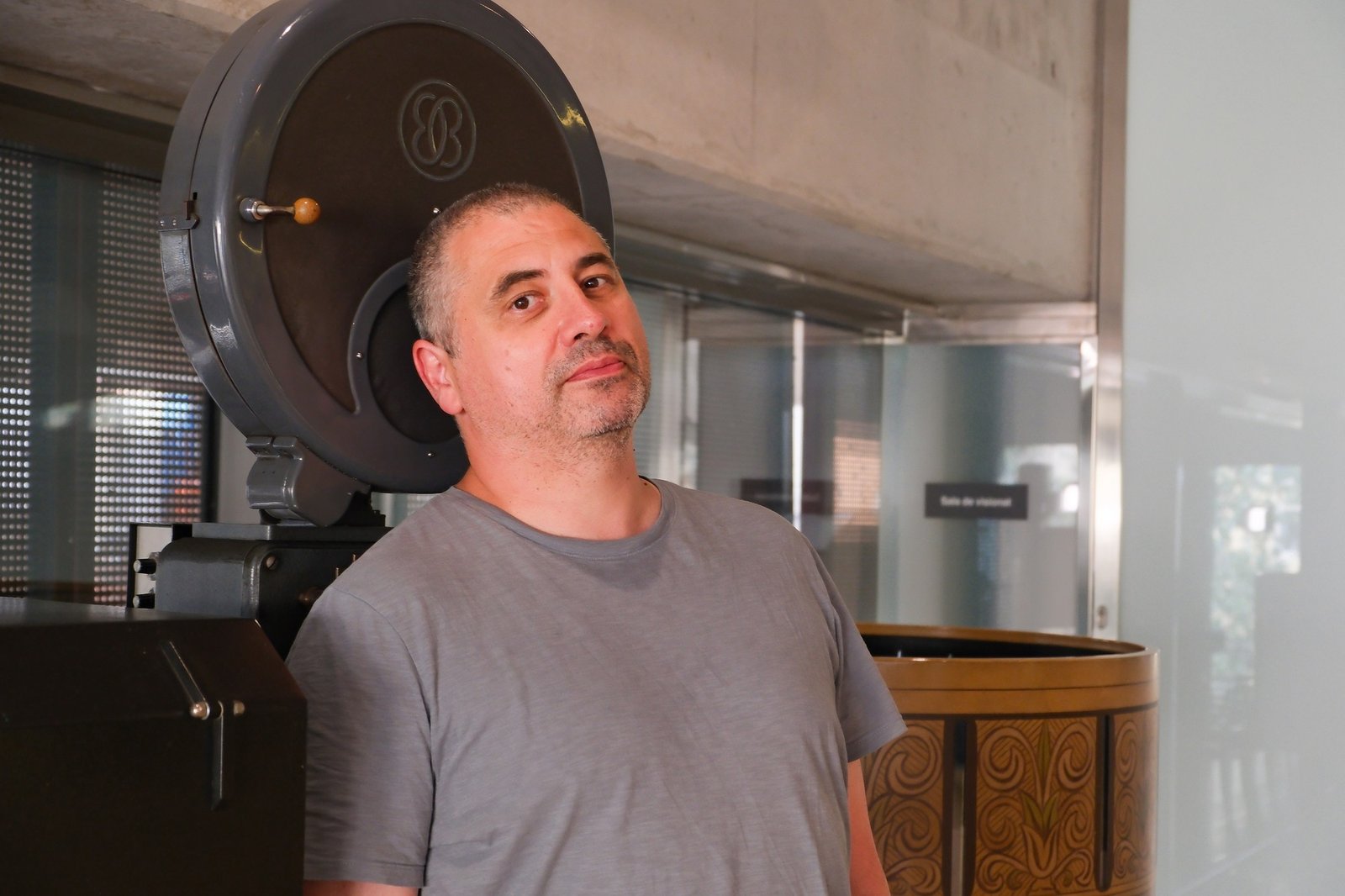
(© Laura Suárez)
We caught up with Radu Jude at the Filmoteca de Catalunya, which is dedicating a retrospective to his work (from 3 June-17 July) and which hails him as “the filmmaker of our time”, a definition he is sceptical of. He shared his feelings about being the subject of a tribute, as well as the ideas and cross-cultural elements behind his latest, multi-layered film, The Diary of a Chambermaid, which recently premiered in the Directors’ Fortnight section of the Cannes Film Festival.
Cineuropa: You have amassed a substantial body of work, but still, how do you feel about having retrospectives already, before even reaching 50?
Radu Jude: I am so busy working on my new film Love Diptych [see the news] that I don’t have time to think about it. However, last year, I had a bigger retrospective at the Centre Pompidou, and honestly, I was feeling embarrassed. I don’t think I deserve it, but that’s the curators’ problem.
Let’s talk about The Diary of a Chambermaid. Why did you choose to shift the sexual harassment central to Octave Mirbeau’s novel and Buñuel’s adaptation into a metanarrative layer?
That was the idea from the beginning, as I wanted to put an emphasis on the social layer. I’m very sensitive to these stories of immigration and the children left behind while their parents work abroad, with the communication between them only taking place online.
At the same time, I wanted to show another kind of exploitation, which is not as spectacular or perverse as in the book; to build up a contemporary narrative while referring to a story from 125 years ago. The adaptation itself is a kind of montage game. I already did something similar in Do Not Expect Too Much from the End of the World, where an older film enters into a dialogue with a new one. Here, it’s more or less the same: a different story of a chambermaid in France, nothing spectacular, nothing perverse, nothing extreme. The kinky part remains in the play, where the character performs asides, and only verbally. A clash between different forms of exploitation occurs.
The so-called “Skype kids” phenomenon, widespread across Eastern Europe, is little explored in cinema. Why was it important for you to bring it up?
I have kids myself, and it touches me. Twenty-five percent of Romanians work abroad, including part of my family – they are actually here, in Spain. The stories of abandoned kids are everywhere: in informal conversations, in the media. It’s maybe been the main social issue in our countries over the last 20 years.
I was shocked by cases of children committing suicide because they missed their parents, and I introduced this motif into the script. The drama in the film doesn’t happen in France, actually, but back home in Romania, through a video chat.
Another interesting point is that you were invited to make a film in France, but it turned out very Romanian. How come?
Producer Saïd Ben Saïd invited me to make a movie set in France. I hesitated at first, unsure what I could do there, until I remembered an idea I had carried around with me for a long time. He liked the subject, so I wrote the script and did the research while the project was being financed. I couldn’t make a film about France or French people, because I don’t live there, but migration is an issue that concerns us all.
It’s also a question of what it means to be Romanian today. We live all over Europe and all over the world. So, I positioned myself as a midpoint: between Romania and France, between literature, theatre and cinema, and between past and present. Bringing all of these things together was the main point.
The paradox is that you made an ironic film about France’s gauche caviar with French state funding, which was granted through left-wing cultural policies. Was that intentional?
I wasn’t even sure if it was relevant, because I don’t know French society very well, and I didn’t have a French co-writer. But when we premiered it at Cannes, people laughed a lot. The point is not to depict the characters as bad or ridiculous. The system of inequalities between West and East is put in place so well that you don’t need to be a pervert to take part in exploitation. And now, in Romania, we have migrants coming from Sri Lanka, Bangladesh and Central Asia. Suddenly, you can see Romanians exploiting others. It’s a mechanism. I tried to describe it in a light-hearted way, and I tried not to say that these people are horrible or necessarily hypocrites. They are part of a larger construct that creates contradictory situations, but it doesn’t mean the ones involved are acting in bad faith.
You are surprising people again by taking an unexpected turn – The Diary of a Chambermaid is nothing like Dracula.
Sometimes, viewers want to pigeonhole filmmakers and assume that the last movie they made is the direction they are going in. But I never go in the same direction. I’m proud of Dracula – I think it’s a very poetic film – but The Diary of a Chambermaid is something completely different.
