
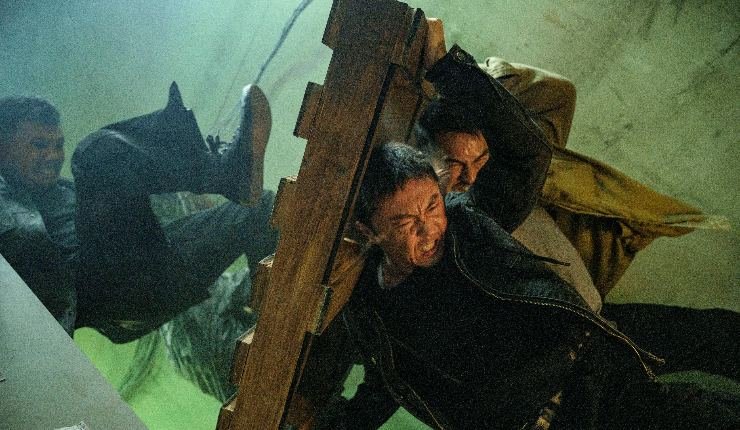
When it comes to East Asian action cinema, two names stand firmly at the forefront of the genre: Kenji Tanigaki and Kensuke Sonomura. The Furious brought these two powerhouses together to create what they call the ultimate action movie. Kensuke Sonomura, the action choreographer for The Furious, is best known for his action direction on the Baby Assassins trilogy and One Percenter, as well as directing and action‑directing Hydra, Bad City, and Ghost Killer.
In this exclusive interview, I chatted with Kensuke Sonomura via email about the action choreography of The Furious. They discussed what it’s like to choreograph action for Kenji Tanigaki, how he blended different martial arts, and which aspect of martial arts cinema he loves most.
TPM: What is it like choreographing action for Kenji Tanigaki, especially given that he is an incredibly famous action choreographer and director in his own right? How does it compare to working alongside an established action figure like him versus working with Yugo Sakamoto, who is more established as a writer and director?
Kensuke Sonomura: Kenji-san contacted me about The Furious because he wanted to incorporate the style of my directorial work, Hydra. Therefore, he entrusted me almost entirely with the action choreography, allowing me to approach it in the same way I would with any other director. The choreography process began with Kenji-san explaining his character development plans and the themes he wanted each scene to convey, and I then worked on the choreography accordingly. Having directed before, I know that being both director and action director is incredibly hard work, especially on a large project like this one. It essentially becomes the workload of two people, making it easy to lose focus on both the action and the dramatic elements. That’s why Kenji-san initially told me he would leave all the action to me. It was a very interesting proposition for me, so I readily accepted the offer. I am very grateful to Kenji-san for giving me this opportunity.
TPM: How early in the action design process did you know who the core cast would be? Once the cast was confirmed, did that change how you approached the choreography and overall design in order to get the best possible action out of each cast member?
Kensuke Sonomura: Xie Miao and Joe Taslim were cast in the lead roles shortly after I was approached. Of course, I knew them, and they have built very impressive careers. I also had a general understanding of their individual styles, so shaping the choreography went relatively smoothly. However, this time, the extremely high hurdle of creating the ultimate action movie was set, which put a lot of pressure on me. If I had them in the film and choreographed mediocre action, Kenji-san and I would have been heavily criticised.
TPM: Additionally, each cast member brings their own martial arts background—Xie Miao in wushu, Joe Taslim in judo, and Yayan Ruhian in pencak silat. How do you balance choreography that highlights their individual styles while also blending them in creative ways?
Kensuke Sonomura: Before we started choreographing, Kenji and I had a deep discussion about their fighting styles. I believe a key characteristic of my action choreography is the deliberate emphasis on raw, instinctive aspects. Traditional Hong Kong and Chinese kung fu movies tend to have relatively clear choreography, so I suggested that a mix of these two elements would suit Wang Wei’s style. That’s how Kenji named the style “Street Kung Fu.” I imagined what it would be like if a kung fu master existed in a world like the “Jason Bourne” series, and made sure to regularly incorporate movements that are not only instinctive but also visually appealing. Regarding Joe Taslim’s style, we can’t ignore the fact that he was a judo representative for Indonesia.
However, I believe a common mistake when incorporating judo into movies is to simply include superficial, flashy throws without exploring it further. I was always curious why the opponents being thrown seemed so easy. In reality, neither the thrower nor the thrown wants to lose, so this time we focused on depicting the psychological battle and strategy rather than relying on dialogue. We showed how the thrown person tries to resist even when the throwing technique begins, but ultimately, the desire to throw is stronger, leading to success. This psychological battle between the characters is a crucial point in conveying the characters’ emotions to the audience.
Also, judo has a history of eliminating dangerous throwing techniques as it has developed as a competitive sport. However, in the world of this film, we felt that clean, competitive techniques alone would not be enough to express the anger, so we intentionally researched illegal judo techniques. There was a judo practitioner on the stunt team, so we learned illegal techniques from him while designing the action. Kenji called this style “combat judo, Lol.
TPM: There are a few hallmarks of your action design in The Furious—examples being the “tower of people” in the MMA ring, which feels reminiscent of Bad City and people sliding around floors. I wanted to ask: how do you balance recreating moments from your previous work while keeping them fresh and unique for The Furious?
Kensuke Sonomura: Maintaining freshness is a very serious concern for me. It’s been over 20 years since I started as an action director, and when I first started, everything felt fresh. “Let’s incorporate that move into the choreography,” or “Let’s try to imitate that move from that movie”… But as I continued this job, I inevitably encountered situations I’d done before. So at one point, I decided to think like this: “Let’s include a human tower at least once in every scene,” or “What would it look like if I remade something I’ve done before with my current interpretation and imagination?” lol For example, just like how John Woo inserts scenes with two pistols or doves, I want people to think, “That’s Sonomura’s work!” when they see a human tower lol. Unfortunately, new ideas don’t just come to you when you try to think of them… But if you stop thinking, you’re giving up the right to new ideas. That’s why I think it’s important to keep thinking and keep going. I think life is interesting because if you approach it with that mindset, one day an idea will suddenly come to me lol.
TPM: Adding on to that, The Furious features choreography and action that many audiences may not have seen before, but is an evolution of your previous works. Could you briefly explain how you come up with such creative action sequences, and what you hope audiences take away from them after watching the film?
Kensuke Sonomura: I would be very happy if you found the action design in this film to be fresh. Action design is never a job that I complete in my own mind. Trusted team members propose various ideas. It’s what you might call brainstorming. Sometimes I incorporate them as they are, and sometimes I get inspiration from a part of it and it is reborn as something completely different. I make the final decision on the choreography according to my preferences, but I make sure that I never make the decision unilaterally. I ask the stunt team if they have a good reaction to the choreography, and I make the decision after sensing from the atmosphere that everyone is happy. Whether the stunt team finds the choreography rewarding is a major factor in my decision. And my greatest wish would be for the audience to say things like, “I’ve never seen movements like that before,” or “There’s still so much potential in action choreography.” I also hope to create works that inspire others to pursue a career as a stuntman, just like I did in the past.
TPM: You mentioned before, when I spoke to you for Ghost Killer, that every movement in a fight is like a line of dialogue. Which movement in a fight scene in The Furious conveys the most meaning to you?
Kensuke Sonomura: I’m always conscious of incorporating an emotional flow into every scene, so it’s difficult to choose just one, but if I had to pick something that’s easy to understand, it would be the fight scene when Wang Wei and Navin first meet. I designed it hoping that the way they explore each other’s personalities through fighting would be visually conveyed.
TPM: I think the final fight scene in The Furious is arguably your magnum opus of action choreography. I wanted to know how long it took to choreograph the final set piece, and how you organically balance the transitions between separate one-on-one fights, then two-on-two sequences, and finally a five-way fight?
Kensuke Sonomura: I’m glad you called it “Magnum opus.” I designed it with that in mind. The fight scene in the police station was one of the most difficult choreographies I’ve ever worked on. All the action design for the police station scene was finished towards the end of filming. It took a full month in total. We were also filming other scenes at the same time, so we had to use our days off to make it in time for the shoot, which was really tough. Plus, it was a chaotic fight with 2v2 and 2v2v1 elements, which made it even more challenging. Usually, even in a 2v2 fight, they have two pairs of 1v1 fighters in different locations to make it look like they’re fighting at the same time. But this time, I felt the theme was to fit all five people into the same frame, and I didn’t want to take the easy way out. Because we had to make it the “ultimate action movie” lol. So, from the choreography stage, we incorporated the camera work into the choreography. All the main cast members are top-notch action actors, so I figured the audience would want to see them all fighting at the same time, and I racked my brains to come up with that lol.
TPM: I think The Furious is a love letter to all of martial arts cinema, so I wanted to know what is an aspect of martial arts cinema you love the most and that is perfectly showcased in The Furious?
Kensuke Sonomura: I love the old Shaw Brothers movies. In particular, Lau Kar-leung’s choreography still looks great today. I feel that many of Lau Kar-leung’s films have a strong theme about martial arts. It’s not just violence, but the growth of the characters and their ideologies are depicted through martial arts, and there is an astonishing complexity to the choreography and the energy that comes through on screen. Think of the action scenes in The Furious as my own modern reinterpretation of Lau Kar-leung’s style.
TPM: Additionally, continuing with this idea of the film being a love letter to martial arts cinema. I think it’s one of your more violent works to date and is reminiscent of the new wave of Indonesian action films that emerged after The Raid. I wanted to ask whether knowing an action scene is meant to be a bloodbath changes the way you approach choreography, or if that’s something that never really crosses your mind.
Kensuke Sonomura: The bloody developments in this film weren’t solely due to my direction. Kenji-san’s directing style also played a significant role. We aimed for a volume of action that would exhaust the audience, so the content inevitably escalated. We approached each action scene as if it were the final battle of a typical movie, holding nothing back and disregarding balance. As a result, we had to constantly change the plot, which led to the bloody scenes.
TPM: Finally, this is more of a light-hearted question, but I was wondering if you and Kenji ever discussed the fact that you worked on One Percenter, which includes a character poking fun at him and his Rurouni Kenshin films?
Kensuke Sonomura: I’ve never talked to Kenji-san about One Percenter lol. I was also confused when I first read the script, but I knew Kenji-san wasn’t the type to get angry about something like that, and I think he was used as a model for the role because he’s such an iconic figure in the Japanese stunt industry, making the direction easy to understand. In the end, the actor who played the role had a strong personality that made him seem like a completely different person, so I was a little relieved, lol.
The Furious is in UK cinemas from June 26th, with the UK premiere on June 20th. The US release is June 12th.
Discover more from
Subscribe to get the latest posts sent to your email.
