
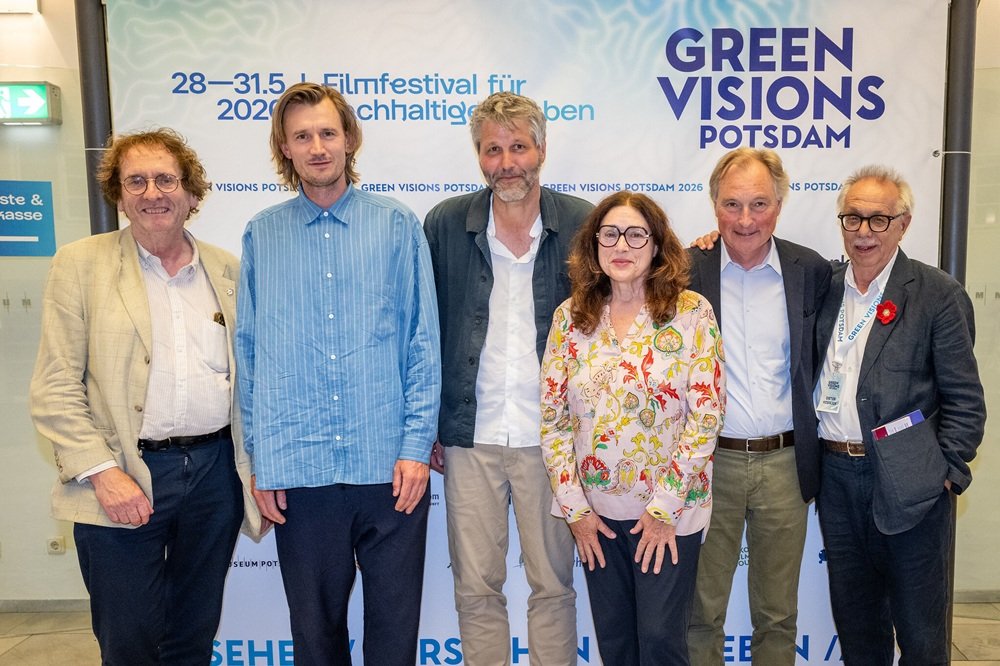
– The third edition of the environmentally focused German festival offered films, scientific knowledge and practical solutions to enduring problems
l-r: Dr Michael Braungart (the NGO Cradle to Cradle), Søren Pihlmann (Pihlmann Architects), Marc-Christoph Wagner (director of Materials Matter), Dr Monika Griefahn (Cradle to Cradle), Reiner Nagel (Bundesstiftung Baukultur) and Dieter Kosslick (festival director, Green Visions Potsdam) at the event (© Peter Himsel/Green Visions Potsdam 2026)
The circular economy in the construction industry, renaturing and rewilding, deep-sea exploration, the rights of nature as well as glacial melting were some of the key topics in focus in the 24 fiction features, documentaries and animated movies presented at the third edition of Green Visions Potsdam from 28-31 May. The event generally features films accompanied by scientists, who give a deeper insight into complex subjects. Every screening is followed by a talk with filmmakers and experts, who discuss challenges and the potential solutions to them.
Sustainable services and products were offered at the Market for Sustainable Living, located in front of the Filmmuseum Potsdam, which served as the main venue for the four-day event. At the market, audiences were able to taste organic food and drinks, and find out more about seeds and the impact of renewables.
“Right now, we are once again seeing how dependent our society still is on oil and gas, and how this continues to generate greenhouse gas emissions. This makes it all the more important to expand renewable energy and consistently utilise the free energy we get from the sun,” emphasises festival director Dieter Kosslick. “Many people have long understood this and are taking action themselves: in Germany, many photovoltaic systems can be seen on rooftops, and in a short period of time, around 1.5 million balcony power plants have been installed. This shows that the energy transition has long since begun in many households.”
The festival kicked off with the German premiere of the documentary Trop Chaud by Benjamin Weiss, which takes a look behind the scenes of the fight against climate change. Climate Seniors showed great courage and commitment in deciding to take on their own country: they filed a complaint with the European Court of Human Rights (ECHR) against the Swiss government, alleging that it is failing to adequately protect their health. Seventy-something climate activist Elisabeth Stern gave an insight into the eight-year battle that culminated in the spectacular ruling by the ECHR that climate protection is a human right.
Human health is also affected by toxic substances lurking in many buildings. “We need to build houses that benefit the environment and that can even provide nutrition,” stated Dr Michael Braungart, an innovator and the man behind the Cradle to Cradle eco-design concept, which states that products should be designed to function as part of cycles, so that there is no unnecessary waste – only useful raw materials. The concept of “circular architecture” was applied by Danish architect Søren Pihlmann, who made the Danish Pavilion more environmentally friendly at the 2025 Venice Biennale by using only materials he found within the exhibition building. This process is documented in the film Materials Matter by Marc-Christoph Wagner and Simon Weyhe. Furthermore, the German movie A House Made of Garbage by Tatjana Mischke and Valentin Thurn shows the building of Berlin’s first house made of waste.
A topic that often stirs strong emotions is renaturing and rewilding. In the British documentary Wild Land – The Return of Nature, David Allen accompanies a couple who let nature take over their dilapidated, 400-year-old estate. Instead of ploughing or mowing, they let the greenery grow, and see how species return and the landscape becomes rejuvenated, which is viewed with scepticism by the public. In Derek vs. Derek, two English neighbours have very different ideas about farming and life in general: filmmaker James Dawson observes the conflict between intensive, traditional dairy farming and a commitment to the wilderness that would enable the return of local species, such as beavers.
A growing number of people are convinced that ecosystems should be granted the same rights that humans and corporations have. In the Belgian film Nature’s Guardians, Audrey Lavis follows individuals who are rethinking our relationship with nature. As the first country worldwide to do so, Ecuador established the rights of nature in its constitution. In Europe, Spain has emerged as the first nation in which an ecosystem has its own legal status, thanks to the 600,000 people who saved the polluted Mar Menor lagoon, near Murcia.
Seventy percent of our planet lies hidden in the deep sea. In this untouched habitat, unknown animals live in a place shaped by the cold, extreme pressure and darkness. Their existence is now threatened by corporations like The Metals Company, which want to exploit this deep-sea environment by mining manganese nodules. In the documentary How Deep Is Your Love, British filmmaker Eleanor Mortimer takes the audience on a journey where researchers explore the wonders of the fantastical creatures living in this dark marine world.
“Green Vision is a small festival with big films,” sums up former Berlinale director Kosslick. “We show films that hold out hope and also raise awareness.”
