
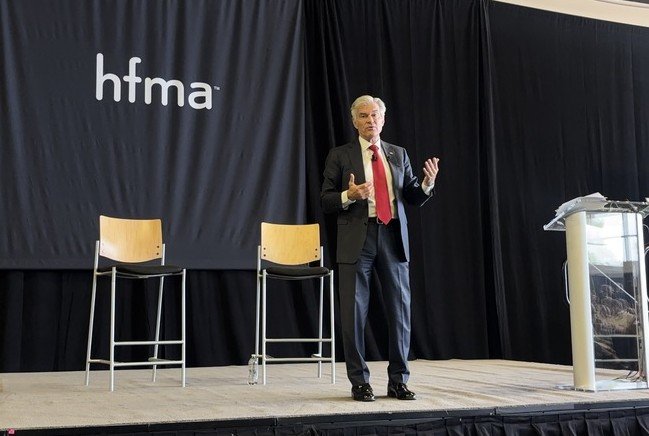
CMS Administrator Dr. Mehmet Oz is optimistic about Washington’s ability to bend the healthcare cost curve, he said during a Tuesday address at the HFMA Annual Conference in National Harbor, Maryland.
“It’s not all rosy, but there’s some opportunities. As a clinician, I’ll tell you, if you have an opportunity to fix a problem, it gives you more hope than if you think the issue is terminal. We’re definitely not terminal,” he declared.
During his talk, Dr. Oz outlined a few key areas that CMS is targeting to make healthcare more affordable. Below are the main pillars of the agency’s affordability agenda.
Fraud, waste and abuse
Eliminating fraud from the Medicare program alone would double the trust fund’s lifespan without raising taxes, Dr. Oz argued.
He cited examples of large-scale fraud cases that the federal government has busted in recent months — an outsized number of durable medical equipment suppliers in South Florida, a disproportionate share of the country’s hospices concentrated in Los Angeles, and inflated personal care services employment in New York and California.
“Much of this started during Covid, because what we taught fraudsters in Covid was, we’re going to give a lot of money away from the federal government, and we don’t really have a way of tracking it, so we can’t really tell if you used it the right way, and we can’t get it back if you didn’t. Because of that, we brought a lot of people into the health ecosystem who never thought of defrauding healthcare before — but now that they know it’s possible, they’re loving it,” Dr. Oz remarked.
Drug pricing reform
Dr. Oz highlighted the Most Favored Nation pricing initiative, which requires pharma companies to charge Americans no more than what developed countries pay abroad. He projected that the policy will result in $600 billion in savings over 10 years.
He also noted that Medicare beneficiaries with obesity-related conditions will be able to access GLP-1 medications for $50 per month starting July 1.
Tech modernization
CMS is replacing Medicare’s COBOL-based billing system with a cloud platform, marking the first upgrade in more than 50 years. Dr. Oz said this change will speed up how Medicare processes and adjudicates claims.
He also noted that CMS launched its Medicare App Library in April, which seeks to create a more consumer-driven, app-based health data infrastructure.
Under the initiative, patient data doesn’t stay siloed within individual apps. Instead, participating companies connect to CMS-backed data-sharing networks — including health information exchanges and interoperability frameworks — that allow data to flow directly into clinicians’ workflows. Nearly 800 health tech companies have signed onto the initiative, Dr. Oz said.
Preventive health and nutrition
The country’s high chronic illness burden — particularly obesity — has a huge impact on rising healthcare costs, Dr. Oz pointed out.
To help fix this, CMS is working to embed nutrition education into medical school curricula. Dr. Oz noted that more than 50 schools have pledged 40 hours of nutrition training.
“The problem is that we don’t teach people going through their training about things like nutrition, so they don’t think they matter. It turns out if you want to deal with the chronic illnesses that drive at least 70% of all healthcare costs, you have got to be able to address basic realities of preventive medicine, including nutrition,” he remarked.
Dr. Oz also cited the recently revised food pyramid as a meaningful step toward correcting decades of flawed dietary guidance that he said has contributed to the obesity crisis.
Deregulation
Under a White House executive order, CMS must eliminate 10 regulations for every new one it introduces.
Dr. Oz said he welcomes this mandate. He argued that much of the current quality measurement apparatus creates administrative burden without actually improving care.
“Not everything that you can measure matters, and not everything that matters can be measured,” he stated.
Photo: Katie Adams, MedCity News
