
The Trump administration is hypocritical when it accuses Canada and many other countries of failing to do enough to end forced and child labour around the world.
Such abuse is not a trivial matter.
Canadians should remember the 2013 collapse of the Rana Plaza building in Bangladesh, home to five large garment factories, which supplied cheap goods to companies in the West.
Over 1,100 people died and more than 2,500 were injured in that event. Many of them were garment workers, and some produced clothing for Canadian companies, including Loblaw subsidiary Joe Fresh.
That was an abusive situation which rose to the level of an international scandal.
But daily, beyond the headlines, many thousands of involuntary workers produce all or parts of goods we consume, in miserable and sometimes dangerous conditions.
The use of prisoners, political and otherwise, in international supply chains is routine in parts of the world (including the U.S.).
This writer has observed children painstakingly making carpets by hand in Egypt and India. That sort of labour is, at least, relatively safe, something we could not say about all child or forced labour.
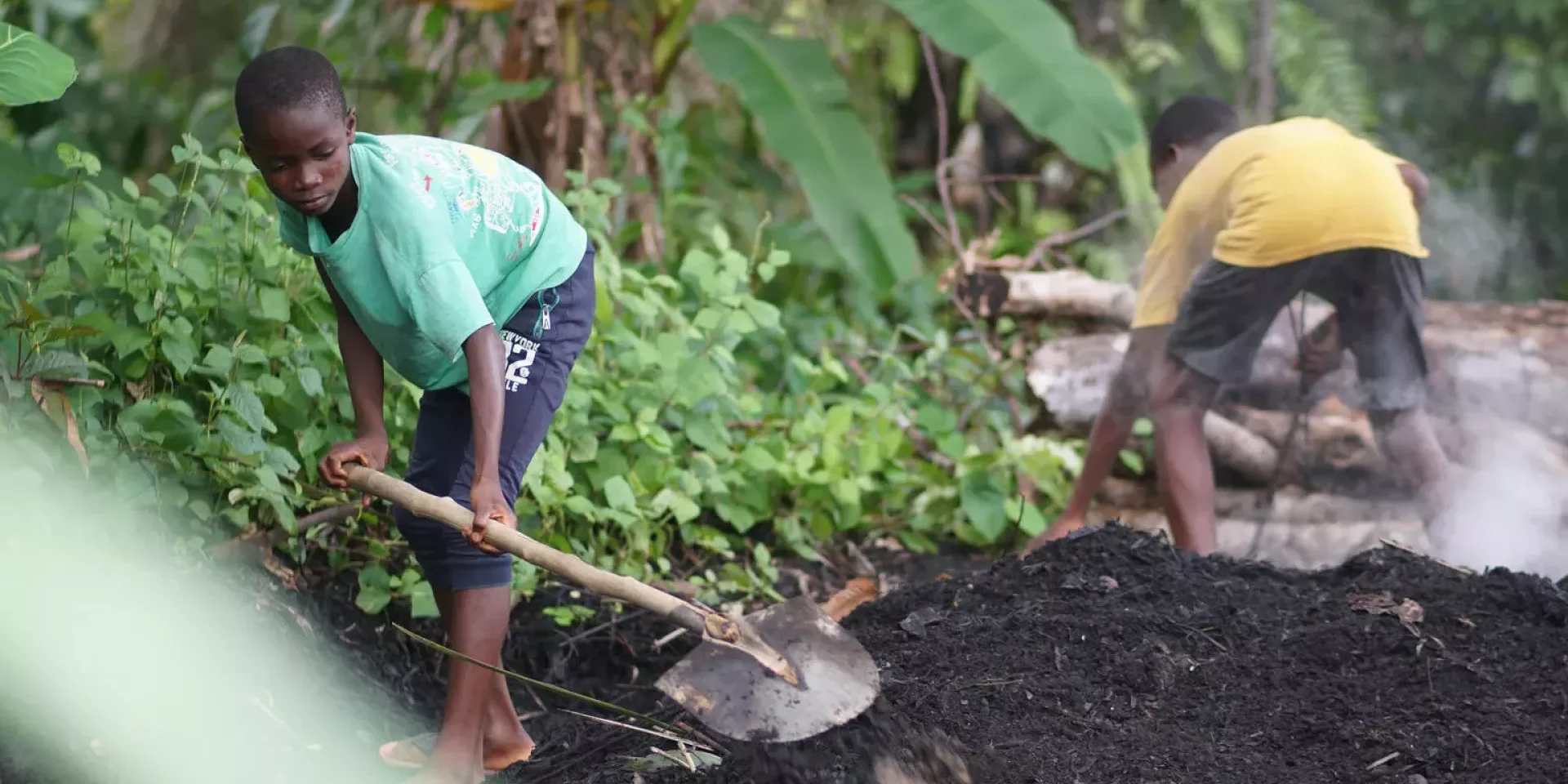
In its most recent reporting, UNICEF relates that there are over 138 million child labourers in the world.
In one country alone, the West African nation of Sierra Leone, UNICEF reports “almost 1 in 5 children are engaged in child labour.”
“Child labour compromises children’s education, limiting future opportunities and perpetuating an inter-generational cycle of deprivation.”
And so, the U.S. administration is not off-base in drawing the world’s attention to the scandal of forced and child labour.
However, the Trump government’s real motive is not to achieve justice; it is to find a legal way for the U.S. executive branch to bypass Congress and impose tariffs on goods from many countries, including Canada.
The U.S. constitution clearly assigns the power to levy tariffs to the legislative branch, to Congress, not to the President.
An earlier effort denied by courts
Early in his current term Trump tried to use the 1974 U.S. International Economic Emergency Act (IEEA) as a fig leaf for his unconstitutional tariffs.
That was a big stretch, in part because the IEEA never even mentions the word tariff. When Congress passed that IEEA it did not foresee tariffs as one of the arrows in the president’s quiver in the event of an economic emergency.
Lower courts ruled the U.S President’s invocation of the IEEA to be entirely unfounded.
The U.S. Supreme Court, which is normally highly deferential to Trump, upheld those rulings, rendering Trump’s tariffs based on the IEEA null and void.
And so, Donald Trump and his advisors have come up with another loophole to enable them to impose tariffs without Congressional agreement: the forced labour issue.
It is hard to believe the current U.S. President cares a whit about forced labour.
In fact, Trump’s administration has trashed the entire U.S. foreign policy and foreign aid establishment, which, in theory, could have had the expertise to monitor and document the prevalence of what is, in essence, modern-day slavery.
Shortly after assuming office, Trump cut 69 U.S. programs that deal with child labour.
Last year, in 2025, the U.S.-based Economic Policy Institute reported on the current U.S. Labour Department’s cuts to programs that fight international human trafficking and promote labour rights.
Those cuts, says the Institute, “undermine the U.S.‘s ability to monitor foreign governments’ compliance with U.S. trade agreements, and ensure that U.S. workers will compete on an uneven international playing field, fueling a race to the bottom in the global economy.”
On June 2 of this year, in announcing the new U.S. tariffs based on forced labour in supply chains, Trump’s trade representative Jamieson Greer used almost the exact same words as did the Economic Policy Institute a year earlier.
But Greer wasn’t issuing a mea culpa for his own country. He was accusing other countries of tolerating labour abuses, as an excuse for imposing illegal tariffs on them:
“The failure of our most important trading partners to address the importation of goods made with forced labor is unacceptable. This creates a dynamic where American workers are forced to compete globally on an unlevel playing field”
Evidently a sense of irony is a quality in short supply in the current U.S. administration.
The U.S. judicial system will no doubt have its chance to rule on this ploy.
In all likelihood, the courts will find it to be as disingenuous as Trump’s earlier effort to invoke the IEEA as justification for tariffs.
But even if the motives for Greer’s accusation are monumentally dishonest, sadly they ring true when it comes to many countries, including Canada.
A weak law and vague reporting system
The federal New Democrats foreign affairs critic Heather McPherson has pointed out that “Canada has lagged on measures to make sure there is not forced or child labour in supply chains for decades, while other governments have acted.”
And the Edmonton MP has added: “Past Liberal governments repeatedly promised mandatory supply chain due diligence legislation and never delivered on it.”
Canada does have the Fighting Against Forced Labour and Child Labour in Supply Chains Act, which Parliament passed in 2023.
But advocates and experts all say the legislation is ineffective.
The 2023 law includes a reporting requirement. Corporations have to report annually on their due diligence concerning forced and child labour in their supply chains – chains which sometimes stretch around the world.
Anyone can look up the reports. There are over 12,000 of them for 2025, from corporations and from other organizations. They are all available online .
If you do look, you will find numerous reports from giant Canadian and foreign companies, such as Bombardier, Loblaw, Carhatt, Levi Strauss, Walmart, Winners, and Lacoste.
Plus, there are thousands of reports from government departments and agencies, and many small and medium sized operations, such as the Pincher Creek Cooperative Association.
Sadly, all of that verbiage amounts to rather little.
One characteristic of almost all 12,000 plus reports is a high level of generality.
The more than 12,000 reports almost all make a rhetorical commitment to the principles of various conventions banning modern-day slavery.
And almost all state, in a high-level fashion, the companies’ or organizations’ commitments – via training, information sharing, audits and monitoring – to faithfully uphold those principles.
But virtually none of the reports include very much in the way of facts and figures. Many do not even list all the countries that are part of their supply chains.
To cite just one example, the multinational fashion corporation Lacoste tells us it produces and sells over 50 million items a year. Those items include clothing, footwear and accessories, and account for sales of 2.8 billion euros, or about 4.5 billion Canadian dollars.
Lacoste says it employs more than 8,500 people in 98 (!) countries. But its report does not specify whether those are directly employed or through suppliers. Nor does it name the countries.
The report says Lacoste has a supply chain of more than 1,200 factories worldwide. Those factories specialize in everything from raw material processing to final production of garments.
And there you have it.
Those few numbers are pretty much the only tangible facts and figures in the Lacoste report. The rest of it consists of bland and platitudinous statements about audits, compliance, assessing, and monitoring, with nary a tangible detail.
We have to take it all on faith.
The only specific references in the Lacoste report to anything resembling a problem or pattern of abuse concern the production of cotton and what the report vaguely calls an “alert” concerning suppliers in Vietnam.
Lacoste says it resolved the cotton issue by limiting its suppliers to six countries, among them the U.S., Greece and Spain.
As for the Vietnam situation, Lacoste reports that when it received the (non-specific) complaint it hired the consulting firm Ulula to investigate.
Lacoste’s report does not tell us what Ulula has been investigating or what the investigation has turned up so far. Nor does it list any other action in response to the Vietnam complaint.
So much for transparency. And Lacoste is typical in this regard. Read as many of the reports as you can and see for yourself.
Although the 2023 Canadian legislation requires organizations and corporations to make available some sort of annual report on forced and child labour, it does not require much else.
It is up to companies and organizations to decide what details they will put in their reports, and with how much precision.
It is in no corporation’s interest to divulge any information that could damage its reputation or have an impact on its bottom line. In this case, the government of Canada is getting what it asks for – which is not much.
There are provisions in the 2023 Canadian law for inspections. And the government can even impose sanctions on companies and organizations that allow child and forced labour in their supply chains.
