
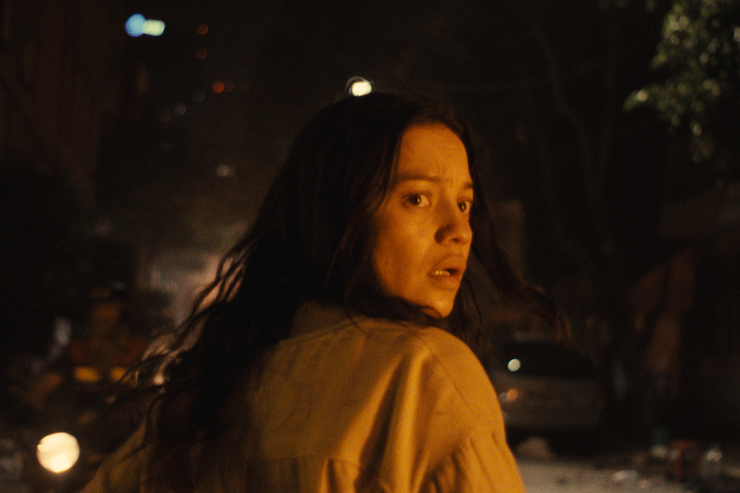
Based on a 2019 novel of the same name written by Karina Sainz Borgos, It Would Be Night in Caracas, written and co-directed by Mariana Rondón and Marité Ugas, tells the story of Adelaida (Natalia Reyes) during the 2017 uprising in Caracas. At the beginning of the film, as riots break out in Venezuela, Adelaida has just buried her mother and lost her home to the armed militia that has taken it over without her consent. As the riots continue, Adelaida must find a way to survive amongst the chaos her city has called in.
The film opens with a wide shot of the riots in Caracas that slowly closes in and turns into a medium close-up of the main character, Adelaida. The opening sequence immediately reveals the perspective that the film is going to take: depicting such a key moment of Venezuela’s history through the story of a young woman who is experiencing the harsh reality of it. Adopting Adelaida’s point of view is, overall, a very successful choice for the film to tell its story, as we only see the riots from her perspective. This choice also allows the audience to witness the direct impact on everyday life that the Caracas riots had on the citizens of the city.
The film portrays the chaos and destruction Caracas is experiencing brilliantly. A lot of the footage of the actual violence that breaks out in the streets is either found footage of the time or a recreation of clips that were going viral on social media when shared by Venezuelans during this very demonstration. This is particularly why most of the violence is shot from above, as a lot of people would only witness it and be able to film it while hiding in their apartments. This raw realism that the film portrays might be why it resonates so much with audiences who have experienced the riots in Venezuela, or across the world at large, and the fear and chaos that the film portrays.
As It Would Be Night in Caracas goes on, the audience quickly realises that this is a movie that never judges its characters for their actions. While we are seeing the events unfold through the perspective of Adelaida, none of them is portrayed entirely as a villain or a victim, but rather as a result of the world that they live in. In one way or another, this very powerful story shows us that all of these characters are equally perpetrators and victims within the same breath.
There were moments when I wished the film delved deeper into Adelaida’s life and backstory, but instead it chose to focus on the present moment. While the thriller element of the movie works really well, the flashbacks and the main character’s relationship with her mother are equally fascinating to watch. As the original story explored the introspective aspect a little bit more, it feels like a missed opportunity not to show this in the movie as much. The relationship between Adelaida and Santiago is also quite predictable in the way it develops, and I would have much preferred seeing this storyline develop more organically and originally.
Ultimately, It Would Be Night in Caracas is a very powerful, timely and well-made movie that will resonate not just with the people who have lived a similar experience, but with audiences all over the world. With its haunting cinematography, excellent acting, and brilliant script, the film invites us to witness what a few days in Caracas looked and felt like during the 2017 riots with all the violence, chaos, and fear that comes with it. The film does not spare us any of that. While it may be a difficult watch, it is very much a necessary and important one.
★★★★
In cinemas soon / Natalia Reyes, Moisés Angola, Sheila Monterola, Édgar Ramírez, Samantha Castillo / Dir: Mariana Rondón, Marité Ugás / 15
Discover more from
Subscribe to get the latest posts sent to your email.
