
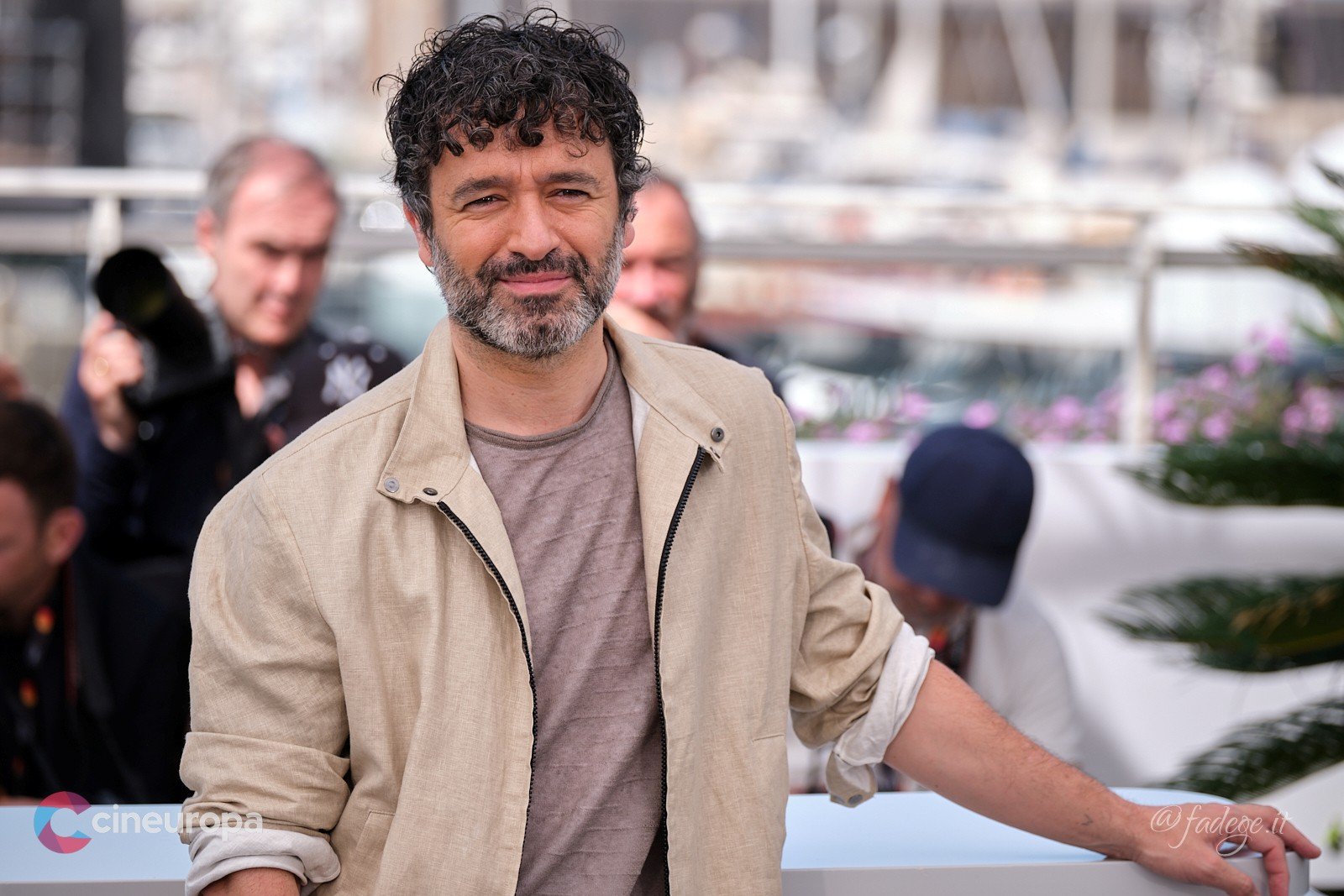
– CANNES 2026: The Spanish filmmaker discusses his new film, which blends life and cinema, starring Javier Bardem and Victoria Luengo
(© 2026 Fabrizio de Gennaro for Cineuropa – fadege.it, @fadege.it)
Following his debut on the Croisette in 2022 with The Beasts in Cannes Première, and a meteoric rise with films (Best Screenplay at San Sebastián in 2016 for May God Save Us and in competition in 2018 with The Realm, Venice Orizzonti in 2019 with Madre) and hit series (The New Years, Riot Police), Spanish director Rodrigo Sorogoyen is in the running in the competition at the 79th Cannes Film Festival with The Beloved.
Cineuropa: Where did the idea for this film about a director father and his actress daughter come from?
Rodrigo Sorogoyen: My co-writer Isabel Peña and I wanted, above all, to tell the story of a father and his daughter — a relationship in which power struggles and issues of hierarchy are ever-present. But I also had ideas rooted in the world of cinema, which I love, because it’s obviously my world and I find it fascinating. I know all the little details, but what I love most is the demystified side of it: completely ordinary people waking up at 6 o’clock in the morning to work hard, all together. For just three months, they travel and every day they work to tell two minutes of a story that isn’t true, of a fiction, of an idea conceived three years earlier. So with Isabel, we tried to blend these two themes, and we saw that it worked because in the film, everyone is constantly questioning everything. The filmmaker’s job is to tell a story, and in the story of this father and his daughter, the narrative is also very important because, in our lives, we tell ourselves a story — to justify ourselves, to forgive ourselves, to understand ourselves, to explain ourselves. In the specific story of this father who had disappeared, who did certain things in the past, and of his daughter who had to live with his absence, this narrative we tell ourselves is even more important. It was also very interesting to have a man who was violent, yet also very charismatic, with the authority that comes with being a father, a man, a director, whereas his daughter has none of that. This gave the subject real weight and opened up a whole host of possibilities.
The way they look at one another, and the difficulty the father and daughter have in looking each other in the eye, seems to be a recurring theme in the film.
The gaze is constant, including that of those around them. Every time one of the two characters looks at the other, it’s very significant. There are many scenes where they look at each other, but it’s true that they are unable to look each other in the eye because there has been no closeness between them in the past – nor is there any in the present that would allow for it – and because they are afraid of discovering something terrible. But she looks at him whenever she can, and he looks at her both as an actress and as his daughter.
What about the film’s pacing, which very gradually reveals information about the characters?
Because that’s how life is. Isabel and I loved the idea behind the opening scene, so that the audience would wonder who these two people are and what they’re talking about. After that 20-minute scene, we’ve got a few clues: the things he says, the things she says, but perhaps they’re not talking about the same thing. We developed this sense of mystery throughout the film, and to do so, we worked extensively on the script and the storyboard, cutting out a lot whilst carefully weighing up the risk that the audience might understand so little that they get bored or lose their way. There were also lots of different edits that I tested on friends, which led to some very interesting discussions. Some thought the father was a jerk, others that he’d changed.
The film also touches on how times have changed on film sets, and the end of the era of all-powerful directors.
To be honest, when we first started working on the script, this wasn’t really on our radar, but we want to portray reality, and this is what’s happening now: women, for example, are refusing to work when this sort of behaviour occurs. That wasn’t the case 20 years ago, and it’s a good thing that things have changed, but in this instance, it was mainly useful for our story, for the father-daughter relationship. Then again, sometimes you set out to tell one thing and end up telling another, which isn’t so far removed from the original, of course.
Striking black-and-white images, playing with colours and formats: what led you to these experimental techniques?
I wanted to move away from The Beasts, which is a classic film, and do something completely different. And since we’re in the world of cinema, I wanted the audience to see all its possibilities. But it’s also linked to the question of narrative that I mentioned earlier. In the film, every character has their own story, so I decided I would also tell that story by using everything: film, digital, black and white, 4:3. I worked hard to bring coherence to the chaos, letting my intuition run free even though I’m usually quite a rational person, and I eventually found it. Black and white, for example, appears for the first time when Emilia fears her father might do something violent, but as nothing violent happens, we switch back to colour. And this continues every time there is an argument, or friction between the two characters, or the father’s violent past is brought up. It builds to a crescendo until the climax of the dinner scene, which is a stylistic extravaganza — a 15-minute sequence filmed with every possible technique, as this is the most intense moment: the father has the least control, he’s angry, his daughter is on edge, and everyone on set is incredibly tense. It ends as a black-and-white elegy, and then this stylistic blend gradually fades away. At the beginning and end of the film, there is none of that; it is shot digitally, like a normal film, without any strangeness.
There’s a quote from Liv Ullmann in the film: “The closer the camera gets, the more you have to drop the mask.” Were you aiming to make a modern Spanish film in the style of Bergman?
In May God Save Us, The Realm or my series Riot Police, the camera was already quite close. Bergman is the master, he’s unattainable, sacred. Javier Bardem said this quote to us when we started working with him on the film. And as we wanted the girl to learn something from her director father — not as a daughter, but as an actress — and also for the audience to learn something, we included it in the script. In life too, when you get closer, you have to drop the mask: you see what isn’t true. I didn’t feel like I was making a Bergman-esque film, but if people think that, it’s brilliant.
(Translated from French)
