
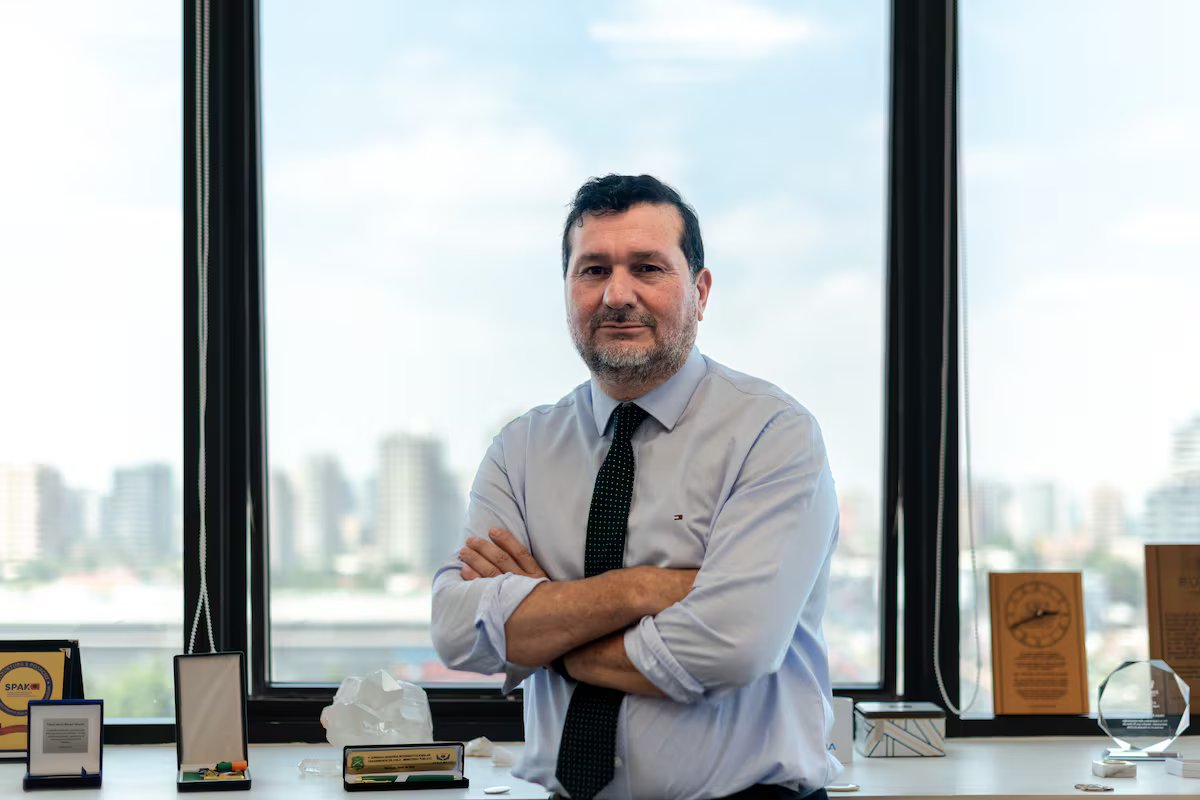
Chilean prosecutor Héctor Barros, coordinator of the Organized Crime and Homicide Teams (ECOH) of the Santiago Metropolitan Region, was not indifferent to the death of Tren de Aragua leader Héctor Rusthenford Guerrero Flores, alias “Niño Guerrero,” last Friday in a joint United States–Venezuela operation. “Our aspiration was always to be able to capture him and bring him before the courts,” he said in an interview with EL PAÍS on Saturday.
Barros is one of the prosecutors who has followed Tren de Aragua’s expansion in Chile most closely. He has led investigations such as the kidnapping and murder of former Venezuelan serviceman Ronald Ojeda in Santiago — a crime that investigators say was allegedly commissioned by Venezuelan Interior Minister Diosdado Cabello to the organization — as well as other probes related to the gang’s activities in Chile. These include the recent Operation Tokio, carried out by the Public Prosecutor’s Office and the Investigations Police (PDI), which succeeded in dismantling a network that infiltrated Chile’s banking system to launder funds tied to Tren de Aragua’s illegal businesses.
The prosecutor says he received information a few days ago about the presence of the Tren de Aragua leader in the mining region of Bolívar state, Venezuela. He adds that they also had records indicating he was not alone but accompanied by two other senior figures in the organization whose whereabouts remain unknown: Yohán José Romero, “Johan Petrica,” and Giovanni Vicente Mosquera Serrano, “Viejo.” U.S. authorities are offering rewards of $4 and $5 million, respectively, for information leading to their capture.
Question. What does the death of Niño Guerrero, announced by Donald Trump, mean for Chile?
Answer. Undoubtedly, it is a very significant development for the various investigations that are open and active in Chile. It will also necessarily produce some changes in the control of the criminal structures operating across different countries. That said, it should be noted that this is not a criminal structure sustained solely by the single leadership of Niño Guerrero; there are other leaders such as Viejo and Johan Petrica. The latter is another figure of great importance within the organization, and from that perspective it is most likely that the power once held by Niño Guerrero will be assumed by another person who could very well be Viejo or Johan Petrica. That is because these are hierarchical, highly pyramidal structures. So, at lower levels there probably won’t be much difference, except that they will now know who sits at the top of the organization.
Q. What did you make of the operation in southern Venezuela?
A. I do not have further background to make a particular assessment. What we did have was information that he was in that area, alongside Johan Petrica. A few days ago we received information that he was in a mining area, in a gold enclave in that region. Suffice it to say that the operation carried out by the United States coincides closely with the location and the people we believed were there, because our records indicated that Niño Guerrero, Johan Petrica and a third person — I believe that is Viejo — had been hiding there for some time and were controlling the mining area. Some even said that Niño Guerrero hid in the mines at that site and had a strong military contingent guarding him. This was the first time we had clarity about his location, because at one point we questioned whether he was really in Venezuela or not, but with that information we were certain he remained in Venezuela.
Q. How long had you been handling that information?
A. During this month. And, as I said before, it was the first time we knew with certainty the specific place where he could be found, because earlier we had theories that he was in Venezuela, others said Colombia, and others suggested islands in the United States. But the information we had was absolutely and completely consistent with the place where they found him and where the death of this criminal leader occurred.
Q. A former prosecutor in Venezuela living in exile, Zair Mundaray, questions whether the person killed was indeed Niño Guerrero, especially given the difficulties of identifying a burned body. Are you 100% sure of the death of the Tren de Aragua leader?
A. I cannot have one hundred percent certainty about that. I could only rule it out or confirm it if I had evidence that he participated directly in that event. Now, until there is much more direct evidence, there will always be theories. Remember that people even claimed Pablo Escobar was alive despite the videos. In this particular case it is most likely that the U.S. government has other types of evidence beyond showing us the video of the explosion, because what we’re shown from above is one thing and another consideration is that there was a ground operation there.
Q. Did this death surprise you?
A. By training, I always have in mind that someone involved in a crime should be arrested, not that it should end this way, as occurred in this case. From that perspective, our aspiration was always to be able to capture him and bring him before the courts. In fact, in Chile there is a court order against Guerrero issued by the prosecutor of Tarapacá, Raúl Arancibia, issued in 2023. We always work and investigate to bring people to court.
Q. To what extent does this affect investigations in Chile?
A. It does not affect investigations in that area because the organization will continue to operate at the lower echelons of its structure. What will occur is a change in leadership. In other words, there may now be a period of uncertainty about who will take the place of Niño Guerrero. These organizations always lose members and immediately replace them. This is a criminal enterprise that does not stop functioning because the general manager has been replaced; there is a measure of uncertainty at lower levels and about the overall structure of who will assume this leadership. We are clear that Niño Guerrero was not the only leader; Petrica and Viejo also held sway over illegal markets and areas of operation. It is most likely that one of those two will be promoted or that others who are directly below Niño Guerrero, Petrica, or Viejo in the hierarchy will rise.
Q. After the death of Niño Guerrero, have you taken new statements from people charged in Chile in connection with Tren de Aragua?
A. Statements are always being taken, even at the request of the defense, from the accused themselves, because that is a routine procedure.
Sign up for our weekly newsletter to get more English-language news coverage from EL PAÍS USA Edition
