
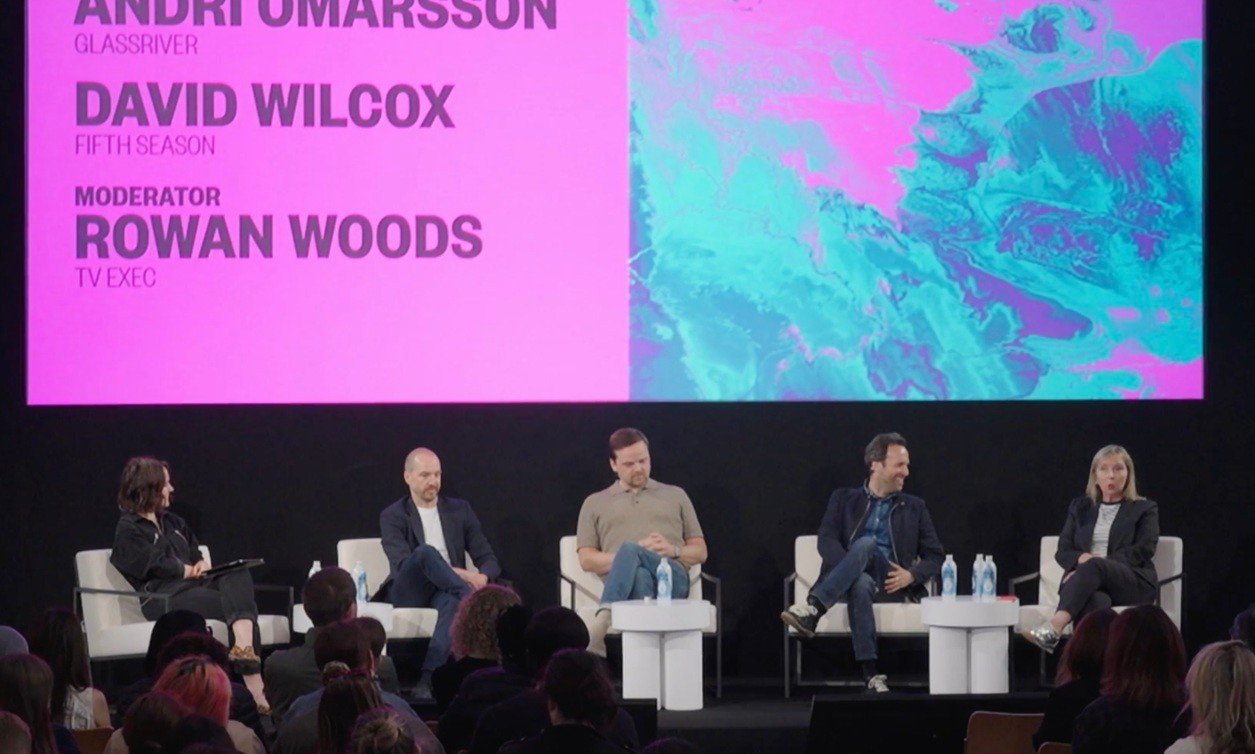
– The speakers discussed how shrinking US financing, rising production costs and international co-productions are driving new models of television production
l-r: Rowan Woods, David Wilcox, Andri Ómarsson, Samuel Kissous and Claire Mundell during the panel
On 5 June, at Christ Church Spitalfields, a panel titled “Big Stories, No Borders: The New Economics of Global Co-Productions” took place during the second edition of SXSW London. The speakers were Claire Mundell, founder of and creative director at Synchronicity Films; Samuel Kissous, CEO and executive producer at Pernel Media; Andri Ómarsson, CEO of Glassriver; and David Wilcox, SVP EMEA at Fifth Season. The talk was moderated by TV executive Rowan Woods.
Wilcox started the conversation by mentioning how Fifth Season’s origins are rooted in co-productions. The company began with projects such as The Night Manager, followed by Killing Eve, Normal People and many more over the years: “We have built a strong track record as an architect of UK-US co-productions, helping to pave the way for this type of international collaboration, and now we continue to shift and shape our strategy as the market requires. A recent example is Honey, produced by See-Saw Films, commissioned by the BBC and co-produced with ZDF. We are currently in the midst of pre-sales for it, and there has been significant interest so far.
“We also frequently engage in UK-US co-productions. Another current example is Treasure Island, a UK-US collaboration co-commissioned by MGM+ for the US market and Paramount+ for the UK, which is a bold, contemporary adaptation of Robert Louis Stevenson’s classic adventure, reimagined for a new generation.”
“We look all around for opportunities, both creatively and financially. With Iceland having a population of only 400,000, we approach things a little bit differently compared to big governments in big countries. Right from the first feature produced in Iceland in 1919, which was a co-production, we have been involved in co-productions ever since, which has made us an expert in the field,” noted Ómarsson. “What we’ve seen is that, in the past, when you were able to produce content locally, you had a lot of creative freedom. Then we had a period of what we call ‘Euro-pudding’, where locally developed content would be adapted with enforced changes, even small ones – like switching a character to a foreigner just to lure in financiers. It often felt artificial.
“What’s changing now is that co-productions are becoming more organic. From the outset, you know you need partners on board, and the story is shaped accordingly. For example, our new series Stella Blómkvist [see the news] has been a 50/50 co-production between Portugal and Iceland from the start. We found a story that naturally exists in both territories, so it doesn’t feel forced. Everyone has a real creative and financial role in the project,” he added.
Kissous noted that the market has changed significantly in recent years. He explained that Pernel Media has produced a number of features, and as the traditional model of securing US pre-sales has declined, it has had to develop new financing strategies by bringing together broadcasters and partners from different markets. “A recent example is Missed Call on Channel 5, which was financed through a collaboration between Channel 5 in the UK and France’s TF1 – the first time that TF1 has entered into this kind of arrangement – alongside a distribution partner, while production was handled entirely by our teams in the UK and France,” he noted. “Missed Call has become a compelling example of a new financing model: after we showcased it at Series Mania, we received strong interest not only from British broadcasters, but also from broadcasters in Italy, Germany and France who wanted to explore similar collaborations. With reduced financing from the USA and distributors unable to fill the entire funding gap, the industry’s options are either to produce shows more cost-effectively, or to secure investment from additional international broadcasters and partners across Europe,” the CEO concluded.
He also noted that the concept of language is important: “When I started doing our first English-language scripted production, I suddenly realised just how much more valuable it was for a distribution partner. To put it bluntly, a distributor might give me £30,000 or £40,000 per episode as a minimum guarantee for distribution, but they would be prepared to offer £300,000 or £400,000 per episode if it were in English. That’s ten times more – it’s insane.”
Ómarsson followed up on the same topic, suggesting that maybe early co-development with international partners can allow productions to balance authenticity and global appeal – for example, by combining Icelandic and English dialogue. In his view, this approach is preferable to forcing projects into English purely for financial reasons, as it enables both cultural authenticity and broader market reach.
Claire Mundell then argued that in recent years, distributor deficits have declined significantly – by around 20% – owing to the reduced availability of US pre-sales, forcing producers to be more selective about the projects they pursue. In the UK, the most viable dramas currently fall within the mid-budget range of approximately £1.5-2 million per episode, as lower-budget productions struggle to remain competitive amid rising production costs and talent fees.
“As a British producer, I benefit from the UK’s ‘terms of trade’ system, which allows independent producers to retain ownership rights. For that reason, my preference is always to finance a project domestically and retain those rights whenever possible. Co-productions therefore need to make creative sense, not just financial sense. I see The Cry as an example of a project that was perfectly suited to international collaboration, while the upcoming drama series Careless represents a successful UK-Australian treaty co-production. Treaty agreements provide access to incentives such as Australia’s 40% producer offset and UK tax credits, creating a more secure financing model. The cultural and linguistic similarities between the UK and Australia also make this partnership particularly effective. We’re actually in the works with another joint production there,” she stated.
