
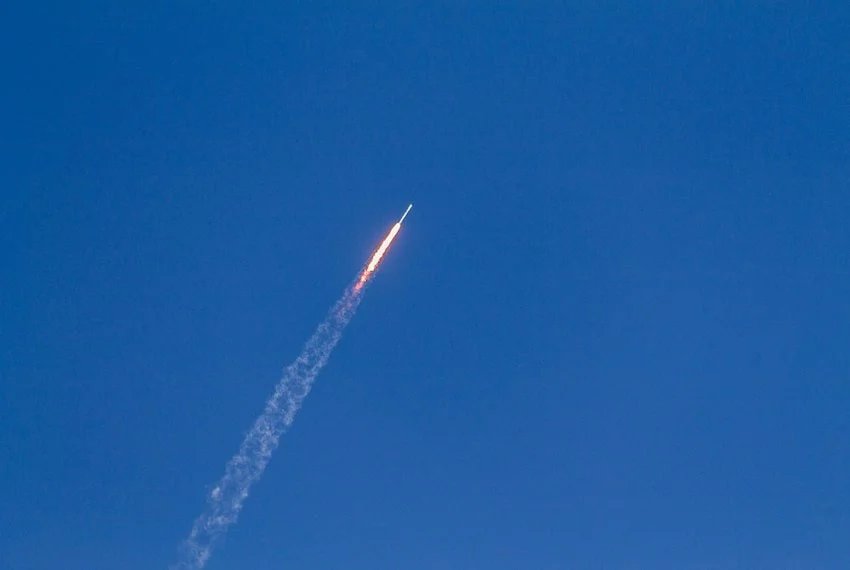
Mexico and South Korea are collaborating on a plan aimed at the eventual construction of launch pads in Mexico, from which satellites and other spacecraft could be launched into orbit.
In June 2024, the Mexican Space Agency (AEM) and the Korea Aerospace Research Institute (KARI) signed an agreement that Mexico’s Ministry of Infrastructure, Communications and Transport (SICT) said would allow the formalization of “collaboration actions to develop space infrastructure in Mexico.”
“Based on [the agreement], a joint feasibility study will be carried out about launch pads, seeking to initiate, with this infrastructure, Mexico’s entry into the global satellite launch market,” the SICT said in a statement after the agreement was signed.
Two years later, the collaboration between the AEM and the KARI is part of the 2026-2030 Mexican Space Plan, according to the news outlet Expansión, which cited a Mexican Space Program document published earlier this month in the federal government’s official gazette.
Via a freedom of information request, Expansión also obtained documents from the federal government that provide additional information about the AEM-KARI collaboration.
The news outlet reported that the two space agencies have together conducted “preliminary studies” focused on the development of launch pads in Mexico, but the 2026-2030 Mexican Space Plan proposes that a more detailed technical and financial feasibility study be carried out.
Expansión wrote that documents it obtained show that the cooperation agreement between the AEM and the KARI include details on the intent to draw up a “work plan to select the location of a future [launch] pad, calculate the construction costs, determine the permits [required] and safety regulations, and develop a business model that allows the operation to be profitable.”
The news outlet said that documents show that “there will be no technological transfer” from Korea to Mexico, adding that the “absence” of such transfer “represents one of the main challenges of the project” whose ultimate aim is to build launch pads in Mexico.
Mexico building its own satellites to monitor climate, security threats
“These types of mechanisms are often considered essential for a nation not only to acquire technology developed abroad, but also to learn how to adapt and perfect it and eventually develop its own scientific and industrial capabilities,” Expansión wrote.
Korea has its own orbital launch pads, whereas Mexico does not.
Expansión didn’t cite any specific date when a first launch pad could be built in Mexico as the result of the collaboration with Korea.
“In the documents consulted, the Mexican Space Agency didn’t provide details on the progress and reach of the collaboration [with the KARI], as said information is still of a confidential nature,” Expansión said.
However, if the collaboration with Korea eventually does lead to the construction of one or more launch pads in Mexico, the Mexican government and Mexican companies could send satellites into space from Mexico, ending, or at least easing, the current dependence on foreign launch pads such as those provided by SpaceX in the United States.
With reports from Expansión
