
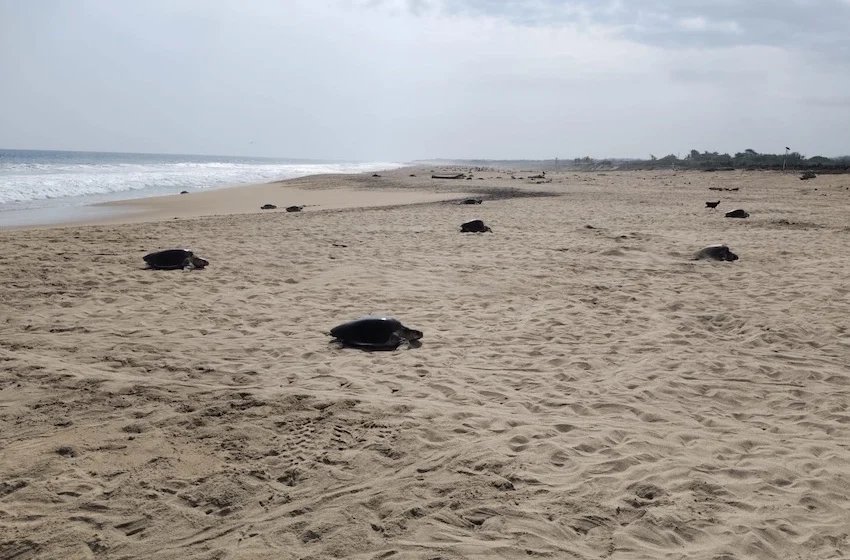
The Morro Ayuta beach sanctuary in Oaxaca hosted a record 1.9 million protected nests and more than 34 million olive ridley sea turtle hatchlings, marking a successful nesting season, Mexico’s National Commission of Natural Protected Areas (Conanp) reported.
The sanctuary, located on Oaxaca’s Pacific coast between Puerto Escondido and Salina Cruz, is one of the most well-regarded marine biodiversity preservation centers worldwide, and is one of only 12 sites where the arribada (arrival of turtles) occurs on a massive scale.
🐢 El santuario de la playa Morro Ayuta, en el Istmo de Tehuantepec, Oaxaca, registró una temporada histórica de desove de tortuga golfina con 1.9 millones de nidos protegidos y más de 34 millones de crías liberadas al mar, informó la Comisión Nacional de Áreas Naturales… pic.twitter.com/t6emRaGHF4
— La Jornada (@lajornadaonline) June 16, 2026
“Thanks to the rains, the wetter beaches and the fact that this summer’s temperature was ideal for egg incubation… the turtle nesting season came to a close with unprecedented numbers,” said Guillermo González Padilla, the head of the turtle camp, in an interview with the newspaper La Jornada.
The olive ridley turtle, which gets its name from the color of its heart-shaped shell, is among the smallest species of sea turtle in the world. They are found primarily in the tropical regions of the Pacific, Indian and Atlantic Oceans.
“We always try to protect as many nests as possible on the beach; however, there are other external factors, such as the current swell, hurricanes and trash,” explained González Padilla. According to Gónzalez Padilla, there are packs of wild dogs that eat around 40 nests a day.
The sanctuary works alongside the federal Program for the Protection and Restoration of Priority Ecosystems and Species (PROREST), the nearby communities of Paja Blanca and Tapanalá and the civil association CostaSalvaje.
In the last 20 years, the olive ridley sea turtle population has grown exponentially, according to González Padilla.
“The reproductive period begins in May,” he explained. “The females mate with one or two males and can retain the sperm of one of them through a specialized organ called the spermatheca, which stores the sperm.”
According to González Padilla, a female can lay almost 500 eggs in a single season, and when their offspring hatch, they memorize the beach and use all their senses to walk on the sand towards the sea.
Sea turtles and their eggs used to be part of the traditional diet of the Indigenous Chontal community, but today, the main challenge for the turtles’ conservation is the proliferation of poachers who sell them on the black market for financial gain, particularly due to a lack of employment in the region.
Mexico’s Federal Attorney for Environmental Protection (Profepa) activates a surveillance protocol at the beginning of the turtle nesting season to prevent poaching, with the support of the Mexican Navy.
The sanctuary is partially funded thanks to the Mexican government’s fine scheme to combat environmental crimes. Fines paid by offending individuals and businesses have helped the current administration raise over 8 million pesos (US $464,700) to support the conservation of priority areas, according to a press release.
With reports from La Jornada and Excelsior
