
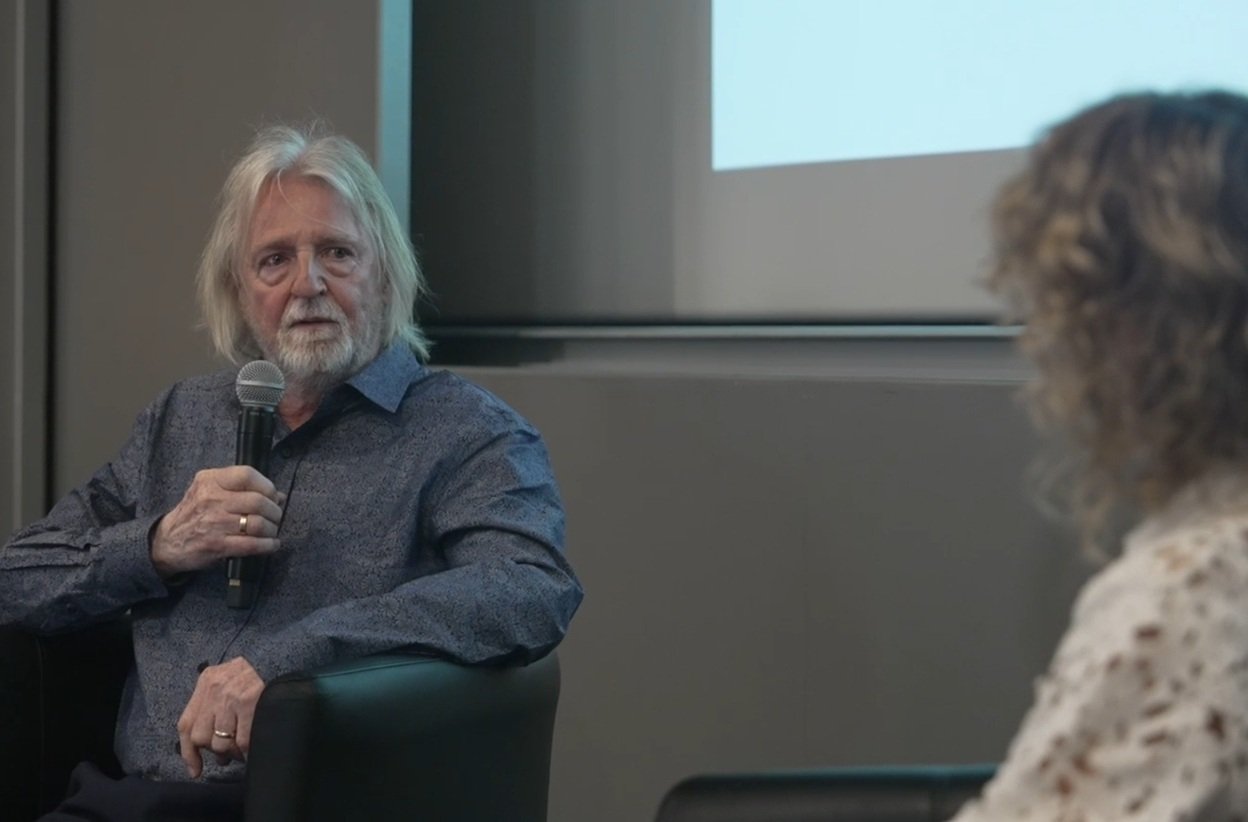
– At Monte-Carlo, the creator of Vikings, The Tudors and Billy the Kid discussed historical icons, magical realism and the need to make things happen on screen
Michael Hirst has spent much of his career returning to figures and worlds that audiences think they already know. Yet, as he explained during an “In Conversation” session at the Monte-Carlo Television Festival’s Business Forum, his instinct is rarely to treat history as a fixed monument. Instead, he looks for vulnerability, danger and contradiction – the human material hidden underneath the icon.
Speaking with journalist Marta Bałaga, Hirst returned first to Elizabeth, the 1998 film helmed by Shekhar Kapur. In England, he said, Elizabeth I remains “an iconic figure”, and that reverence created a problem. “There was a danger in making a movie about Elizabeth I because of the feeling that English people have towards her,” he explained. “We couldn’t have an English director, because the camera would always be pointed up towards her face, bowing to her, basically.”
Kapur’s distance from the myth became an advantage. According to Hirst, the director “didn’t know who Elizabeth I was” and even asked London taxi drivers what they thought of her. After reading the script and related material, he saw her not as a national symbol, but as “just a young woman in a very, very difficult and dangerous place – especially for a woman”. That became the key to the film. “That’s how I wrote it and how we shot it,” Hirst said. Only at the end, once Elizabeth is secure on the throne, does the camera look up at her “for the first time, like a loyal subject”.
A similar act of reframing took place with Vikings. Hirst recalled how little he, and many others, had actually been taught about Viking culture. The popular image, he said, was a cliché of “violent, ignorant, savage people”. Research told a different story, however. “In Viking society, women could vote, they could own houses, they could fight in the shield wall, they could divorce their husbands, and they could rule,” he noted. “In Christian society, none of that applied at all.”
One of the most moving consequences of the series, he added, came during a visit to the Viking Ship Museum in Oslo. The curator closed the museum for him and told him that, since the show, visitor numbers had more than doubled, helping finance further archaeological digs around Norway. However, for Hirst, the point is not to deliver history lessons. “I’m not teaching anybody anything,” he said. Rather, he wants viewers to feel that the past remains connected to the present. “Time is a continuity. It’s not broken up into blocks. The past isn’t a totally strange country.” His shows, he suggested, begin from the discovery that supposedly familiar figures – Elizabeth I, Henry VIII, Billy the Kid and the Vikings – are often stranger, richer and more contemporary than their reputations allow.
That approach was not obvious from the beginning. Hirst described his first encounter with screenwriting through Nicolas Roeg, whom he met while working in publishing. Roeg had read some of his short stories and asked him to write early scenes for a project based on a JM Barrie story. Hirst, then steeped in Henry James at Oxford, produced scenes in which “two guys” talked “in a clever way”. He thought Roeg would love them.
The response was brutal and formative. “He read the first page quite slowly, the second page a little faster, and the third page he just glanced at,” Hirst recalled. Then Roeg opened the window and threw the pages out of it. “He said, ‘Michael, this is a movie. Anything can happen.’ I never forgot that. I had to make things happen.”
Rather than discourage him, the experience pushed him further towards screenwriting. Hirst said he did not want to remain in publishing, and he was also wary of writing prose under the shadow of the literary giants he had studied. “Every time I tried to write prose, it didn’t seem as good as Herman Melville, Henry James, Kipling or whoever,” he said. “So, I thought, ‘Let me start doing something I don’t know how to do.’”
That refusal to be overly trained became part of his method. Hirst said he never wanted to attend screenwriting courses, partly because they often teach writers to imitate existing models. “They just give you examples of other scripts and say, ‘You too could write like this.’ Why would I want to write like that? I’d like to write like I write, and figure this out.” What followed, he said, was an apprenticeship: long, practical and helped by the fact that he was “cheap” enough for producers to commission.
Research remains central to his process. Asked how he begins, Hirst said he reads everything he can and tries to build a case for the story. With Elizabeth, he used a long stretch of wallpaper, writing down anything that struck him: poetry, music, key political figures, enemies and questions about what it meant to be a woman in that society. When he walked back along the notes, he realised that most of what interested him belonged to Elizabeth’s early years, before she became an established queen. “Then I had the structure,” he said.
The present industry, however, gives him cause for concern. Hirst stressed that he has been “given a lot of breaks” and remains grateful, especially now that it is “very, very hard to get anything made”. He added: “I don’t think the movie industry and the TV industry are in a particularly good place at the moment.”
What worries him is not only the difficulty of production, but a possible loss of danger, beauty and imagination. “We live in an increasingly brutalised age,” he said. “Maybe on screen I see more realism, and less magical realism or less imagination.” Still, he resisted simple gloom. “I have children and grandchildren, and pessimism is sentimental. One shouldn’t go around saying everything is bad.”
That belief in magical realism will feed into Bloodaxe, his new Viking-related series, which he said has received a green light for a second season. Hirst explained that the original Vikings already contained elements of magical realism because they experienced their gods visually and physically. In the new series, he has pushed that further, allowing the world to fall apart or strange things to happen in moments of crisis.
