
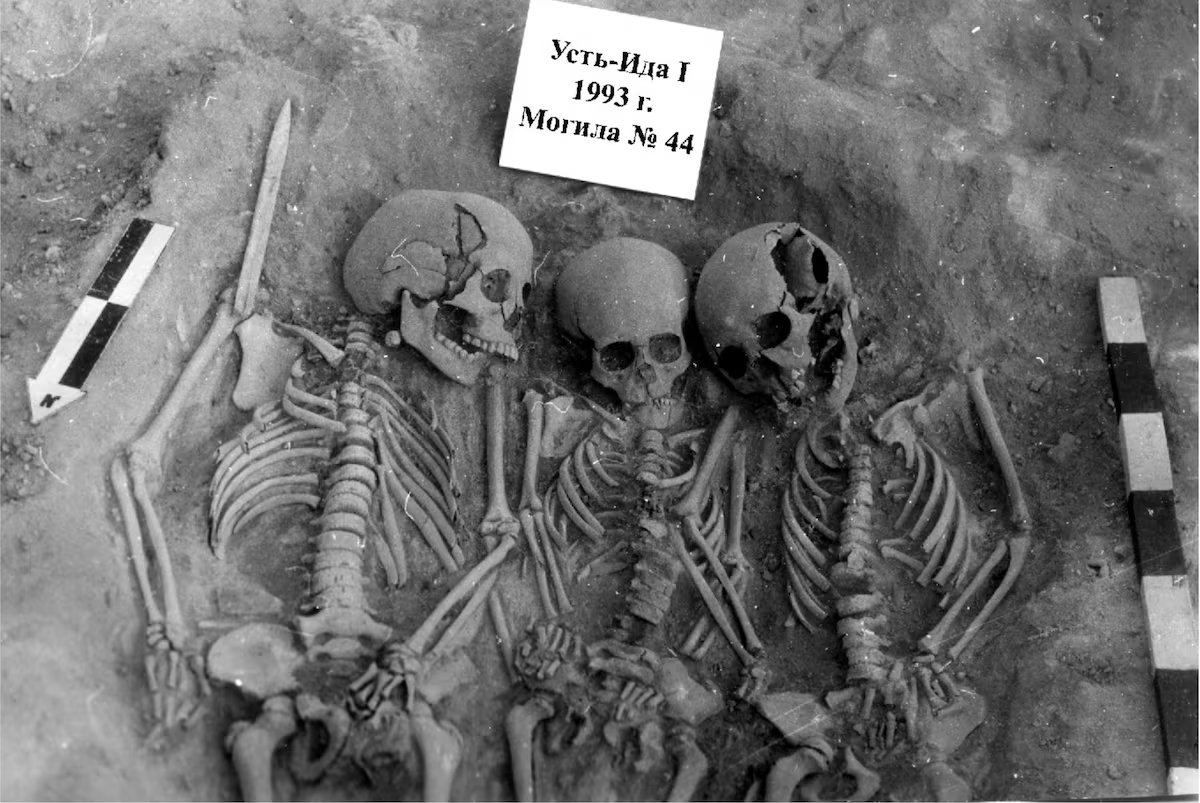
Around Lake Baikal, in southern Siberia and north of present-day Mongolia, nomadic human groups who lived five millennia ago relied on fishing, hunting, and gathering wild fruits. They were still in the Paleolithic; they had not been exposed to agriculture or the sedentarization that produced the first cities, which spread from the Middle East to Europe. Yet that Eden was thought to be free of two of the burdens that accompanied early human settlements: violence and disease. Perhaps the former; but now we know it was not the case of the latter. Researchers who study ancient pathogens have found in that region the oldest outbreak of plague, a scourge that has haunted humans ever since. As they detail in the prestigious journal Nature, the bacterium that caused it lacked the genes that later gave it enormous virulence, but it was nevertheless capable of killing, especially children.
“Baikal was a region very rich in resources and has an exceptional archaeological record, with cemeteries used for generations to bury the dead,” says Ruairidh Macleod, an ancient DNA (paleogenomics) researcher at the University of Oxford and the study’s lead author. “We focused on a specific site called Ust’-Ida, which showed an unusual mortality profile. There was a notable excess of children and adolescents who had died and no clear explanation,” Macleod adds; he carried out this research while completing his doctorate at the University of Cambridge. “There was no evidence of perimortem violence or skeletal trauma that could explain those early deaths,” he concludes.
Archaeologists thought ancient DNA might shed light on the mystery and looked for it in the molars of around 50 human remains, some dating to 5,500 years ago, preserved in several museums and institutions since the first excavations in the 1980s as part of the Baikal Archeology Project. “I took between 50 and 100 milligrams from the root of each tooth,” Macleod says. Once pulverized and treated with chemical reagents, they were able to extract and purify the DNA. The first revelation followed: 39% of the samples bore traces of Yersinia pestis, the bacterium that causes plague. A prevalence that high was not seen even in the worst of the Black Death in the Middle Ages.
“We found the oldest plague genome identified so far,” says Eske Willerslev, professor at the universities of Copenhagen and Cambridge and the study’s senior author. To date, the earliest samples of the plague had been found in northern Europe, but they are about half a millennium more recent. The discovery’s impact is not limited to being the oldest outbreak. “Perhaps more importantly, for the first time we can directly link evidence of plague to elevated mortality,” Willerslev adds.
Most ancient DNA studies had been carried out on prehistoric European populations. “There were reasons to think that major outbreaks of infectious disease were more closely linked to Neolithic agricultural lifestyles than to hunter-gatherers,” says Willerslev, who highlights another aspect: “The oldest known plague cases came from single individuals. What we see here is very different: this is not an isolated event, but a true outbreak that affected many people.”
Why children? That most of the dead were minors had already baffled the Soviet archaeologists who exhumed them during the last century. Only genetics, and in particular paleogenomics developed this century, had the answer. Diving into the genome of Y. pestis, the researchers did not find a gene called ymt. It is a genetic acquisition that brought fleas into the equation. The bacterium’s natural reservoir is several rodent species. These people hunted marmots for their fur and meat — one of the species that still carry the pathogen today. The ymt is a devilishly effective mechanism that amplified transmissibility. This modification allowed Yersinia pestis to accumulate in the digestive tract of fleas that, unable to feed, were driven to bite repeatedly, thereby spreading infected blood.
With fleas came bubonic plague, a clinical form that primarily affects the lymphatic system and was the main agent of the three great pandemics in history: the Plague of Justinian, the Black Death, and the 19th-century pandemic in China. But the bacterium that killed the children at Lake Baikal could not use fleas as a vector. They must have been infected by direct contact with an infected marmot and then between people — that is, it was pneumonic plague, the most severe form, which spreads through the air.
“These ancient strains contain another gene called ypm, which also appears in another species of Yersinia, called Yersinia pseudotuberculosis,” says Astrid Iversen, a co-author of the study. Y. pseudotuberculosis is the predecessor of Y. pestis. The ypm it carries is what immunologists call a superantigen. “The product of this gene can bind to certain molecules of the immune system and provoke a very intense T-cell response. That triggers an extremely strong activation of the immune system,” Iversen adds. The researcher noted that Y. pseudotuberculosis is behind conditions such as Japanese scarlet fever or Kawasaki disease, which particularly affect young children.
“I think we cannot rule out that flea transmission did not occur, although given the genetic components these basal strains have, it could only have happened via what is known as early-phase transmission,” says Aida Andrades Valtueña, an archaeogenetics researcher at the Max Planck Institute for Evolutionary Anthropology (Germany), who discovered one of the oldest cases of bubonic plague in northern Spain. “This type of transmission occurs during the first days, without fleas becoming blocked, but it is much less efficient than transmission by blocked fleas, which is the primary mode today,” Andrades Valtueña, who was not involved in the Baikal study, concludes.
For Nicolás Rascovan, head of the microbial paleogenomics unit at the Institut Pasteur (France), “many elements make this study unique: the period (much older than any known case), the geographic region (much farther east than any case to date) and the context (a hunter-gatherer society, with numerous individuals and families infected, in many cases with the same strain).” This, he adds, contradicts “the idea that agricultural lifestyles were the main determinant in the emergence of plague.”
However, Rascovan says this work does not answer all questions: “The most recent common ancestor between Y. pestis and Y. pseudotuberculosis is estimated at 40,000–50,000 years ago, so there are still several thousand years of Y. pestis evolution and spread that we have ignored, until it eventually infected humans for the first time.”
Sign up for our weekly newsletter to get more English-language news coverage from EL PAÍS USA Edition
