
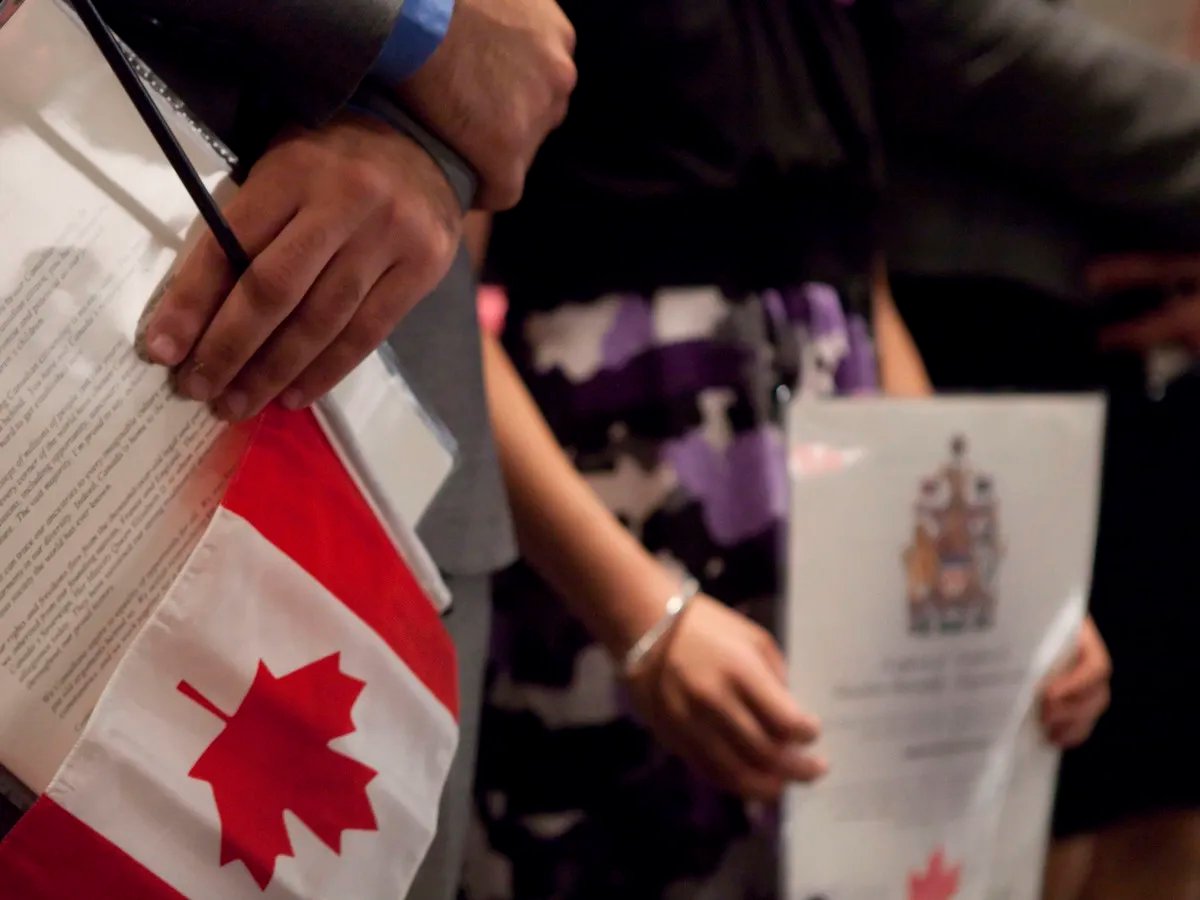
In a sudden about-face, the Canadian government is telling some people who recently applied for citizenship under new laws that their applications are under review and they need to turn over their citizenship certificates.
BBC News reports that Shawn Davis Mooney, who recently relocated permanently from California to Victoria, B.C., with his husband was alarmed when he received his letter.
“It has devastated me beyond imagination,” he said.
Letters shared on social media and signed by Peggy Sun, Registrar of Canadian Citizenship, say in part: “I am writing pursuant to subsection 26(1) of the Citizenship Regulations . This provision authorizes me to require the surrender of a certificate of citizenship where I have reasonable grounds to believe that the holder of the certificate may not be entitled to it (i.e. may not be a Canadian citizen).”
The letters add: “The purpose of this letter is to inform you that I have information in my possession that indicates that you may not be entitled to hold a Canadian certificate of citizenship.”
Help! I’m terrified
byu/WereWolvesForChange inCanadiancitizenship
They say documentation submitted in support of proof of citizenship “is not from the original source authorities responsible for creating or maintaining historical records.” The letters tell recipients to return their citizenship certificate if they have one, concluding: “Should the final decision be that you are entitled to the certificate of citizenship, then it will be returned to you.”
A spokesperson for Immigration, Refugees and Citizenship Canada (IRCC) told National Post in an email that the department was aware that a limited number of people who obtained a certificate under Bill C-3 have been notified that their file is under review.
“The purpose of the review is to determine, through an individualized process, whether the certificate was properly issued based on the evidence required by law,” the spokesperson said. “This is a necessary and important safeguard, and all affected individuals will have an opportunity to provide additional documentary evidence in support of their case.”
The spokesperson added: “ With each application, trained officers review all the evidence before them before approving a citizenship certificate.”
What I learned about the surrender letters today from Service Canada and IRCC
byu/odetomyday inCanadiancitizenship
It’s a situation one University of Toronto law professor characterizes as “reckless and irresponsible.”
Audrey Macklin is Professor of Law and Rebecca Cook Chair in International Human Rights at the Henry N.R. Jackman Faculty of Law at the U of T. She told National Post that a previous citizenship law passed in 2009 under the Harper government was “extraordinarily restrictive” in cutting off Canadian citizenship at the second generation, but she questions the recent passage of Bill C-3, suggesting it swings too far the other way.
Bill C-3: An Act to Amend the Citizenship Act , came into effect in December. It means that so-called “Lost Canadians” who lost or never obtained citizenship under earlier laws can apply if they have ancestors born in Canada, regardless of how many generations back that connection exists.
“It seems to me that this bill was not carefully considered in its effects or in the processes that would be required to implement the rules,” Macklin said. “If you are going to put in place a model where people can rely on 200-year-old evidence, then you have to be … pretty flexible about how you’re going to assess that evidence.”
She added: “They’re suddenly waking up to the idea that evidence that is 200 years old requires different kinds of standards and expertise and procedures in assessment than does evaluating birth certificates from 50 years ago.”
Sad news, I found out my citizenship certificate (previously granted) is now under review
byu/InternetName4 inCanadiancitizenship
Macklin is adamant that applicants are not to blame for the reversal.
“This should in no way impugn the people who applied under the rules that the government has set out,” she said. “I would not present this as somehow there’s something suspicious about people’s applications. The government had the opportunity to put in place processes that were mindful of what they were creating, which is an invitation to apply for citizenship based on very old historical records.”
Macklin also called the new law “anomalous,” noting it flies in the face of other recent changes in Canadian legislation that have made it more difficult for newcomers to obtain citizenship, such as capping the number of new permanent residents, and reducing the number of student visas.
She added that Bill C-3 sets out a more reasonable standard for citizenship going forward. “ For people born after December 2025 you can pass on citizenship by descent, potentially one generation after another, but each generation will have to manifest and demonstrate a connection to Canada.”
Retroactively, it’s a different story. “They don’t require any connection. All you have to show is the descent, and I’m not sure why the government thought it was advisable or necessary to do that,” she said. “Maybe they thought it would just be simpler, and we’ll just get rid of the problem if we attach no conditions retrospectively. (But) if you’re going to have that as a rule, then you’re going to have to contend with … a lot of evidentiary challenges, and you can’t blame those on the people who are applying.”
The immigration news website CIC News (named when IRCC was called Citizenship and Immigration Canada) recommends anyone applying to get their documents directly from the source, noting: “ A ‘source authority’ is the office that originally created and keeps the record; a state or provincial vital statistics office, a civil registry, or, in older Canadian cases, a recognized provincial archive.”
It adds that a scan of a record from a genealogy site is not the same thing, even when the image is identical. “The genealogy site is a finding aid. The registry is the authority.” It also recommends getting records certified.
Finally, it notes that, for any missing records, “IRCC’s own instruction guide tells applicants to include a letter of explanation for any missing or unclear documents. So the gap itself is not automatically a problem, a lack of accompanying explanation is.”
Our website is the place for the latest breaking news, exclusive scoops, longreads and provocative commentary. Please bookmark nationalpost.com and sign up for our newsletters here.
