
– Swedish animator Anna Mantzaris explores human desire for love and connection in her absurdist comedy short
Swedish animator Anna Mantzaris, best known for Good Intentions and But Milk Is Important, returns with another short, Please, which has just had its world premiere in Animafest Zagreb’s Grand Competition. A big co-production between Sweden, France, Czech Republic, Norway and Finland, it explores the difficulty of finding real connection and, ultimately, romantic love in a world dominated by corporate cruelty, wars and inequality.
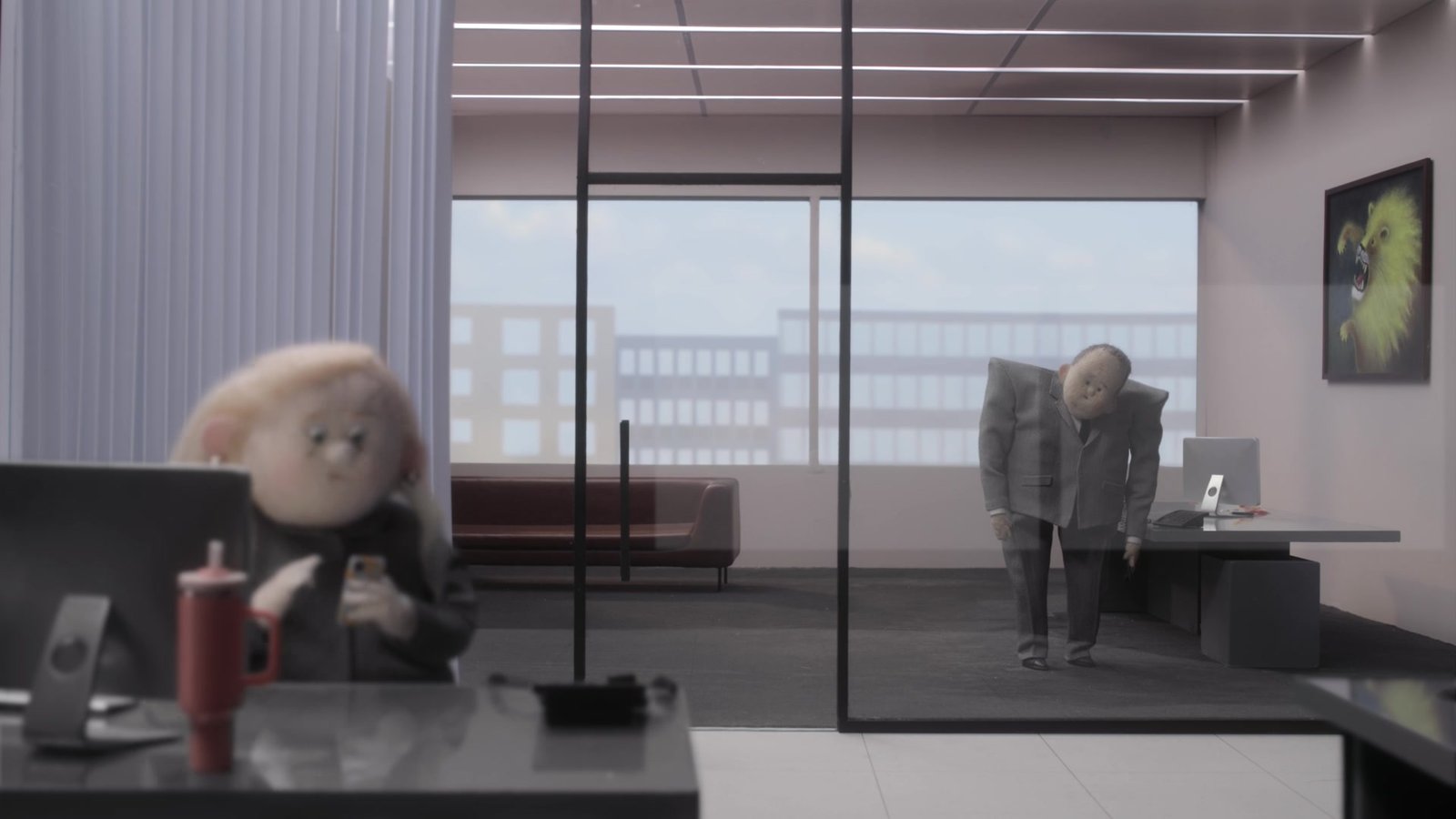
The style and settings of Please evoke the distinctive world of Roy Andersson, with its carefully composed scenes, muted colour palette and portrayal of everyday human absurdity. The stop-motion animation puts disproportionally bodied felt puppets in the scenery of offices, streets and restaurants. That introduces a humourous note to the film: it opens with a disinterested, self-absorbed corporate boss asking his secretary if his head looks too small in his suit. She answers that it doesn’t, but it is obvious to the viewer that, in fact, his head does look overly small in comparison to the rest of his body, especially his big shoulders.
There are other amusing scenes from the life of film’s characters, such as a medieval sexual roleplay between a couple where the man is dressed as a princess while his partner is a knight in shiny armour. Another funny episode takes place at a bar, where a woman is on a date with a man who is just looking at his phone. Even flashing her breasts doesn’t get him to look at her. These little individual stories are not connected in the narrative, which is supported by deadpan editing in which they just alternate in a kind of collage, but they’re all part of the broader theme of alienation.
Music plays an important part in building the atmosphere. Putting Arthur Russell’s song, I Never Get Lonesome, in the background while showing images of male puppets’ Tinder profiles in stereotypical poses like holding the fish they caught or flexing at the gym, mockingly but also compassionately conveys how lonely everyone in this world is.
In the end, one of the characters joins a happy four-member cult which walks around the streets and spreads joy. Dancing, singing and embracing life while the world is literally on fire serves as an important function. Rather than offering a straightforward message of hope, this ending seems to observe, with an ironic distance, the human desire to find comfort, belonging, and meaning amid anxieties of contemporary life. The possibility of community and even love remains, but it is presented with a mixture of sincerity, absurdity and gentle scepticism.
