
– Bojan Stijović’s feature debut is a classical but solidly crafted Montenegrin drama about return, guilt, family ties and drunken nights spiralling out of control
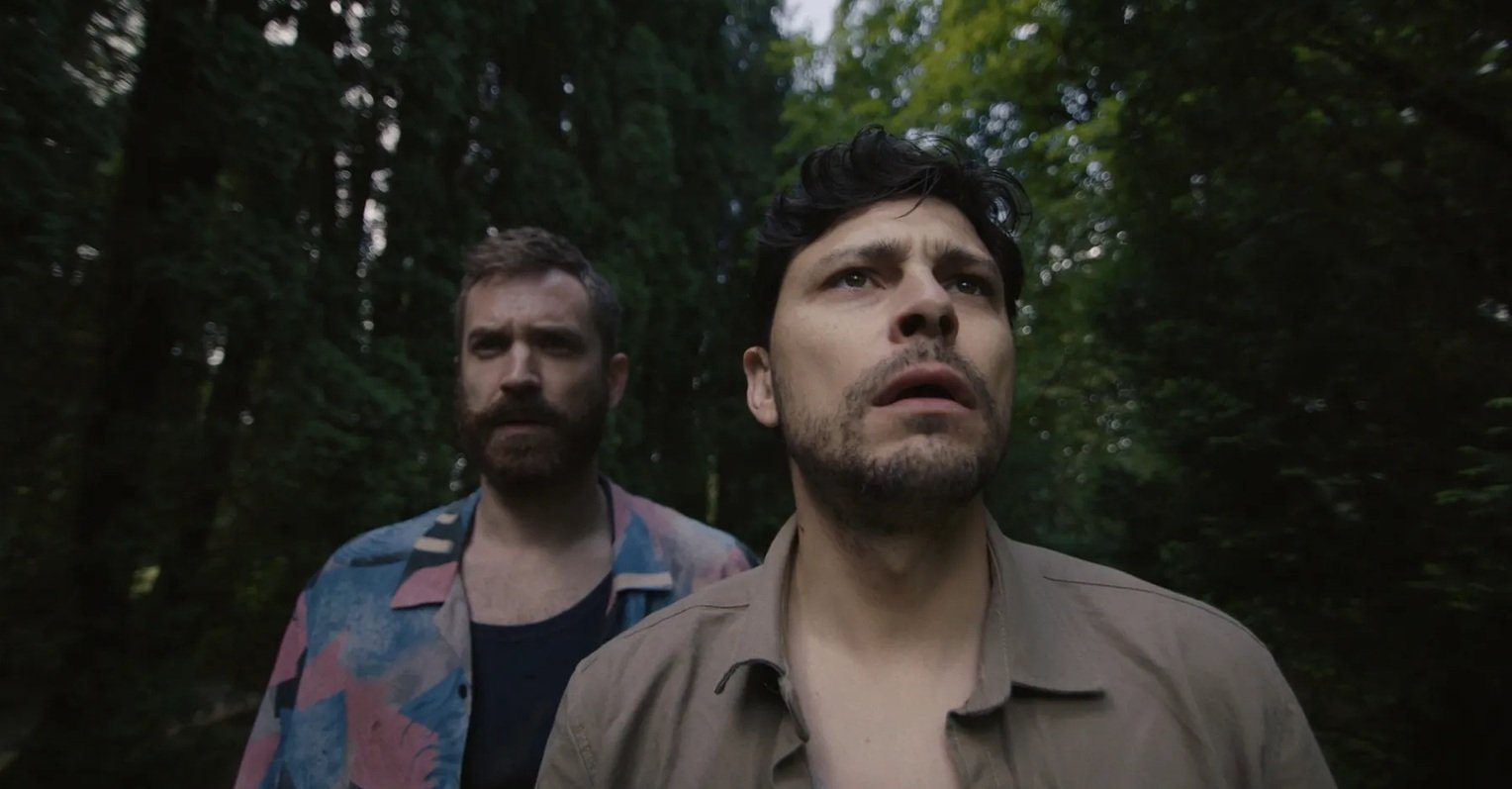
Momčilo Otašević (left) and Marko Janketic in Black Trumpet
There is something both familiar and pleasingly specific about Black Trumpet, the feature-length debut by Montenegrin helmer Bojan Stijović. On paper, the film is built around rather recognisable dramatic topoi: the prodigal return, the small community that both welcomes and judges, the ambiguous authority of family and village life, and an accident that threatens to turn an entire existence upside down. Yet Stijović and screenwriter Stefan Bošković manage to cover these ingredients in a very particular Montenegrin sauce – with no shortage of rakia – and the result is modest and classical, but often effective. The pic bowed at this year’s Bishkek International Film Festival, playing in the International Competition.
After ten years in Zagreb, famed writer Maksim Grahovac (Momčilo Otašević) returns to his hometown in Montenegro to settle a matter of inheritance and reconnect, or at least deal, with his estranged brother Niko (Marko Janketic). Before he even properly re-enters the village and its web of expectations, Maksim accidentally kills a man on the road. Panicking, he turns to Niko for help. His return, meanwhile, generates excitement in the local community, where he is treated as a successful literary figure and even attracts the attention of the Minister of Culture (the aforementioned Bošković). Niko, however, agrees to assist him only in exchange for a share of the inheritance.
The premise is direct, almost brutally simple, and Black Trumpet works best when it allows this sudden catastrophe to collide with long-buried resentments. The central relationship between Maksim and Niko is given fair, compelling development: theirs is not just a brotherly bond damaged by distance, but also a mirror in which neither seems fully able to recognise the other, or perhaps himself, any more. Time away has complicated everything. Home is still home, but no longer a place where Maksim can simply step back into an old role.
That said, one senses there was still room to make the emotional geometry richer. Niko’s wife, Jelena (Milica Janevski), and their son Petar (Strahinja Bubanja) are visible, but not quite enough to fully turn the family unit into a living pressure chamber. A stronger presence of these characters throughout might have lent the drama an extra layer and made Niko’s choices feel even more morally and domestically charged. Still, the film’s character work is never thin, and its sharp, realistic dialogue helps anchor even the more familiar turns in something recognisably human.
Visually, Black Trumpet has the confidence of a strong independent debut. There are no frills, no excessive stylisation and no attempt to inflate the material beyond its natural scale. Yet Dušan Grubin’s pristine cinematography gives the picture a clean, satisfying texture. We get the sense of a sun-drenched Montenegrin village before the movie slips into the blurriness and pressure of an alcohol-fuelled night where events begin to unfold too suddenly and too fast. This speed is part of the point: the experience overwhelms Maksim and at times the audience, too – not in a frustrating way, but in a manner that reproduces the panic of a life abruptly knocked off its axis.
Ultimately, Black Trumpet does not reinvent the moral drama of return, guilt and communal judgement. Its structure is classical, its ingredients fairly recognisable, and some narrative elements could certainly have been pushed further. But there’s enough craft, atmosphere and dramatic instinct here to make Stijović’s debut a promising one. The ingredients are there, and one suspects they may just evolve into something sharper and more personal with a sophomore effort.
Black Trumpet was staged by Montenegro’s Cut-Up doo.
