
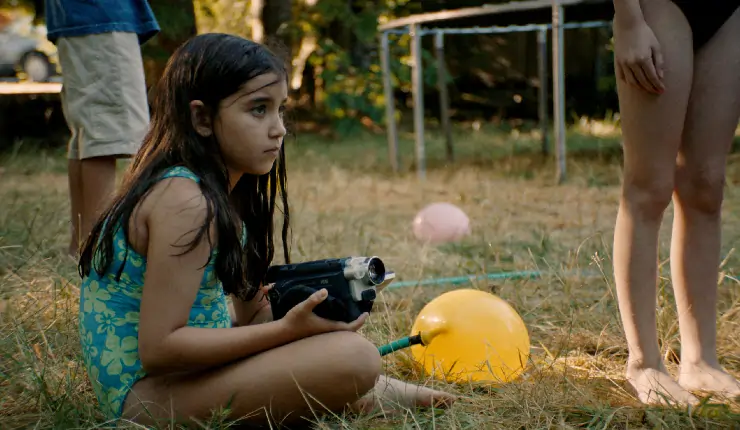
Sophy Romvari’s Blue Heron is, at its core, a work of indulgent and extremely personal artistry. The feature film debut of the Canadian-Hungarian writer and director follows a family of six in the late 1990s, as they settle into their new home on Vancouver Island. As family dynamics play out, we experience the increasingly dangerous behaviours of the eldest child, Jeremy, from the perspective of the youngest child, Sasha.
I think what strikes me most about the auto-fiction of Blue Heron is Romvari‘s ability to remain entirely knitted to her personal experiences conveyed in this film, yet its emotional outpouring is never hindered by such internal catharsis. Often in films nowadays, there’s a benign tendency to make extremely personal gestures be visualised in a way that makes one blind to the end product of their own work, set out on one goal, never able to envision beyond the single straight tunnel, with all the answers revealing themselves by the end of it.
Blue Heron is a movie that, under the guise of memory, recontexualises itself halfway through and delivers a turn of moving revelations that break down the stigma of personal indulgence because its path to clarity is never truly obvious to us. The deceptions of its first half inflict a saddening prejudice that is cleverly levied against the audience, come the second half.
Romvari’s cinematic visualisation of memory is actually not a visualisation at all, but rather her ability to distort the recollective consciousness that the medium already inherits. Cinema in itself is about replaying fractured thoughts from the past, only this time, Romvari utilises the semi-autobiographical quality of the youngest daughter as a camera, peering into her past.
The extreme and obscured close-ups are met with a camera that refuses to stop moving in the opening half, as the clarity of blame and intentions is clouded in those youthful observations. She understands that cinema is an inherently voyeuristic medium, utilising that statement to enact images that blur the line between past and present, watcher and camera, as movies and memories become one.
The peak of this film’s poignancy, however, is that despite this line between past and present fading, Romvari knows that it’s impossible to ever fully achieve this; she bangs at the images in her mind, trying to change things, trying to travel through time to recognise the struggles of Jeremy. Despite the revelatory stance of the second half, the film never wanes in its exposé of fragmented truth; the strengths of its initially ambiguous emotions are its centrifuge, and its confessions are honest enough to never let any of those intentional misjudgments slip away from underneath us.
Whether it’s the use of photographic darkrooms, desperate to uncover the past, the characters with video cameras, or broken images of faces reflected in mirrors, Romvari is able to add so many tangible layers to this somewhat autobiographical text that only furthers the intimate quality of its well-meaning but transparent catharsis. It reaches a conclusion that feels like it always knew that the barrier to the past is just out of arm’s reach, and yet Romvari‘s self-actualisation never fails in its disclosure; it is self-assured but never flat in naivety.
Blue Heron’s blend of fact and fiction leverages a wonderfully totemic play in its child-eye view, as the more the film progresses, the more the pseudo-truth of its cameras both divulges and bewilders. Come the credits, there’s still an aching and indescribable pain beating through its heart.
★★★★
In cinemas UK on June 26th / Eylul Guven, Amy Zimmer, Ádám Tompa, Iringó Réti, Edik Beddoes / Dir: Sophy Romvari / Conic / 12A
Discover more from
Subscribe to get the latest posts sent to your email.
