
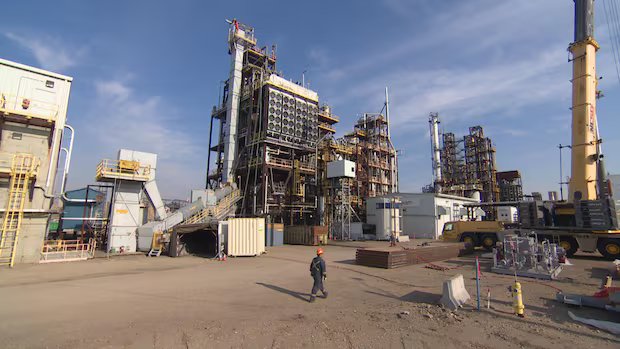
An environmental enforcement order has been issued against a shuttered chemical plant that converted Edmonton’s residential waste into biofuel. The order was issued because of concerns about abandoned infrastructure and lingering chemical contamination on-site.
Alberta Environment and Protected Areas says the Enerkem Alberta Biofuels facility in northeast Edmonton must undertake remediation work on the plant, a biorefinery that operated for more than a decade on city-owned property.
The order, issued June 5, alleges that site’s former operators have failed to safely decommission the site and monitor ongoing risks to the environment.
The order details a string of regulatory concerns that have surfaced since the plant was shut down, including toxic chemicals left in tanks, abandoned industrial waste containers and improperly stored contaminants that threatened to spill from the site.
According to regulatory documents, recent environmental testing shows that soil and groundwater contamination on-site exceeds safe environmental guidelines. Contaminants include methanol — a toxic flammable solvent — and petroleum hydrocarbons left in the soil by plant operations.
The facility used a patented gasification process to convert non-recyclable municipal solid waste into biofuels such as renewable chemical methanol.
Following years of financial and legal challenges, Enerkem’s Edmonton operation shut down in January 2024.
The Quebec-based company later entered insolvency protection proceedings and has since been extensively restructured, taken over by its major lenders and has turned its operational attention overseas.
Jason Unger, executive director of the Environmental Law Centre of Edmonton, said he believes the case highlights the need for stronger, more proactive provincial and municipal oversight of industrial facilities within city boundaries.
Enerkem’s altered financial status raises significant concerns regarding the timeline, funding and execution of environmental remediation, Unger said.
“That is just one of the main concerns in terms of remediating the plant in a timely fashion and ensuring that the public doesn’t end up having to pay for it,” he said.
The enforcement order names Enerkem Alberta Biofuels G.P. Inc., Enerkem Alberta Biofuels LP and a former company director, along with Deloitte Restructuring Inc.
When Enerkem entered insolvency protection in May 2025, Deloitte Restructuring was named as a court-appointed monitor, responsible for managing the company’s remaining assets and debts.
While Enerkem still exists as a corporate entity, little of its operations remain, with no active directors or remaining employees in Edmonton. Company officials have not responded to a request for comment. Officials with Deloitte declined to comment, directing CBC News to its public court records related to insolvency proceedings.
New waste-to-fuel technology
The enforcement order is the latest issue for the facility meant to revolutionize waste management in Edmonton and divert 100,000 tonnes of waste annually.
Under a 25-year lease agreement signed in 2010, Enerkem promised to build a plant that would transform waste into cellulosic ethanol, the first commercial-scale plant in the world to do so.
Located at the Edmonton Waste Management Centre, the $80-million facility was partly funded by the province. The City of Edmonton also built a $40-million waste-preparation facility specifically to supply the feedstock that Enerkem would need.
In January 2024, Enerkem, struggling to remain profitable, announced the operation would shut down production, 11 years before its city lease agreement was set to expire.
The facility had faced numerous logistical challenges and produced a fraction (around five million litres) of its original annual target of 36 million litres of cellulosic ethanol.
Investigation begins
More than two years after the plant closed, Alberta Environment officials say mandatory remediation measures remain incomplete. The regulatory investigation began in the fall of 2025 following a complaint from city inspectors who raised concerns over a possible leak and “unknown liquids” being stored at the abandoned site.
In October 2025, Alberta Environment completed its first inspection. The department’s officers found unidentifiable liquids, open tank valves and various chemical containers — including methanol — had been left sitting at the closed facility, along with industrial tote bags with more unidentified substances.
Unknown liquid was found in a bermed area with tanks in the south side of the facility and the gates or valves had been left open, the order states.
Methanol, sulfuric acid, wastewater
In response to concerns raised during the inspections, Deloitte hired a contractor to dispose of the high-risk chemicals, which testing later confirmed included methanol, sulfuric acid and industrial wastewater.
Subsequent testing, supplied to Alberta Environment on May 6, 2026, details the extent of contamination. The investigation found that unsafe levels of methanol and hydrocarbons were present on the property along with unacceptable concentrations of dissolved solids, chlorides and manganese.
Alberta Environment has ordered Enerkem to investigate how far the soil and groundwater contamination has spread and submit a formal remediation plan. A final decommissioning plan is due by January 2027.
Municipalities [are] here for the long haul. Whereas companies are often not.– Jason Unger
Court documents show Deloitte has been accepting bids and plans to sell off the plant’s remaining equipment, the final step before finalizing creditor-protection proceedings.
In a statement, André Joseph, the City of Edmonton’s director of sustainable waste processing, said the city continues to work with all parties to ensure remediation is completed. Enerkem remains responsible for decommissioning the site and maintaining public safety is a priority, he said.
Unger said he believes the case is another example of the risks that come with welcoming such innovative but unproven industrial operations to Alberta. These projects can leave behind contaminated lands that are an unwelcome and costly environmental liability, he said.
“Municipalities [are] here for the long haul. Whereas companies are often not.”
