
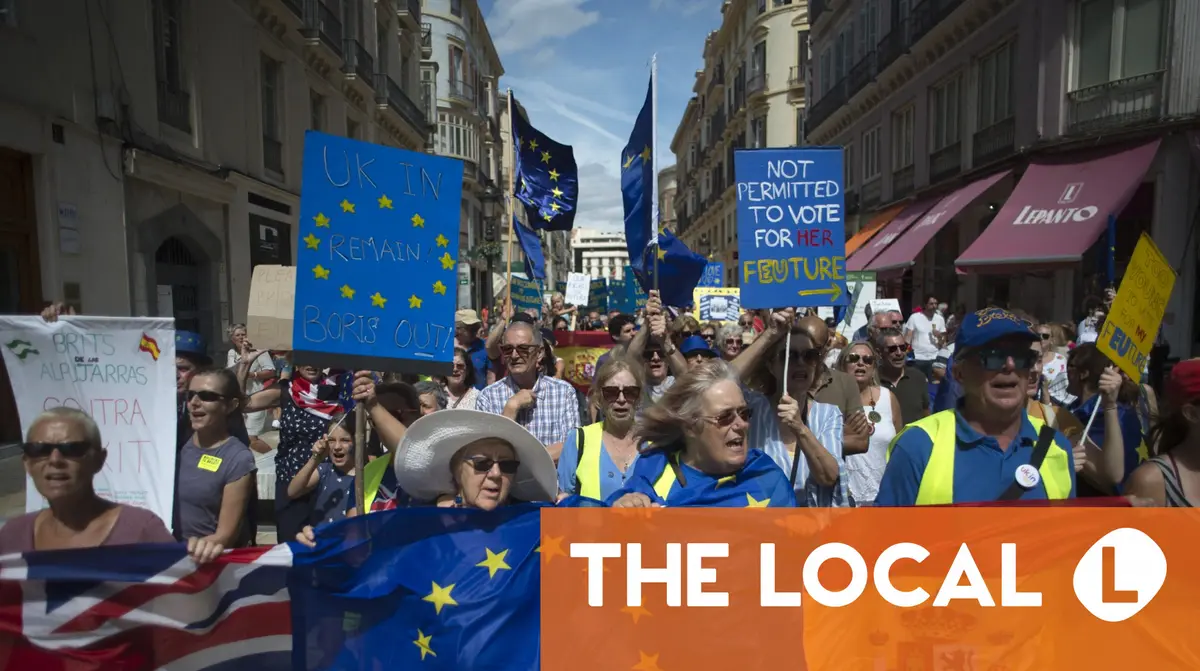
From bureaucracy to broken dreams, The Local’s British readers in Spain explain the real-life consequences Brexit has had for them as the UK marks ten years since it voted to leave the EU.
Where were you on June 24th 2016?
Do you remember switching on the TV on that Friday morning to discover that the UK had voted to leave the EU?
The previous day, 33.6 million Brits (72.2 percent of registered voters) headed to the ballot boxes, the outcome being 52 percent who voted “leave” and 48 percent who voted “remain”.
That fateful decision would set in motion years of news headlines, endless negotiations, deep polarisation, an economic downturn and seven changes of prime minister.
Beyond crisis-riddled UK politics and macroeconomics, Brexit has had a real-life impact for the approximately 400,000 UK nationals who reside in Spain, the tens of thousands of non-resident Britons who own Spanish homes, and many others.
Crucially, moving to Spain looks very different to how it once was. Any Brit now looking to relocate to Spain faces a battle with financial requirements, appointments, paperwork and long waiting periods.
For some it’s been a struggle, for others it’s been impossible.
The drawbacks of becoming a non-EU national have become all too clear.
We asked our readers to tell us in a survey how Brexit has changed their life in Spain over the past decade. This is what you had to say.
Brits in Spain protected under the Withdrawal Agreement
UK nationals who can prove they were living in Spain before December 31st 2020 are protected by the Withdrawal Agreement (WA) and have therefore been allowed to stay here largely under the same conditions as they did before Brexit.
They are in many ways the lucky ones.
Nonetheless, this doesn’t mean that life hasn’t changed for these Brits. Brexit has meant more admin that they didn’t have to deal with before, and their non-EU status has made them realise what they’ve lost.
One reader explained it perfectly when writing: “For me, it is that low level daily stress and anxiety that was never there before Brexit”.
Bill Donaldson, a 70 year old who has lived in Spain for 30 years, agreed. “It’s just a constant niggle; airport queues and confusion, complications on buying/selling property and (the biggie for me) we have no right to vote in European elections,” he said.
Sue, who lives in Málaga province, explained for that for her “not much has changed except having to change to a TIE (the residency card of non-EU nationals). I’m a WA-protected resident so still have the same rights as before. I will just have to update my TIE in another 4 years and by then I’m hoping all the hiccups people are experiencing now will be sorted.”
Another reader agreed with her that for them life in Spain was not very different since Brexit: “Luckily for us, not much. We became residents in 2018 and now have permanent residency on TIEs. The only difficult part was getting appointments to change our documents.”
For some though, it wasn’t so much the extra admin, but more the loss of connection with those back home because of it. “The biggest difference is in receiving presents in the post from the UK. Christmas, birthday, Easter… considerable tax has to be paid,” one reader who lives in Madrid wrote.
READ ALSO: EU to slap €3 customs duty on small parcels from July 1st
Those ultimately seem to be the main issues for those with protected WA status – problems getting TIE cards and renewing them, which airport queue to stand, and the loss of freedom in not being able to easily move to other EU countries.
Brits moving to Spain after Brexit
For those who arrived after Brexit, however, it’s an entirely different story – complicated visa processes, financial setbacks, loss of relationships, homes and more.
Andy (59), who lives in Estepona, told The Local: “The withdrawal cost me a considerable amount of money. Due to my employment I had to relinquish my residency for a period of time, with the intention of renewing it on completion of my contract. Because of Brexit, that never happened. I sold my property to downsize and that cost me thousands that I wouldn’t have had to pay if we were still a member of the EU or I had been able to renew my residency. I have nothing good to say about Brexit, and lots of negatives”.
Edward Burke, aged 73, now resident in Málaga province, agreed that financial pressures and trying to get permission to live here is difficult. “Visa application appointments are almost impossible within the time limits. I have had to prove I have sufficient money for the non-lucrative visa”, he said.
READ MORE: Is my UK pension enough to live in Spain in 2026?
Then there are the stories of those desperately trying to make a life in Spain or who have gone to extreme lengths to do so due to the issues Brexit has created for them.
And it seems that this is affecting younger people in particular, as they are the ones who don’t necessarily have the financial resources to be able to qualify for a visa.
Christina (35) – who lives between Scotland, Granada and Barcelona – explained that it was more the personal costs that affected her: “It cost me a personal relationship because the distance became too much pressure. I have become isolated from my close friends in the EU and travelling became a lot more difficult. Since Brexit, I have been attempting to move to EU but has not been able to because obtaining a work visa is almost impossible. My friends that stayed in UK had to leave too and my local businesses in UK lost a lot of seasonal workers.
“Financial issues aside, though there are plenty, the real human impact is that it forced closeness and openness to be distanced. It broke my heart and made my dreams so much further away,” she told The Local.
READ ALSO: British child born in Spain before Brexit denied residency
For another reader personal circumstances also made it difficult. It affected me negatively “since my wife is subject to the 90 /180 rule which limits the time we can stay here”.
Thirty-three-year-old Fern, a resident of Castilla y León, explained: “It has absolutely f***ed us. I came over two years ago as an auxiliar de conversación (English language assisant) and the amount of paperwork to procure the correct visa made my heart sink as I knew that if I had come straight from university ten years ago it would have been a fraction of the cost. With all the delay and uncertainty on whether the auxiliar programme would go forward this year I’m stuck in a position of needing to ask my Spanish partner to do a pareja de hecho with me, long before either of us would have voluntarily decided to do it…. the truth is that we are just as bureaucratically foreign as an American or Chinese immigrant. I’ve been searching for jobs over here as an English language teacher, but private academies cannot give the number of hours required to sponsor a work visa so I’m constantly getting passed over for Irish candidates who are less hassle. It breaks my heart because I know the vote was so so close and life could have looked so different. It’s truly the biggest act of self-harm the UK has ever undertaken”.
Second-home owners
Then there are UK nationals who aren’t Spanish residents but who own a second home in Spain. Many of them have had their plans ruined by Brexit and the rules that now apply to them as non-EU nationals, especially regarding freedom of movement.
Paul, who owns a home in the Valencia region, told The Local: “We have owned a second home in Spain since 2006, have always considered ourselves European, and voted remain. We bought a rural property unwanted by Spanish buyers, have used local tradesmen to develop and maintain it, and support businesses in our small town. Under these circumstances, we feel unfairly treated by the 90/180 rule…. Of course, we are also restricted in potential visits to other Schengen countries. If we had known this would happen, we might not have invested in a Spanish property”.
READ ALSO: The reasons why Brits are buying fewer homes in Spain
For Laura, who also owned a home in Valencia, the situation became untenable: “We have sold up (very sadly). We bought our house in 2006 with a view to retiring to Spain eventually. However, since Brexit, we could only spend the time in Spain that we had planned to by becoming resident…. So, in the end, it made sense to cut our losses and sell up and just tour the world instead.”
Laura went on to add that “the ironic thing is that we voted for Brexit. We did so on the basis that we would have better control of our finances and laws. We love being part of Europe, and it was great when there were just 12 countries in the EEC, but we hated the fact that 27 other countries now had a say in how the UK was run, particularly our fisheries (my husband is a fisherman). However, we were mis-sold and not much has been negotiated (i.e. nothing) so it was all based on lies and propaganda. Do we regret voting Leave? Yes. Do we regret selling? Not under the circumstances. But if those circumstances had been different (i.e. we had not had Brexit) then we would still have our house there”.
Brits who’ve become Spanish either through citizenship or at heart
Lastly, there are those who appreciate their lives in Spain and those who have even become Spanish, negating their Brexit stresses and worries entirely.
“It has made me even more content that I’m living in Spain. Britain is crumbling and I would not want to live there… in fact, I couldn’t afford to live there anymore on my small pensions. In Spain I live quite comfortably,” one reader told The Local.
Steve Mallon, aged 64, who lives in Catalonia said: “For me, Brexit created a lot of uncertainty and worry. There were so many unknowns at the beginning it could feel quite overwhelming. Ultimately, the process of getting the new TIE was pretty straightforward and then I quickly started the process of getting Spanish citizenship. I eventually received it in 2025, and it was great to be European again”.
READ ALSO: Will I lose my British citizenship if I become Spanish?
