
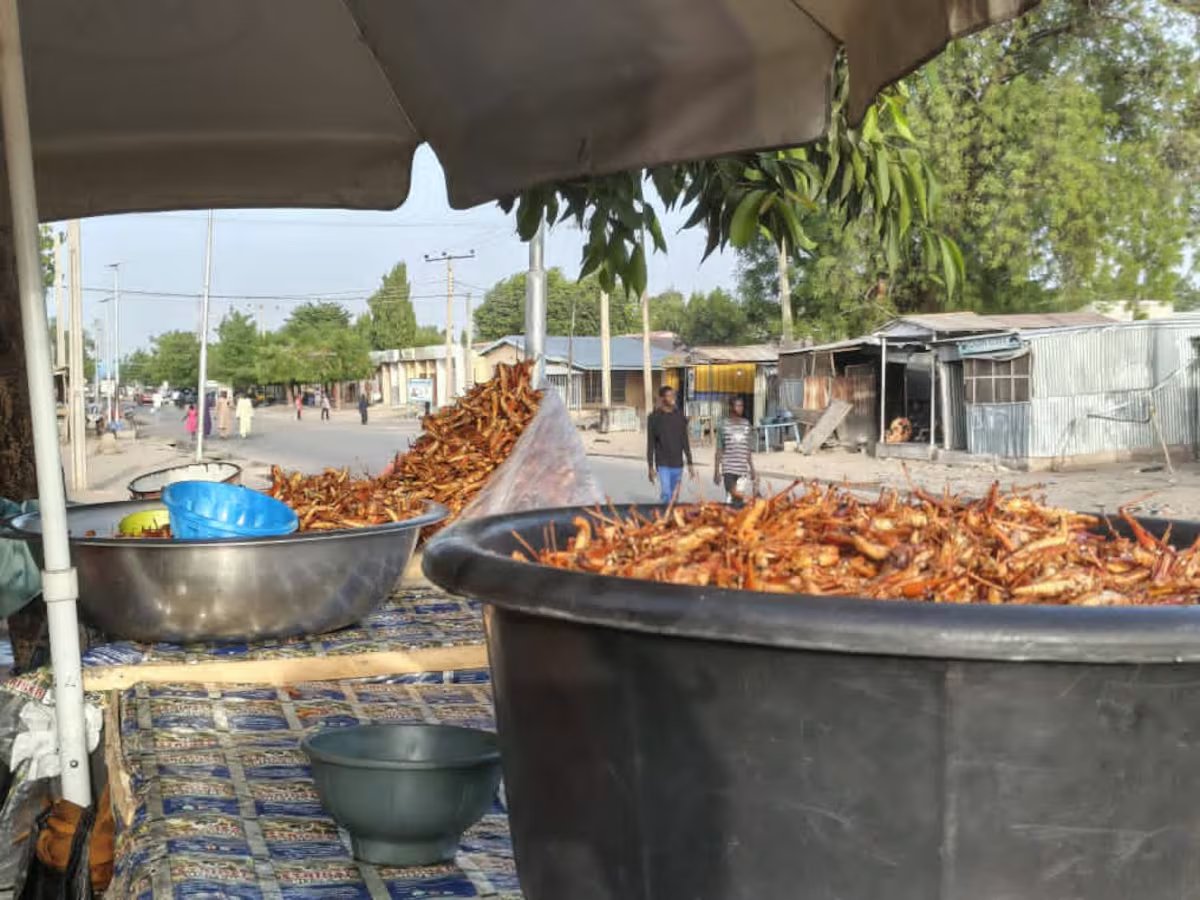
Every morning in Wulari, a neighborhood of Maiduguri in Borno State, Nigeria, the air fills with the rich aroma of freshly fried grasshoppers. At a small roadside stand, Ayuba Naomi, 35, serves a steady stream of customers who arrive before the first batch is even ready. “Grasshoppers are widely eaten. Our customers have increased. We send to places like Abuja, Lagos, Kano and even to countries such as Saudi Arabia and the United Kingdom,” she says. “When demand is high, especially from customers outside Maiduguri, we can sell around three sacks in a day,” she adds. Some of her buyers also come from neighboring Cameroon.
What for Naomi is an everyday business is part of a widespread practice in some countries with the potential to help address protein shortfalls for much of the world amid climate-driven agricultural decline and population growth. The Food and Agriculture Organization of the United Nations (FAO) estimates that around 2,000 insect species are eaten by some 2 billion people. In Africa, Asia and Latin America they are a regular part of the diet and, in many cases, also a source of income for thousands of families.
Their high protein content and other nutrients, together with lower production costs for some species compared with other animal protein sources, have attracted the interest of researchers and international organizations. They are studying the role insects could play in diversifying diets and improving food security, especially in places where millions of people cannot afford a healthy diet. Some 2.3 billion people worldwide are in that situation, according to the latest annual report on the state of food security.
In Wulari, Naomi prepares them to suit her increasingly diverse customers. First she sun-dries the raw grasshoppers, then removes the intestines, wings, limbs and hind legs before washing them thoroughly. “Some retailers ask for them already fried and we pack and seal them in boxes that they then import into their country. For some, we parboil and sun-dry them and then pack them in sacks. They then fry them themselves there,” she explains as she places the next batch of grasshoppers into hot peanut oil.
Some retailers ask for them already fried and we pack and seal them in boxes. For some, we parboil and sun-dry them and then pack them in sacks. They then fry them themselves
Ayuba Naomi, who runs a grasshopper sale business
Much of the insect trade still operates informally. In Nigeria, the chain that takes grasshoppers from the field to urban markets depends on hundreds of collectors and small traders.
One of them is 40-year-old Babagana Zarami, who has spent a decade catching grasshoppers around Maiduguri. During the rainy season, he and other collectors go out at dusk to traverse wooded areas where the insects are more abundant. “When we go into the forest, we strap a lamp to our forehead, wear hand gloves or plastic bags on our hands, and cover our feet with rice sacks or wear rainboots to guard against snake and other bites,” he explains.
They collect the insects “on tree leaves and on grasses.” “They are difficult to catch now, even after the rainfall period,” Zarami says. He explains that insecurity in some areas has also reduced collectors’ access to places where they were once plentiful. In the past, he says, he could return with up to five sacks of grasshoppers.
Still, the activity continues to sustain a small local economy. In the market, collectors sell 13 kilograms of grasshoppers for about 4,000 nairas (€2.5) to wholesalers, who then distribute them to merchants and retail sellers. The FAO notes that edible insect gathering provides an income source for thousands of people in different regions of the world and can contribute both to food security and rural livelihoods.
Protein-rich insects
Maiduguri is not an isolated case. In countries such as Uganda and Kenya, grasshoppers are also sold in urban markets during collection seasons. In southern Africa, the UN food agency highlights a growing industry around the mopane caterpillar: it is estimated to generate tens of millions of dollars a year, with much of those earnings going to collectors, often rural women with limited resources. In places such as Laos, insect gathering combines household consumption with sales in local markets.
Beyond their economic importance, insects have drawn growing interest for their nutritional value. According to the FAO, their protein content is comparable to conventional meat and they often provide essential amino acids, iron, calcium, B vitamins and polyunsaturated fatty acids.
“Grasshoppers provide high-quality protein comparable to foods such as beef, chicken and fish. They also supply important nutrients such as iron, zinc, calcium and some B-complex vitamins,” Uju Onuorah, an associate researcher at Nutrition Drive for Healthy Diet Initiatives, tells this newspaper.
Grasshoppers provide high-quality protein comparable to foods such as beef, chicken and fish
Uju Onuorah, associate researcher at Nutrition Drive for Healthy Diet Initiatives
“For example, the iron in insects can help reduce the risk of anemia, especially in communities where iron deficiency. And food insecurity is common. In places like Nigeria, where grasshoppers are already eaten in some regions, they can be a practical and affordable way to improve nutrition,” she adds.
The prospect of scaling up consumption has also attracted some researchers’ attention. “Our research shows that we can actually tame these insects and start rearing them in big numbers as an alternative source of protein for our people,” says Philip Nyeko, lead researcher and professor at the College of Agricultural and Environmental Sciences at Makerere University.
The Western idea that eating insects is primitive or barbaric has not encouraged developing countries to prioritize them on the development aid agenda
FAO
However, despite their widespread consumption and growing scientific evidence about their nutritional benefits, insects remain marginal in many official food and nutrition strategies. “The Western idea that eating insects is primitive or barbaric has not encouraged developing countries to give it priority on the development aid agenda,” the FAO notes.
Experts point to several factors. On the one hand, cultural prejudices against eating insects persist. On the other, gaps remain in areas such as production, processing, storage and marketing. The FAO also warns that, as with any other food, edible insects can be associated with food safety risks and require appropriate controls.
“While we know insects are nutritious, there is still not enough large-scale, locally relevant data on long-term safety, nutrient consistency, and best production practices,” Onuorah concludes.
Sign up for our weekly newsletter to get more English-language news coverage from EL PAÍS USA Edition
