
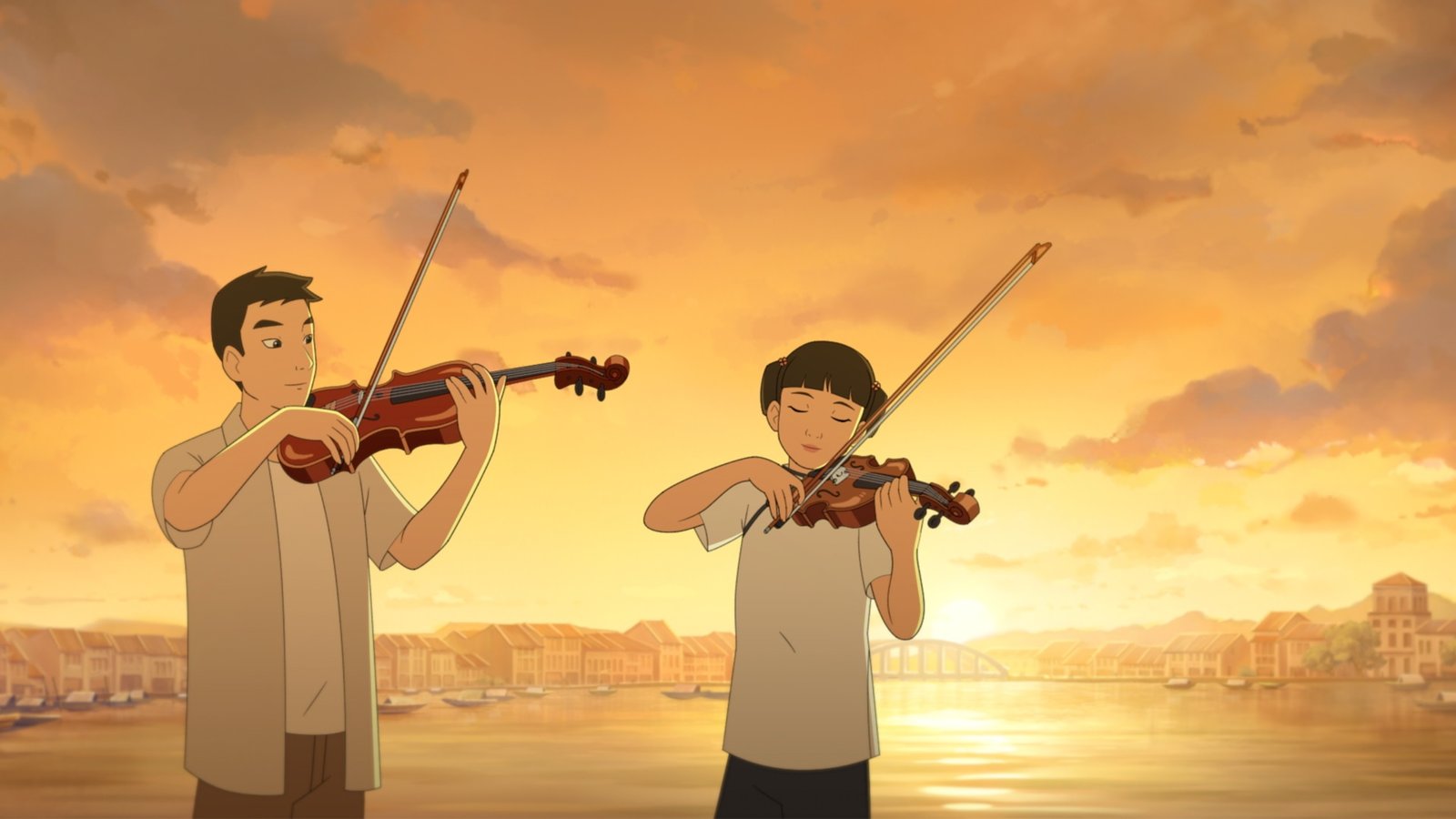
– Ervin Han and Raúl García deliver a film of sweeping temporal scope, blending the intimate with epic war history and with the flame of music guiding the way
“Dreams are the fuel of youth. I don’t know whether they really come true but maybe it’s enough to remember how they began.” It’s a question from a tenacious Spanish journalist in 1982 put to a violin legend born in Singapore which kicks off an enthralling deep dive into the past: “why have you played the same violin for 40 years when you could have had the best Stradivariuses or Guarneris?” The doors to a powerful secret memory are teased open by an old photo unearthed by the music-loving reporter: a black and white portrait of a little girl and a little boy with their violins. Thus begins the seductive movie The Violinist by Singapore’s Ervin Han and Spain’s Raúl García (Extraordinary Tales), which was unveiled in the Official Competition of the 45th Annecy Animated Film Festival.
“Stories and music are all we have.” In 1932 in Singapore, in what was then British Malaysia, young Fei is preparing for her first recital when Kai – an orphan cared for by the household maid – enters into her everyday life. Endowed with the perfect musical ear, the little boy takes himself off to learn to play the violin, with the blessing of Fei’s teacher, and in just a few months, to everyone’s surprise, it turns out he’s a true prodigy. Over the years that follow, having become inseparable, Fei and Kai perform as a duo at an increasing number of small concerts, but, in 1937, the second war between China and Japan breaks out, creeping dangerously closer to Malaysia, until the tragic bombing of the region in July 1941 which acts as a prelude to Japan’s occupation of Singapore (“there wasn’t any light, just darkness, with no hope, no music “). Kai subsequently joins the resistance and goes underground. Will these two friends survive the war? Will they one day play the Sonata of the Setting Sun in D Major which Kai started to compose for their two violins? To what extent can music comfort tormented souls, or better still, become a guide, a flame of peace to illuminate the future?
Cleverly interweaving an individual story with wider history, the screenplay penned by Ervin Han and Jordan K See paints a vast sweeping portrait borrowing from various genres (with its sentimental core, war film components – espionage and attacks by the resistance, meetings with submariners, threats from the Kempeitai (the Japanese Gestapo), etc. -, post-war investigative style…). The story unfolds across 50 years, transporting us from town to jungle by way of concert rooms, and with the guiding thread of music which lends a voice to the myriad emotions felt at the time. It’s a brilliant flashback-crafted film, alternating viewpoints and showing all the signs of an excellent work, which is wonderfully set to music by Ricky Ho and Isabel Latorre, which underscores the value of hand-drawing, and which, just like the violin itself (“the instrument that most resembles a human voice”), firmly anchors the power of hope and the resilience of dreams and art in a world overcome by conflict.
The Violinist was produced by Robot Playground Media (Singapore) together with TV On Producciones (Spain) and Altri Occhi (Italy). France tv distribution are steering world sales.
(Translated from French)
