
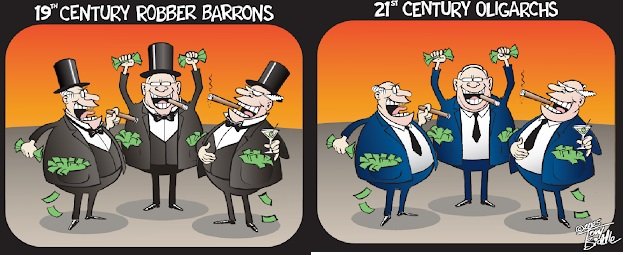
The World’s Biggest Oligarchies
The United States
As we all have seen, the US Oligarchs operate right out in the open. Elon Musk, as CEO of multiple strategic companies including Tesla, SpaceX, and Starlink, has direct contracts with the US Department of War, NASA, and the intelligence community.
He has personally communicated with military officials regarding Starlink deployment in Ukraine and has met with US presidents from both parties. These interactions grant him extraordinary leverage over military communication systems, space policy, and geopolitical decision making.
Musk’s use of social media platforms to shape political discourse, especially after acquiring Twitter, now called X, has amplified his ability to influence elections and public opinion without oversight.
Another powerful figure is Peter Thiel, who co-founded Palantir Technologies. The company has deep ties to the Pentagon, the CIA, and immigration enforcement.
Thiel has been a major donor to political candidates aligned with nationalist and anti-globalist agendas, including President Donald Trump and Vice President J.D. Vance.
Through both philanthropic and corporate channels, Thiel has pushed for policies that serve his ideological vision and economic interests. His influence is not limited to campaign contributions, it extends into the development of surveillance tools, data analytics, and defense procurement strategies.
Jeff Bezos, founder of Amazon and owner of the Washington Post, also exemplifies the convergence of economic power and political access.
Amazon’s lobbying efforts have reshaped labor laws, antitrust policy, and tax regulation.
The company’s deep integration with cloud computing services used by federal agencies, particularly through Amazon Web Services, creates both dependency and influence.
Despite controversies over labor conditions and data privacy, Amazon continues to benefit from favorable regulatory treatment and government procurement contracts.
Bezos’s ownership of a major newspaper allows him direct influence over the public narrative, particularly in Washington, DC, where media and politics are tightly intertwined. In both Canada and the United States, the same pattern emerges, concentrated wealth translates into access, access translates into policy and laws
Russia
The primary example of an oligarchy was born from the post-Soviet fire sale of Russian state assets in the 1990s. Those assets are now thoroughly subordinated to the Kremlin.
Russian President Vladimir Putin’s power and control come from an integration of intelligence services, business cartels, and nationalist paramilitaries.
Putin’s main subordinate oligarchs, Igor Sechin (Rosneft), Gennady Timchenko, are longtime Putin allies with stakes in energy and infrastructure.
Cyprus has become one of the main places for Russian wealth with many Russian Oligarchs establishing businesses and financial structures there, where Cyprus’s “golden visa program” and weak enforcement of regulations have encouraged the influx of Russian money.
India
India has risen from decades of crony capitalism to a full-fledged oligarchy; massive wealth held and being accumulated by a few while many languish in increasing poverty.
It has a corrupt political system dominated and controlled by India’s wealthiest industrialists. India has 205 billionaires.
Prime Minister Nahrendra Modi, a Trump acolyte and a big proponent of trickle down economics, has slashed taxes for the wealthy, has also set up a commission to get rid of unnecessary regulations.
Modi has privatized many public assets and services, claiming “The government has no business being in business.”
Modi’s most influential friend oligarch is billionaire Gautam Adani.
As Modi won term after term, Adani’s fortunes rose too. Adani’s companies have been handed government contracts and in areas where his companies operate, Modi has declared “special economic zones.” In those zones, there are no rules or regulations.
Ninety percent of the work force is in the unorganized sector with no labor laws guiding their employment rights.
The public health system is nearly nonfunctioning in a majority of India. The public education system is in shambles marked by absenteeism of teachers and poor oversight by the administrators.
Access to clean drinking water remains a national issue for some.
Under Prime Minister Modi severe environmental degradation has accelerated as has poverty.
China
The Party-State-Capitalist triad of China’s oligarchy is uniquely institutionalized through the Chinese Communist Party (CCP).
Unlike in Russia or Iran, China’s business elite are deeply embedded within the party hierarchy.
The red capitalist class includes: Zhong Shanshan (bottled water and pharma), Jack Ma (Ali Baba), Pony Ma, Lei Jun.
Tech tycoons are brought to heel when perceived as politically threatening.
The true oligarchs are party princelings children of revolutionary leaders who dominate key sectors.
The party has embraced digital authoritarianism as a tool of social control. Surveillance, nationalism and party loyalty are fused to protect elite privilege while projecting the illusion of unified socialist governance.
Far Right Networks the Oligarch Infantry
Alarmingly, what is happening globally is a merger of corporate and nationalist interests, where far-right idealogues in both formal parties and informal militias serve as ideological and physical enforcers for oligarchs.
These groups operate across borders, share messaging templates, and increasingly coordinate via social media, encrypted channels, and informal international networks.
In the US, groups like Turning Point USA, Project Veritas, and even paramilitary adjacent groups like Proud Boys and Oath Keepers often echo billionaire backed narratives (e.g., Koch, Mercer, Thiel) targeting public regulation, climate action, and democratic norms. Now the far-right evangelical Christian nationalists have gained power and control over the Republican party and President Trump.
Europe
Far right parties like Vox (Spain), Fidesz (Hungary), Law and Justice (Poland), and Alternatives for Deutschland (Germany) maintain informal ties to fossil fuel, agribusiness, and real estate oligarchs, by using anti-immigration and anti-EU rhetoric to weaken regulatory frameworks.
Latin America and Southeast Asia
Similar alliances are emerging. There are reactionary street forces backed by business elites looking to forestall social or land reform.
There is increasing evidence of cross-national collaboration, especially around climate denial, conspiracy culture, and anti-democratic messaging, using Telegram and WhatsApp channels. They participate in international conferences like Conservative Political Action Committees in Brazil and in Hungary, where shared funders are the connective tissue.
Philippines
Far right populism has been used to delegitimize liberal opposition and independent media. Former President Rodrigo Duterte’s drug war and current President Bong Bong Marcos’ revivalism rely on nationalist mythology, historical revisionism, and social media influence operations. They are often funded or backed by these dynasties to distract from systemic inequality and preserve elite dominance
Russia
The far-right, whether in the form of nationalist ideologues like Alexander Dugin or paramilitary outfits, has been instrumentalized to enforce regime loyalty, suppress dissent, and project Russian influence abroad. These groups are increasingly interconnected with European far right parties, providing funding and ideological support.
Yevgeny Prigozhin was famously killed in a plane crash after a failed coup attempt. His Wagner group represented the militarized arm of this oligarchy, as both a foreign policy tool and an internal threat management system. The Wagner group has been broken into four groups fighting for and answering to Moscow.
Far-right networks and oligarchic systems are not merely co-existing; they are increasingly co-dependent.
Whether in Alberta or across Eurasia, oligarchs deploy populist nationalist actors to shield themselves from reform, co-opt democratic institutions, and delegitimize progressive movements.
What is being created is a global reactionary axis, transnational, digitally integrated, ideologically flexible, and ruthlessly self-serving.
It is critically important that journalists understand and chart these power structures and who funds whom. Reporting on the messaging by the far right and who is rewarded is important. It is critical to countering their growing influence.
This is not a war of ideas alone, but a coordinated assault on democratic infrastructure waged by capital and its ideological infantry.
