
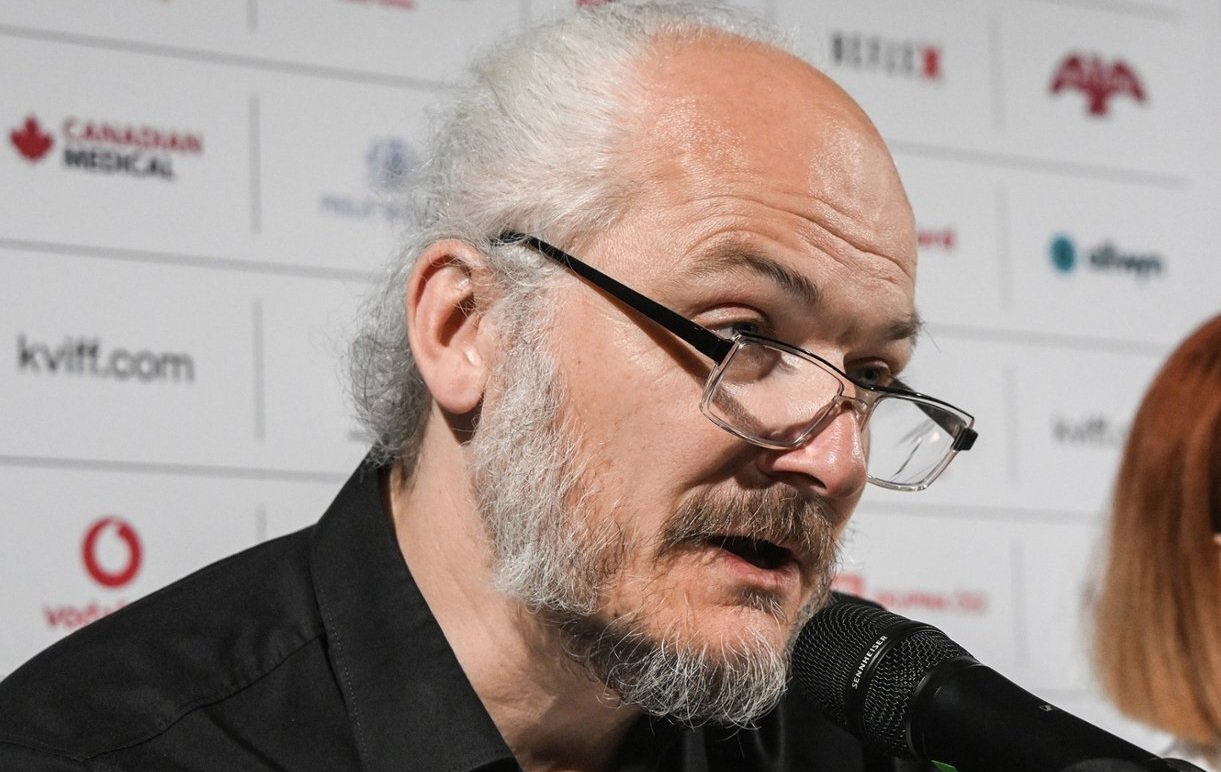
– The artistic director reflects on how the jubilee edition reconnects the Czech festival with its archival legacy and openness to world cinema
(© Film Servis Festival Karlovy Vary)
As the Karlovy Vary International Film Festival (KVIFF, 3-11 July) prepares for its 60th edition (see the news), artistic director Karel Och discusses the jubilee programme, the festival’s historical openness to world cinema, the Proxima competition, and the state of Czech and Slovak cinema.
Cineuropa: The 60th edition naturally invites reflection. How did the anniversary shape this year’s programme?
Karel Och: The most visible manifestation of the anniversary is in the classic part of the programme, specifically in our “Out of the Past” section, which we have devoted entirely this year to films from the history of the Karlovy Vary Festival. From the end of last year, I spent time in the library of the National Film Archive, consulting festival dailies, internal documents, printed materials from the late 1940s and 1950s, brochures, and other archival sources. The primary reason was to gather information for the retrospective and to select the right films, of which there are ultimately 16. There will also be an exhibition of photographs in the Thermal and Pupp [hotels], covering individual editions from the first one in August 1946 to the present day.
Did the jubilee affect the way you approached the official selection?
We did not approach the selection of films for the Crystal Globe Competition or Proxima any differently from previous years. But immersing oneself in archival materials inevitably provokes reflections on what our predecessors did. One figure who came strongly to mind was A M Brousil, one of the festival’s co-founders, who headed programming for almost 40 years. In the early 1960s, he founded the Symposium of New and Young Cinema from Asia, Africa and Latin America. It was a progressive section, presenting films from what were then called developing countries. In that sense, Karlovy Vary was progressive. That historical connection resonates this year. Colombia, Myanmar and Switzerland are appearing in our competitions for the first time.
The programme combines returning filmmakers with new voices. How important is that balance?
It is always a pleasure when, every year, we have at least one or two returning filmmakers in the main programme. Bulgarian duo Petar Valchanov and Kristina Grozeva, who won the festival in 2019 with The Father, are returning to the main competition with Black Money for White Nights. Mark Cousins is also returning. He is very close to us, not only because he won the main prize here two years ago, but also because he has been coming to Karlovy Vary for 15 years with his sophisticated film essays. Šimon Holý is another returning filmmaker. We presented two of his three previous films, and now, with Chica Checa, he will appear in the Grand Hall for the first time. This is a project he had already been thinking about before those earlier films. In a way, it is a life’s project, if one can use that phrase about someone so young.
What does this year’s selection say about Czech and Slovak cinema?
As in previous years, it is very difficult to generalise about Czech cinema. It may be easier to speak about Slovak cinema, where I see, if not a wave, then certainly a strong tendency among young directors, especially female directors, who, together with young producers, are quickly reaching a European level. The two pictures by Slovak filmmakers, Martina Buchelová’s Lover, Not a Fighter, and Anna and Šimon Domček’s 33 Steps, in the Proxima competition are proof of that.
In the Czech Republic, the situation has always been more elusive. The projects that emerge during the year could hardly be more different from one another, which makes any synthesis very complicated. This year, one of my strongest experiences came from Zdeněk Tyc and his City of Fathers. He is certainly not a newcomer. So it seems that, in Czech fiction cinema, this year belongs more to mature, experienced filmmakers than to younger ones. Documentary film is a separate category. In that context, I prefer to speak about Czechoslovak or Slovak-Czech cinema. A beautiful example is the Berlinale-winning documentary If Pigeons Turned to Gold by Pepa Lubojacki, which I think will bring many wonderful moments abroad this year and next.
Bulgaria is currently producing a streak of movies. How do you see its position compared with other European film industries in the region?
Bulgaria is interesting. We have not only Petar Valchanov and Kristina Grozeva, but also filmmakers such as Stephan Komandarev. What they seem to share is the ability to create an understandable shortcut: to communicate, within a feature film, the everyday problems of ordinary people in a way that is legible to Western European viewers. From an Eastern European perspective, that shortcut may sometimes seem slightly simplified. But it helps the films travel without losing their human dimension. By contrast, Poland, despite its size and tradition, has recently not had as rich a festival presence as one might expect. The same is true to some extent of Hungary, unless we are speaking about established filmmakers. Austria, on the other hand, feels more encouraging in terms of younger talents. Through initiatives such as Future Frames, we can already see young German and Austrian filmmakers beginning to move into feature filmmaking.
As the festival enters a new decade, what do you see as the main challenge facing it?
The continuous challenge is to keep satisfying filmmakers as much as possible. At a time when more and more films are being made, it is not easy to stand out. Distribution is extremely difficult, but even on the festival circuit, it is hard. We want to continue bringing films to the audiences for whom they were made. We also want to help cultivate the artistic environment by using movies to offer reflections on the social and political questions shaping the world. I believe festivals in general, and Karlovy Vary specifically, still have the power to create moments of calm, focused discussion about the fundamental questions in our lives.
