
On Thursday, I was among roughly 15 journalists, influencers and industry analysts invited to the headquarters of UnitedHealthcare and Optum in Eden Prairie, Minnesota. When the invitation came a month ago, it was billed as an opportunity for the largest insurance company in the world to showcase how it is leveraging technology (read AI) to improve healthcare and serve patients.
But they weren’t going to announce any news.
No product launch.
No huge partnership.
No sale or purchase of assets.
Just an opportunity for journalists to see the innovations, hear from top executives, including UnitedHealthcare CEO Tim Noel and Optum CEO Dr. Patrick Conway.
It became clear from the invite and the fact that the company had never hosted such an event before, that this was being orchestrated to change hearts and minds — first of skeptical journalists and then, through them, of the broader American public. Anyone who has been following the news since the tragedy of December 2024 involving the company’s former CEO — and the unprecedented and shocking online reaction to that tragedy — will understand why the company is desperate to change the narrative.
But did the company succeed after a day-long session with journalists ranging from marquee organizations like the New York Times and the Wall Street Journal, to industry publications like MedCity News, Fierce, Beckers, to Gen Z-dedicated news organizations like The News Movement and influencers like Dr. Sasha Hadad?
I give the team A+ on the initiative and for taking the risk of inviting journalists in and placing no major restrictions on them. We were allowed to ask as many questions as we wanted, and I, for one, took full advantage. We were never rushed. I don’t believe any journalist got a chance to interview Tim Noel, the current CEO, one-on-one, even though some of us asked. But he and Optum CEO Dr. Patrick Conway spent some time taking questions from us, as did every executive and employee we met later. So kudos to everyone at UnitedHealth Group who participated either actively or passively. We received great Midwestern warmth and hospitality.
I was pleasantly surprised when Noel acknowledged that as a participant in the healthcare system, UnitedHealthcare has an obligation to improve it.
But when it comes to true moral leadership and accountability, I give them a C. A litany of lawsuits filed against UnitedHealthcare and Optum from every conceivable stakeholder — investors, dead patients’ families, employee whistleblowers, health systems, states — was dismissed as “disagreements” or “one-offs.” That term was repeated by the CEO, the COO as well a call-center agent in a bid to dismiss the pure vitriol that the American public feels toward the company. Is all of the vitriol fair? Not at all, but there seemed to be no acknowledgment that some of it comes from real pain and frustration.
And what about product innovation and member resolution services? The company is certainly using AI to improve areas like prior authorization, help patients get better price estimates and provider quality metrics. It is working with partners such as Google to create a robust agentic AI platform that can answer the eternally burning question: Is this covered?
I don’t have the technological prowess to determine how good the answers from the Benefits Inquiry Agent or those from Avery that helps members find doctors among other things are, but if they are good, given UnitedHealthcare’s scale, it will surely benefit members, physicians and customers alike.
As for resolving members’ problems before they get too big, there’s a giant wall with floor-to-ceiling LED screens numbering 35 that monitor customer interactions in real-time and a group of analysts on hand to react when color-coded alerts tell them the acuity of a problem so they can be addressed quickly.
Here’s some notable takeaways from my day in Eden Prairie, headquarters of both UnitedHealthcare and its data analytics, PBM and provider group Optum:
Being the “instrument of change”
“I’ll start by saying that the healthcare system needs to work better and I think anyone who participates in the delivery of care, the payment of care needs to acknowledge the fact that there is room for improvement and if you are part of the healthcare ecosystem, you inherently are part of the problem and need to raise your hand to say that you’re going to be [an] instrument of change and start helping to fix those problems,” Noel said right off the bat in a fireside chat with Dr. Conway that was moderated by Terry Samuel, a former editor of USA Today and a former NPR journalist.
Noel and Dr. Conway (who said he still sees patients part-time) listed improvements the company has been making:
- Optum Health has reduced hospital admission rates by 18%
- ER admissions are down by 11-12%
- UnitedHealthcare is exempting rural providers from most prior authorizations by this fall
- Patient satisfaction is in the 80s and 90s (presumably net promoter scores)
- They have a goal of making 80% of prior authorizations decisions in real time by the end of 2027
Later when Samuel, who now the hosts UnitedHealthcare’s newly launched podcast called Building Better Health, asked why people should trust the company, both Noel and Dr. Conway cited the company’s actions.
Noel said they would have to earn the trust and what he has been doing is going to visit health systems and talking with providers. He added how he is also focusing on standardized processes and building coalitions to further the cause of standardization because those help to reduce frustration.
When asked the same question, Dr. Conway, who oversees Optum Health (its care deliver division), Optum Insight (the data and analytics division) and OptumRx (the PMB division) responded like this:
“I actually said in the senior Optum leadership call yesterday, our say do quotient should be 100% — what we say, we do,” he said.
He added that all the interactions between patients and Optum providers as well as between patients and OptumRx and between other stakeholders in the system and the company should be “delightful” and that builds trust.
Are UnitedHealthcare and Optum credible messengers?
When the fireside opened up for Q&A, I asked the first question to Noel. Here’s the audio
And here’s the unedited transcript of the exchange for those who’d rather read:
Arundhati: So I just wanted to expand upon what Terry talked about — trust. I appreciate what you’re doing and it’s great to have us in here, but the reality is over the last at least year and a half, there are multiple negative headlines. You have patients suing you for alleged wrongful deaths. You have employees suing you for reduced, trying to cut costs and affecting patients poorly. You have states suing you for inflating Medicaid codes to get better payment. You have health systems suing you for underpaying Medicare Advantage claims. So how are you a credible messenger of “this is a new United and we care about patients” because so far the history has not been very great.
Noel: Yeah. We obviously are commercial standing in the marketplace and with the industry that’s complex and you have multiple participants, health systems, care providers, patients, regulatory bodies, federal at the state level. In instances that can be incredibly nuanced, there are going to be commercial disagreements that occur. But it’s concerning for us. And when there are instances where we feel like there are things we can do better, particularly on the member side, I think we’ve held ourselves accountable to that. Another thing we’re doing on the trust and reputation side is we’ve moved to a more transparent mindset. We published the results of our medical prior authorization programs to our website at the end of March and we’re going to be doing something similar on the pharmacy side as well. Because at the end of the day and when you really look at how we perform on audits that are performed by all these bodies, we perform really, really well.
So when you do a full and complete rendering of how we’re actually performing and you get into the actual results, we do well. But I do think we need to take lead to be able to show the totality of our performance because these one-off scenarios that you’re talking about are ones that call into question is the totality of what they’re doing broken or wrong and stepping forward and showing this information proactively builds transparency and then accountability to the work that we’re doing. We’re comfortable with the totality of that. And we’re also, when we’ve had to state our case, we have done well.
Arundhati: If these are one-off, as you suggest, why are senators Josh Hawley and Senator Warren, two from different parties, coming together to break up big medicine? It seems like the problem is much more acute than you’re describing.
Noel: Yeah. I mean, I think I stand in previous conversation. There’s always going to be commercial disagreements. There are all political beliefs and sometimes there is consistency amongst what those are on the left and on the right side. But for us, we’re working in a construct that’s complex and we conform to those rules. A lot of times with the case of certain folks in DC, they actually don’t like the rules and that’s really what they’re taking issue with. It’s not the conformity of entities involved in that system’s ability to actually follow the rules. It’s more they don’t like the rules. And we play by the rules that are set, but there’s sometimes a lack of consistency on whether or not those in DC think that they’re the right ones.
AI innovations and Google’s expertise
Next, we went over to the Situation Room (yes, indeed that is what it’s called) where we saw presentations from different executives who provided overviews of several tech tools. Here are a few notable ones.
- Avery — a chatbot/voice-enabled tech companion, available on the UHC app or by phone (1800-UNITED HEALTHCARE) that can help members search for primary or specialty care physicians based on their location. Avery recommends physicians based on their quality and provides price estimates for whatever service is being searched for. Avery can also secure specialist referrals from the member’s primary care provider right from the app and call the doctor’s office to schedule an appointment. It can also transfer callers who have dialed the 1-800 number to a human customer service agent. One downside: Avery can only speak and understand English, at least today.
“What Siri is to Apple, what Alexa is to Amazon, Avery is to UnitedHealthcare,” explained Prianka Advani, senior vice president, AI Delivery & Telephony, UnitedHealth Group, in her Avery demo.
- Surest — an insurance plan with a companion digital app that provides upfront copays and no deductibles. This AI-driven tool aims to steer members towards the most effective care in a given market and aims to consolidate billing for various services tied to treating a condition into one bill instead of peppering the patient with multiple ones.
“So if they’re having a surgery done and there’s an anesthesiologist that comes in and potentially they’re in network or out of network and the member would get different bills historically. We bundle that all together so the consumer simply and transparently knows exactly what the cost of that service is going to be,” said Craig Kurtzweil, chief data & analytics officer, UnitedHealthcare, Employer & Individual.
The “most effective care” and copay calculation is based on three years worth of data that the company has collected on physician performance and practice patterns — the so-called secret sauce — so that patients are being steered toward a list of providers that provide high quality care whether they are an Optum provider or not, Kurtzweil explained.
“It’s a simple bundle copay that they know exactly what it’s going to cost before they even schedule the appointment and it saves them a bunch of money. So anywhere from 20 to 40% of savings to the member in out-of-pocket costs,” he said.
Currently, UnitedHealthcare has more than 1 million members on this AI-enabled plan design.
- Value Connect — While the above two pieces of technology are aimed at helping patients connect with quality physicians and understand the costs of services upfront, Value Connect aims to provide data to clinical, operational and financial teams to aide in the shift to value-based care. For instance, the AI-driven tool can identify high risk, chronic disease patients and help care coordinators engage patients with different care services so that they don’t end up in the ER. That way better care is delivered at a lower cost and outcomes are improved. This tool aims to allow more effective collaboration between payers and providers. Currently 20 out of the nation’s 25 largest health plans are using this tool as well as 15 providers, said Julie Durham, CIO, Optum Insight and Applied AI, UnitedHealth Group.
- Google partnership and Optum Benefits Inquiry Agent — Earlier this year, Optum expanded its collaboration with Google tied to its Optum Real product, with the goal of lowering administrative burden on providers and boosting real-time, digital payer-provider interactions. The goal is to reduce and even eliminate unnecessary phone calls and manual follow-up.
Optum Real is an AI-enabled platform designed to reduce administrative burden and call center demand for payers.
At the event, Sandeep Dadlani, CEO of Optum Insight, explained that Google will be supporting the creation of the Optum Benefit Inquiry Agent, to solve the burning question in healthcare: Is this covered? That is a question that drives a lot of call-center volume. Aashima Gupta, global director with Google Cloud’s Global Healthcare Solutions group, explained that Google will be supporting the agentic platform to make sure that there are guardrails and to gather the data that are in different places for the agent to be able to answer queries accurately and with certainty.
However, don’t expect the age-old pre-recorded disclaimer “This is not a guarantee of benefits” to go away anytime soon even when the AI agent is answering questions.
The wall of tech
If the Situation Room at Optum’s headquarters looked like the curved CNN Magic Wall on Presidential Election Nights, the Consumer Operations Vitals and Experience was like a data wonk’s dream. From the Optum headquarters, we took a bus to UnitedHealthcare’s headquarters, where this wall was erected. It was in a room that had roughly a 15-20-foot ceiling. Scores of young employees plugged away at their screens while facing a wall of 35 LED screens stretched from the floor to ceiling and from one wall to another.
What were the screens monitoring? The member experience of nearly all 50 million UnitedHealthcare members in consumer facing tools, including the app, portal, surveys and phone calls.
“We’re looking at click streams on our portal and our app. Our monitoring covers around 95% of any journey a member can take on those digital assets and we’re looking for behaviors like changes in frustration. Are they starting to rage click on a link? Are they scrolling up and down on the page? Are they clicking the retry button?” said Liv Murphy, senior director, Consumer Operations Vitals & Experience, UnitedHealthcare. “We’re looking for the anomaly. We’re looking for the behavior change. So when a member or a group of members starts calling us more often, when they’re sentiment or their mood, their tonality on the call starts to decline. When there are calls post login … when they call us within 24 hours of being on our website is increasing transfer rates, all of those things we would call non-obvious signals of frustration from our members.”
If an anomaly is detected, not an individual anomaly but something that manifests a bit more broadly, then the analysts on the team can research the problem and try to solve it.
“So for example, Estradiol, there’s a shortage for the Estradiol medication right now that members are facing. We picked up increased call rates from members saying, ‘My prescription was denied. I can’t get this.’ So it’s all due to an FDA change removing a label, but demand went up, supply stayed the same,” Murphy said. “So we’re keeping an eye on that and trying to make sure our members are getting alternatives. We’re also monitoring our providers to see if they need any assistance in getting members alternatives in this sense.”
If things become too problematic, color-coded alerts show up in red, orange and yellow on this tech crisis wall.
“We’re trying to keep frustration from entering the system. So we alert our consumer resolution partners, our ops partners, command center, other teams. And the outcome of that is we’ve been able to protect millions of experiences in doing so in this pathway since we launched,” Murphy said.
Except of course when the Change Healthcare debacle occurred in February 2024. That’s when the wall was all red, Murphy recalled when asked, noting that the incident happened less than a month after Consumer Operations Vitals and Experience launched.
“Girlfriend, I got you”
The part of the day that was perhaps designed to be the most authentic also turned out to be repetitive, redundant, and a bit forced. Three customer service agents who are internally referred to as “advocates” shared their stories of helping patients through really difficult moments.
“I’ve helped plenty of members with helping them find food, utilities, housing, other resources as well,” explained Daniel Vacura, advocate, Community & State, UnitedHealthcare. “And then with my role, I’m a navigator, so I make outbound calls. I reach out to close gaps in care. I help them schedule an annual wellness visit, get them that new primary care physician, which is awesome.”
Fatimah Alcine, advocate for the Employer & Individual markets, UnitedHealthcare, shared the story of a member, in the last stages of kidney failure, who had called frantically after her medication was denied. Alcine felt empathy for her given that she battles her own chronic condition.
“When you don’t have a medication,when you have a chronic illness, that’s a total step back,” she explained. “Just for one day not taking your medication [can] set you back two, three months. So by me hearing that at that point I was like, ‘Oh no.’ In my head I’m like, ‘Girlfriend, I got you. We are going to get this figure out.’”
And so she did by calling the member’s employer’s human resources and its pharmacy benefit manager and several managers there to get an eligibility update done in real time. That reactivated her plan and the pharmacy was not only able to dispense the medication that day, but at a cost that was about 95% cheaper than what she had been paying — going from $500 per month to $25 using the new copay card that Alcine was able to dig up.
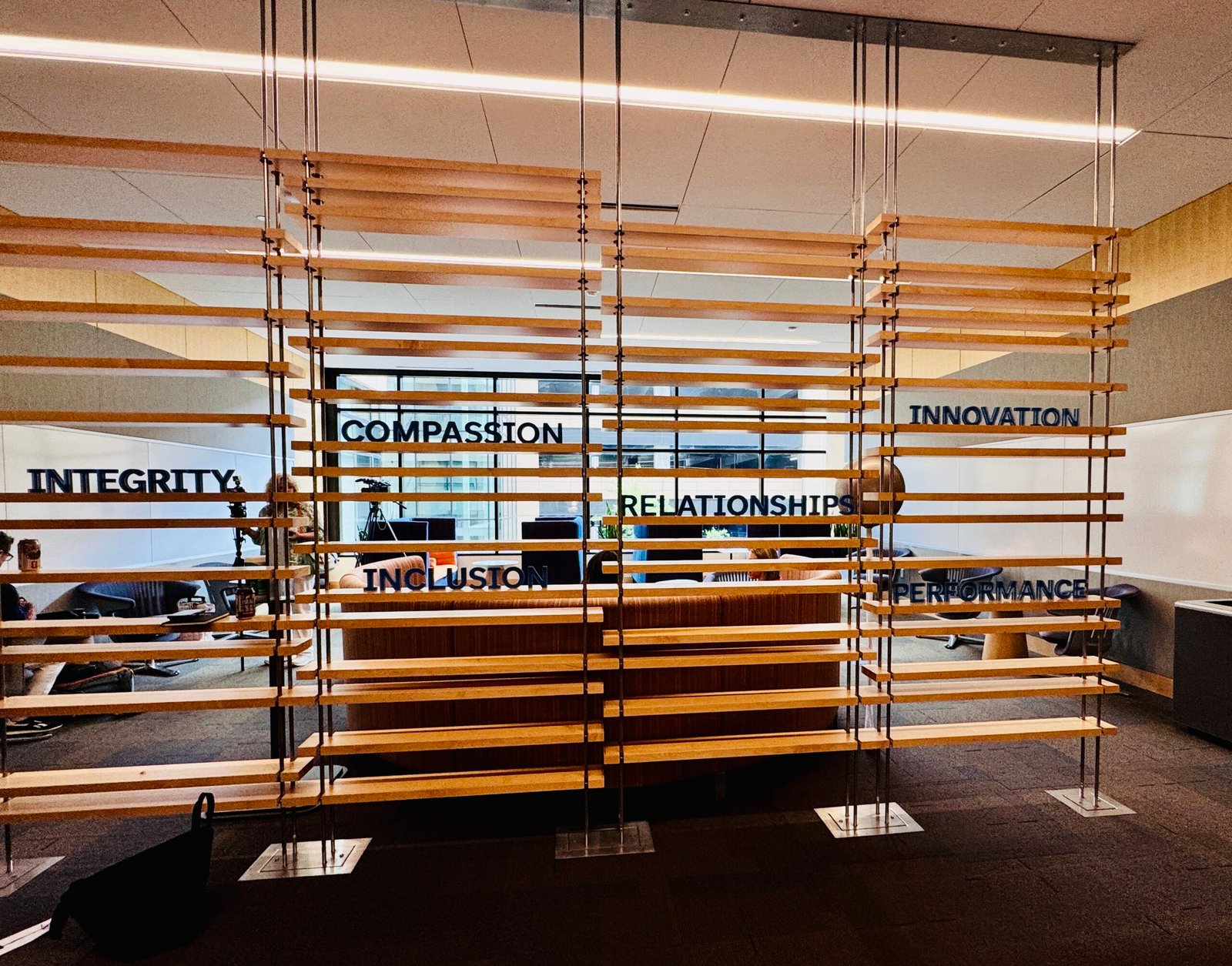
These customer representatives are fielding calls that could easily turn hostile depending on the intensity of the frustration the caller is facing, but all three said that they are motivated by what they describe as UnitedHealthcare’s ideals of compassion, integrity and inclusion — words that were displayed on a partition area inside that building.
All three want to change the narrative — it appeared to be that they want to push back against opinions they think people have developed wrongly, all from being on social media.
My takeaways
Did we see and do all that we wanted to at the event? No. Did we get to have some hands on use of tech as was implied in our day’s agenda? No. Passively listening to tech presentations even with Q&A is not the same as taking the tech for a whirl. I would advise that next time around, they consider allowing a journalist to call Avery or the Optum Benefits Inquiry Agent and see how the tools perform. This other company did.
UnitedHealthcare’s overwhelming motivation and message seemed to be “We are committed to transparency, we truly help our members with all this great technology, see how compassionate our advocates are. But we are misunderstood. So if we let people in through the doors, they will see just how great we are.”
I was appreciative of the gesture of transparency in inviting us in, of all the tools and technology being developed to reduce friction and frustration.
But that’s not enough.
We also need moral leadership from senior executives at the world’s largest healthcare insurer and employer of providers. If that occurs, perhaps there will be fewer negative headlines around corporate actions tied to its financial motivations.
This event seems to imply that we have a new UnitedHealthcare with a more open culture. Can the new UnitedHealthcare serve patients and providers well enough to change hearts and minds while simultaneously pleasing Wall Street?
We shall see.
