
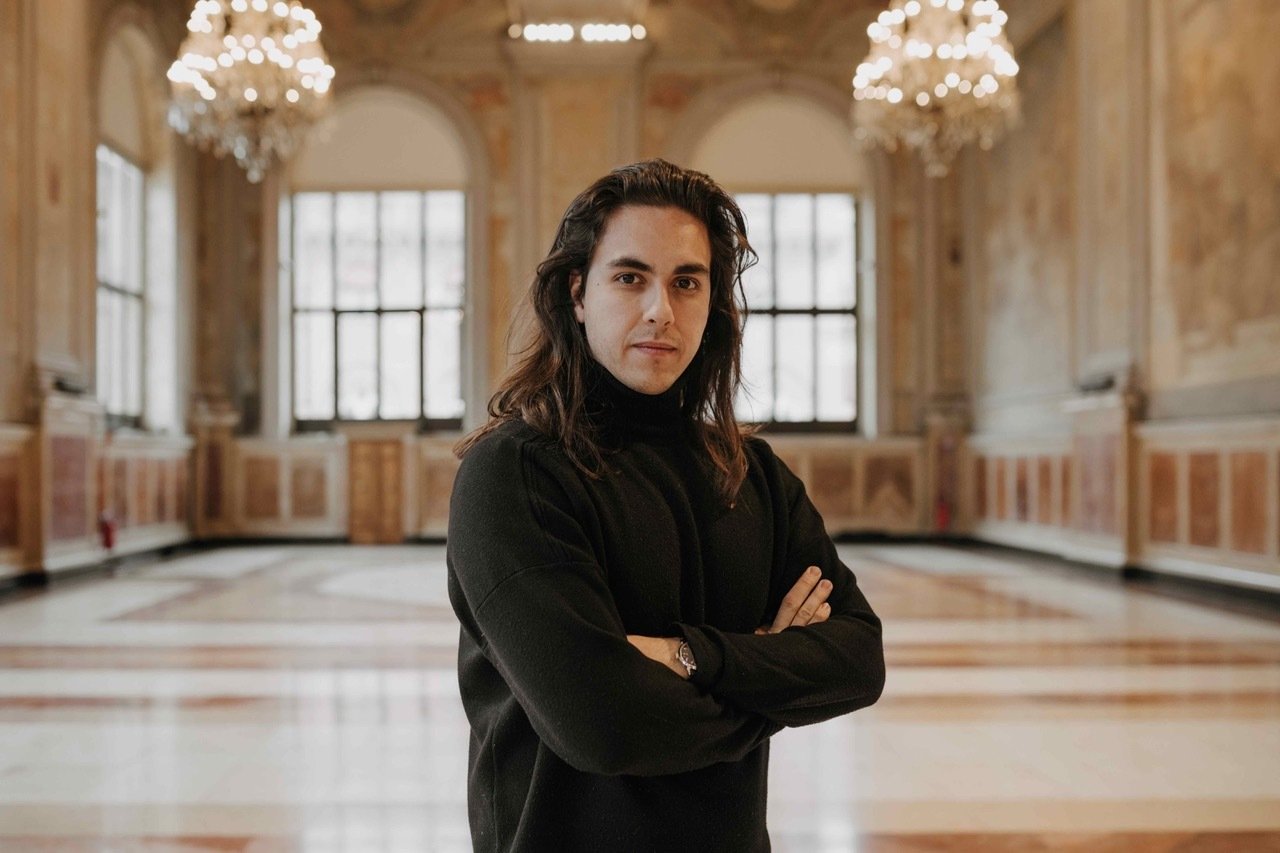
– The Czech filmmaker speaks about the origins of the project, the construction of its secret society and why he sees manipulation itself as the movie’s true protagonist
Czech filmmaker David Balda emerged as one of the youngest directors when his first feature, Intruder, was released in cinemas when he was just 18 years old. Still in the early stages of his career, Balda has finished his sophomore feature, Manipulation, with an international cast. Its recent premiere in Germany, through Filmwelt Verleihagentur GmbH, will be followed by theatrical releases in Poland, the Czech Republic, Slovakia and the UK.
Balda spoke to Cineuropa about the origins of the project, the construction of its secret society, working outside public funding structures and why he sees manipulation itself as the film’s true protagonist.
Cineuropa: After Intruder, Manipulation seems like a very different project. Where did it stem from?
David Balda: It is different, but there is also a connection. The reason I make films is still the same: I want to convey to my generation, and others, some kind of message. Intruder was about flying, but its real motif was freedom, the desire for freedom, and how fragile it is. After it came out in 2019, I asked myself what should come next. Freedom is fundamental, and manipulation is everywhere around us. We met people who had been in sects or closed communities, as well as priests and others with experience of these structures. I did not want to show manipulation through politics or the media, because those things change. I wanted to show the mechanism itself. That mechanism worked 1,000 years ago, and it will work in 100 years’ time.
Did you base the secret society on a real organisation?
No; we did not take one group and copy it. There is the Roman Catholic Church, but we absolutely do not present it as a sect. There is a certain order inside the Church pushing it in a particular direction. Then there is the main power structure, the society around the Grand Master. We created our own society from principles that these structures often share: hierarchy, rituals, symbols, the feeling of being exceptional and the desire for power. From the outside, the secret society and the church structure seem different. But in the end, they want the same thing: power, influence and control.
How did you build the screenplay?
We had something I called a screenwriting consortium – there were four of us. I was the youngest, and the oldest member was 80. We wrote the dialogue by having a dialogue among ourselves: teasing each other, challenging each other, arguing things through. From the beginning, we knew we did not want to make the film only for Czech and Slovak audiences. The subject is universal. We had foreign actors in mind early, and some roles were written with them in mind. But I did not want the movie to rest only on Matteo. For me, there are several leading roles: the manipulators, who are trying to steal the main role from each other. The main character should be manipulation itself.
The film was privately financed. How difficult was that?
The feature did not receive a single Czech crown from public budgets. I am the producer through my own company. It is primarily private investors, mostly from the real-estate business, who invested for a share of the film’s income. COVID-19 delayed everything. We were writing in 2019 and 2020, and bringing foreign actors into the Czech Republic was impossible. We shot in 2023 and 2024. That is why international strategy mattered. If I had asked investors to support a Czech film only for the Czech market, I would have been misleading them. We had actors known in specific countries and a subject with international potential. Film is always risky, but this reduced the risk.
You served as director, producer, co-writer and cinematographer. Why keep so much control?
I can only make a film if I am also the producer. I am open to ideas, but I never want a producer to say: “Put this actor in the role because he is our friend.” I need to feel free. Of course, I carry the risk on my shoulders. If I cast someone badly, that is my responsibility. But I do not want to be a director for hire. It is also practical: if a location does not work, I can make a decision as director, producer and co-writer. I know where I can move to and how to react. But it is an enormous amount of work because the film is your child, and if it is released internationally, it has to look like it.
How did you assemble and work with the international cast?
I knew all of the actors I approached from films, or I had them in mind in some way. The first criterion was always what they could bring as actors. But of course, they also had to be useful for the film in the territories where we wanted to release it. Pawel Delag is a major star in Poland, Heino Ferch is an extraordinary name in Germany, James Faulkner in Britain, the French actors in France – it all had a logic to it. But we also wanted a Czech presence. I think Pavel Kříž has matured beautifully, and he is very good in the film.
How did you define the visual style?
I think in terms of atmosphere. You can have the best dialogue in the world, but without atmosphere, it will not work. The style came from the locations. We shot Prague mostly at night, so it became empty and beautiful. Bologna has another energy: history, symbolism and transcendence on one side, and students and young energy on the other. I do not use storyboards. I write down the shots, but I work through emotion and space. Once I arrive on location, half of the preparation changes.
Are you already preparing your next film?
I have started writing it. The next movie should be about the idea that if you want to be successful and get to the top, you can choose a dirty path that is faster or a clean path that is slower. It is about how you decide and what your moral values are.
