
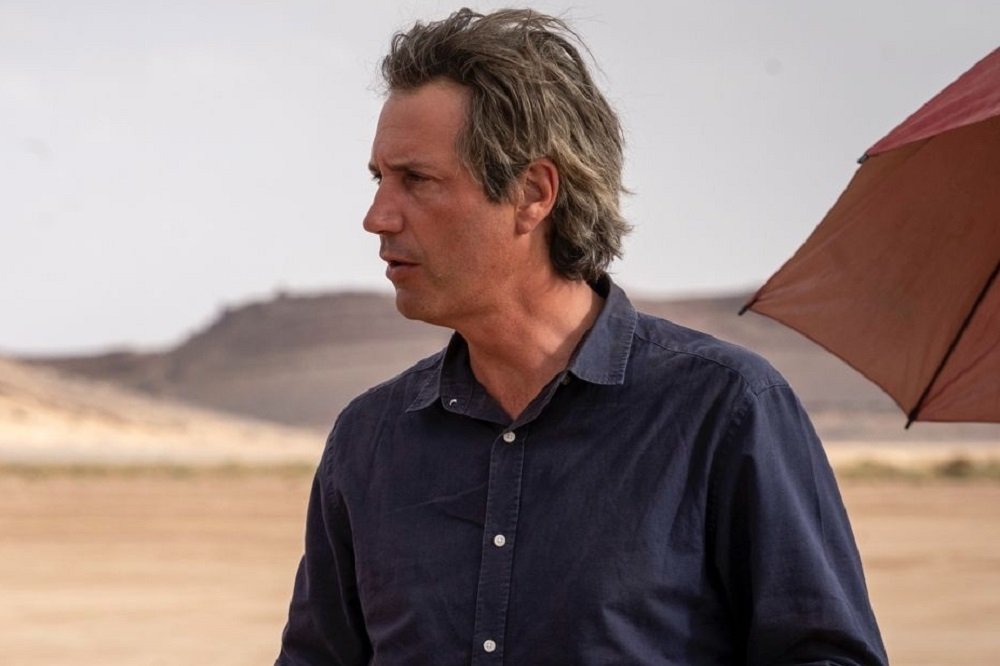
“The important thing for me was to demystify de Gaulle, to rediscover the man behind the legend”
– The French director discusses his ambitious two-part series on General Charles de Gaulle’s years of fighting for Free France
Last May, Antonin Baudry presented, out-of-competition at the Cannes Film Festival, the first part of the two-part series De Gaulle: Résistance and De Gaulle: Liberté, which recounts the General’s struggle between 1940 and 1944 for Free France, as he refused to surrender to the enemy and, above all, to collaborate. A truly monumental project, as spectacular as it is epic, quite different in style from the typical French biopic, and featuring a unique release strategy, with the two parts hitting cinemas one month apart. The filmmaker, who made his name with The Wolf’s Call, looks back on this adventure with us on the eve of the second instalment’s release in France on 26 June, a few weeks after the first instalment’s release on 3 June.
Cineuropa: How did this project come about?
Antonin Baudry: I love adventure films, and when I came across the story of the Free French Forces – so epic, colourful and full of twists and turns, a story where they are constantly a hair’s breadth away from defeat – I thought to myself that this was fertile ground, especially as it is a struggle for hope and freedom. Together with my co-author, Bérénice Villa, who is also a historian, we spent over a year researching the subject. When I heard the letter that Fernand Bonnier de la Chapelle, a young Resistance fighter, had written to his father before being shot, it was a real turning point. We built the narrative around two central characters: the General and this young Resistance fighter, who, though on their last legs, were trying to create a different France from the one that had capitulated.
De Gaulle is the driving force, but the struggle is being waged on various fronts.
The question is whether Free France will be able to save France. There is the battlefield against the Germans, in Africa; there is the arena of the domestic Resistance in occupied France; and then there is a third realm, a profoundly human one, that of relations between heads of state and the balance of power. They all act in unison, which I find appealing from a cinematic perspective. De Gaulle coordinates the first two, but he is particularly active in the third.
How did you approach the character of de Gaulle?
The important thing for me was to demystify him, to rediscover the human being behind the legend. It’s not the icon that interests me; I want to see someone who has doubts, yet who, despite everything, overcomes the obstacles standing in his way; I want to know how he does it, what makes him different at that moment, and where he draws his strength from. Faced with a near-impossible mission, for which he often fights alone, I want to understand why he persists. His main characteristic is his inflexibility. He never compromises. He is very fallible; he is paralysed at the thought of speaking in public; he doesn’t know a word of English when he arrives in London; he even contemplates suicide – but despite all that, he perseveres. For me, it’s a lesson: no matter who he is or where he comes from, he sets himself an ideal and sticks to it – and that will transform him.
De Gaulle: Résistance is a spectacular, epic film, but one that seems to have deliberately chosen not to belong to any particular genre.
For me, it’s first and foremost an adventure film, but it goes without saying that I didn’t want to rule anything out, and certainly didn’t want to limit myself to a single genre, be it a war film or anything else. And then, constantly being on the verge of tears and laughter at the same time – that’s my way of seeing the world, and it’s surely reflected in the way I film.
The film stands out from other films about the Second World War because it focuses on the struggle for France’s sovereignty rather than on the fight against Germany.
Most of these films were made by Americans, and generally speaking, we find ourselves caught up in their narrative – this idea that Europeans killed one another because of their own demons and that the Americans came to save us, helping us to be reasonable and to modernise. But that is their history, not ours, and I found it interesting to try to reclaim our history by telling it from the perspective of those who lived through it.
The main setting for the war action in the film is Africa.
Yes, much of the war was fought in North Africa. I believe that two-thirds of the Free French forces came from Africa, but also from Polynesia and the West Indies. These soldiers played an absolutely decisive role in France’s fate. Similarly, France would not have regained its freedom without the contribution of its young people. The first stirrings of the Free French were those school pupils who rose up, risking their lives to resist the Nazi occupiers. But even Jean Moulin was very young, as was General Leclerc. It was almost as if, faced with a France on its last legs, a younger France had rallied to say ‘no’.
(Translated from French)
