
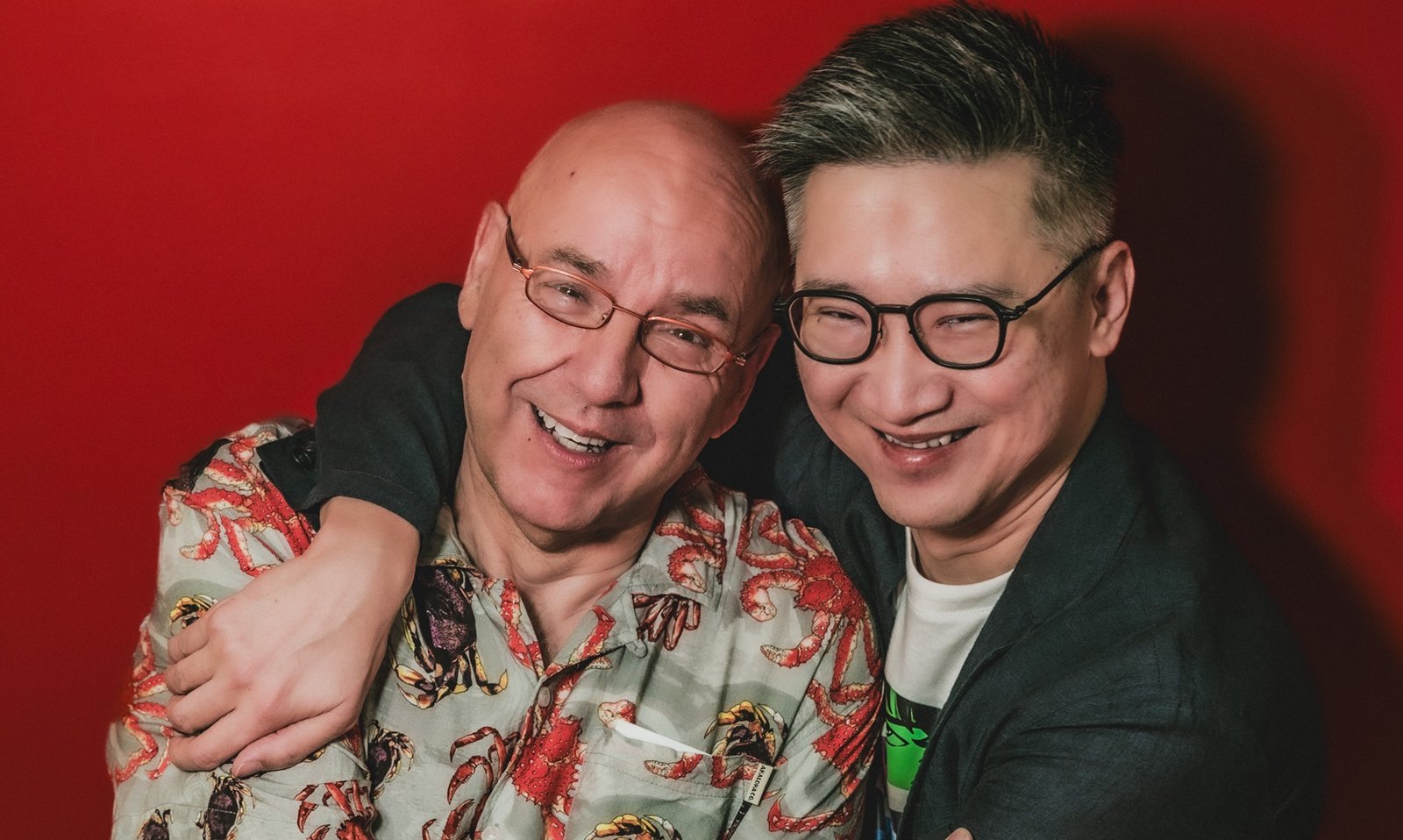
– The directors break down their animation, in which a nosy reporter gets to meet a famous violinist, and hear her story about love, war and her priceless instrument
Raúl García (left) and Ervin Han (© Annecy Festival/F Murarotto)
In The Violinist, freshly awarded the Annecy Film Festival’s Crystal for Best Feature Film (see the news), a nosy reporter finally gets to meet a famous violinist – and hear her story about love, war and her priceless instrument that starts in 1930s Singapore. Directors Ervin Han and Raúl García tell us more.
Cineuropa: There’s something very big about the scale of this story. You have war, and you have this decades-long love story. Were you afraid of it?
Raúl García: Well, if there’s anything that animation can do, it’s to tell epic stories without the problems of live action, such as extras, casting and location. For us, when we thought about the story, the only limit was our imagination. In this case, it was Ervin’s imagination because he wrote the script.
Ervin Han: I was always aware it’s almost 80 years, three different eras and a big conflict in the middle. But I was never too worried about it, or worried that it would grow too big, because what always held the story together was a sense of intimacy and restraint in the characters. Much of the storytelling is done through the music. It changes its rhythm and its texture, and you almost don’t think about the scale so much.
RG: Basically, we’re telling a love story: a very small, human story. It’s just that the canvas we use is so huge.
EH: It’s also about historical memory and time, and I think we respond quite instinctively to that as human beings. We all have our memories, our sense of how time passes. I hope the scale is not a distraction.
There’s something about this film that brings to mind historical epics from the 1990s – it’s something that Spielberg could have done. Were you also thinking of films from past eras?
EH: There are a few movies we’ve always talked about. It might not be a surprise to you, but one of them is The Pianist. It had that sense of music being an anchor for humanity, and a source of comfort and dignity during wartime.
RG: Then there was Millennium Actress.
EH: It’s an animation by Satoshi Kon, who only made seven films. These two inspired us very early on. Some people have told us there’s a resemblance to Titanic, too, in terms of the bookends. Then, more recently, we’ve heard that the ending felt like La La Land!
RG: I thought more about The Umbrellas of Cherbourg. When you make a movie, consciously or unconsciously, you end up paying homage to the people who came before you, and everything that affected you and influenced the way you are.
When it comes to the music, you really had to make sure this was the biggest thing here. Everything that happens, happens because of music.
EH: We’ve always seen the music as another character: a character that grows. From the first moment we hear certain themes, it changes as the characters go through the events in the film, until the very end of it, when a two-violin sonata becomes a full concerto. It took about a year to compose, but the work started very early.
RG: We decided to divide the music into three different themes. One is that major sonata that becomes the leitmotif – it’s about their love story. Then we have the “action music”, reflecting the fear and the war, and the classical music played throughout the film. Tchaikovsky’s Violin Concerto is one of our favourites.
EH: Our composer, Joseba Beristain, was so clever in arranging some of these classics and weaving in our original themes. He had fun with that, but it was also very challenging. I don’t really know music, and I don’t play any instruments, so music is a very mystical thing. We don’t understand how it works, but we know how it makes us feel. I think that’s all that matters.
RG: We wanted the film to be believable, so one of the things we insisted on from day one was that the character had to play the violin. The movements had to be right. In live-action movies, you see people playing piano or guitar, and it doesn’t work. Even in Amadeus, there are a couple of moments like that. We paid attention to these little details because that’s what brings these characters to life. It makes you forget you’re watching an animated film. We made a movie that just happened to be animated.
Did you know each other before, or did you come together specifically for this story?
EH: We began as friends, really. Of course, Raúl’s background in animation is legendary. He was a visiting professor at animation school in Singapore some years back, and we talked about working together someday. I was like: “Oh my God, how can I work with this guy who has worked on The Little Mermaid, Fantasia and Who Framed Roger Rabbit?”
RG: He’s too modest. But we hit it off right away, and then he did a series of great short films.
EH: This is my first feature, and I’m 51. It’s our studio’s first feature and Singapore’s first feature in almost 15 years – we don’t have a proper industry yet. I wanted it to be a story about who we are and where we come from – something that could resonate across borders and cultures. At first, I invited Raúl to come on board as animation director, but then the discussions expanded, and we started to think about Spanish co-production.
RG: When I went to teach in Singapore, I didn’t know anything about the culture or the history, and I found it fascinating. We had seen the history of World War II from the European point of view, and most likely from the US point of view, which reduced it to Pearl Harbor and Hiroshima. That’s it.
EH: Many of my European friends or people at markets and festivals are not aware that Southeast Asia was colonised by European countries for hundreds of years. Then the world changed and the empires started to fall, but you don’t see it being portrayed – at least not from a Southeast Asian perspective.
RG: We didn’t want to give a history lesson, but these events affect the way our characters think and the way they act. If after seeing the film someone wants to dig deeper, that would be great.
