
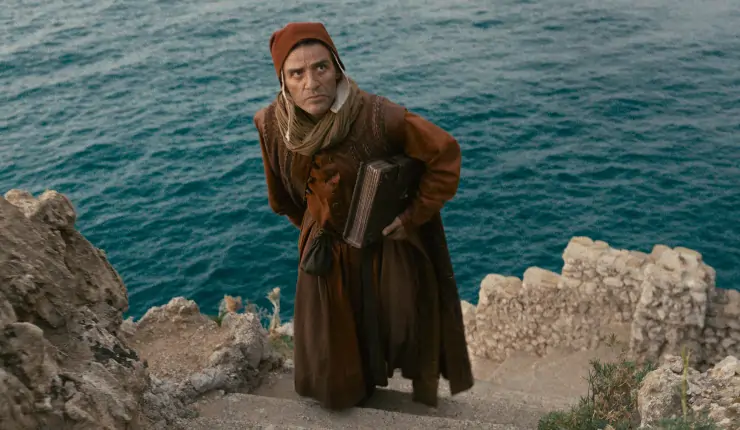
It’s poetic to this film’s existence that, before its world premiere at the Venice Film Festival in September 2025, Julian Schnabel’s half-biopic period piece, half-black-and-white mobster flick, In the Hand of Dante, had a private screener leak online for all the world to watch, yet no one ever really bothered with it. Much was the case with this film’s path to streaming; no Western distributor dared to pick this one up for a theatrical release, and so it got the honourable death of being snatched by Netflix for a straight-to-streaming release, nearly 10 months after its original premiere. Even after its Venice date, no major autumn film festival wanted it in their catalogue either. A perfect statement on the nature of this film, really.
Sitting at a gaping 153 minutes long, this fascinating failure of a film follows a Dante Alighieri scholar who, after a Vatican priest discovers the original manuscript of Dante’s Divine Comedy, sets out to steal it with the help of some gangster allies. Oh, and one other note: in tandem with this story runs a narrative following Dante’s quest in the creation of his masterpiece. The 2001 set half exists in a wide-screen, black-and-white format, with the early 14th-century half in a smaller aspect ratio of colour.
To go with that comes a laughably stacked cast where most play a role in both parts of the film. Oscar Isaac plays the real-life scholar Nick Tosches as well as Dante himself. Gerard Butler, who also stars in the film, makes an appearance as check notes, the Pope in 1300s Italy. The rest of the cast includes John Malkovich, Martin Scorsese donning a massive beard, Al Pacino, Jason Momoa and unfortunately Gal Gadot, who is every bit as lifeless as you’d expect. The film is based on the 2002 book of the same name that Tosches himself wrote, inserting himself into a mob fan-fic parallel to Dante’s story where Nick’s events in this are false; hilarious premise, I know.
Maybe this film was doomed right from the off with source material such as that, but there’s a desperation about the way Schanbel, whose period drama history lies in his Van Gogh biopic At Eternity’s Gate, attempts to draw lines of oral poetry between its two stylistically antithetical parts. Moments of characters in the 2001 segment delivering awkward parables in an attempt to reconstruct Dante’s profound writing in a more modern setting place this at such an uneven angle that it requires such a feat for the audience to get on top of.
Sure, its production and costuming are pretty incredible- credit where credit is due- but the peel-back label of its black-and-white textures left me in derogatory fascination, as its despondent dialogue seeks revelation but only finds the anguish inside of Dante’s Inferno and the ninth circle of hell. I called this film a fascinating failure because the freedom and endless ramblings of its verse are risks taken, as it flies off on tangents and into retrospect within other stories, unbothered by its complete lack of nuance.
Its lack of balance isn’t helped by a series of performances that are mannered as if in a completely different project, which is why the 14th-century segments work, to an extent, by themselves, as their frustrations are more welcome in such a space. Unfortunately, the film spends more of its time in 2001, and draws to a climax that neither satisfies nor fascinates, but bores in its maladroit action sensibilities. Having forgotten its retroactive segments, the film assembles its disconnected set of messages and goes out on a whim of vague romance, championing a banal message about the importance of literature to romantic self-actualisation.
Ultimately, In the Hand of Dante is as confused in its disposition as you or I are; it throws famous faces, superficial texture to its dual imagery, and modernised poetry at a text that never equites to germane peculiarities. Its author vehemently expresses his love for one of the famous works of art out there, but its self-imposed and dissonant sense of fan-fiction never had me feeling anything other than a cold sceptic, as I begged for its as its amateurisms to let go. As Dante struggles to write and actualise Paradiso, one can only laugh, as Schnabel’s film struggles to ever reach a state of critical paradise.
★★
On Netflix now / Oscar Isaac, Gal Gadot, Martin Scorsese, John Malkovich, Gerard Butler, Jason Momoa / Dir: Julian Schnabel / Netflix / 15
Discover more from
Subscribe to get the latest posts sent to your email.
