
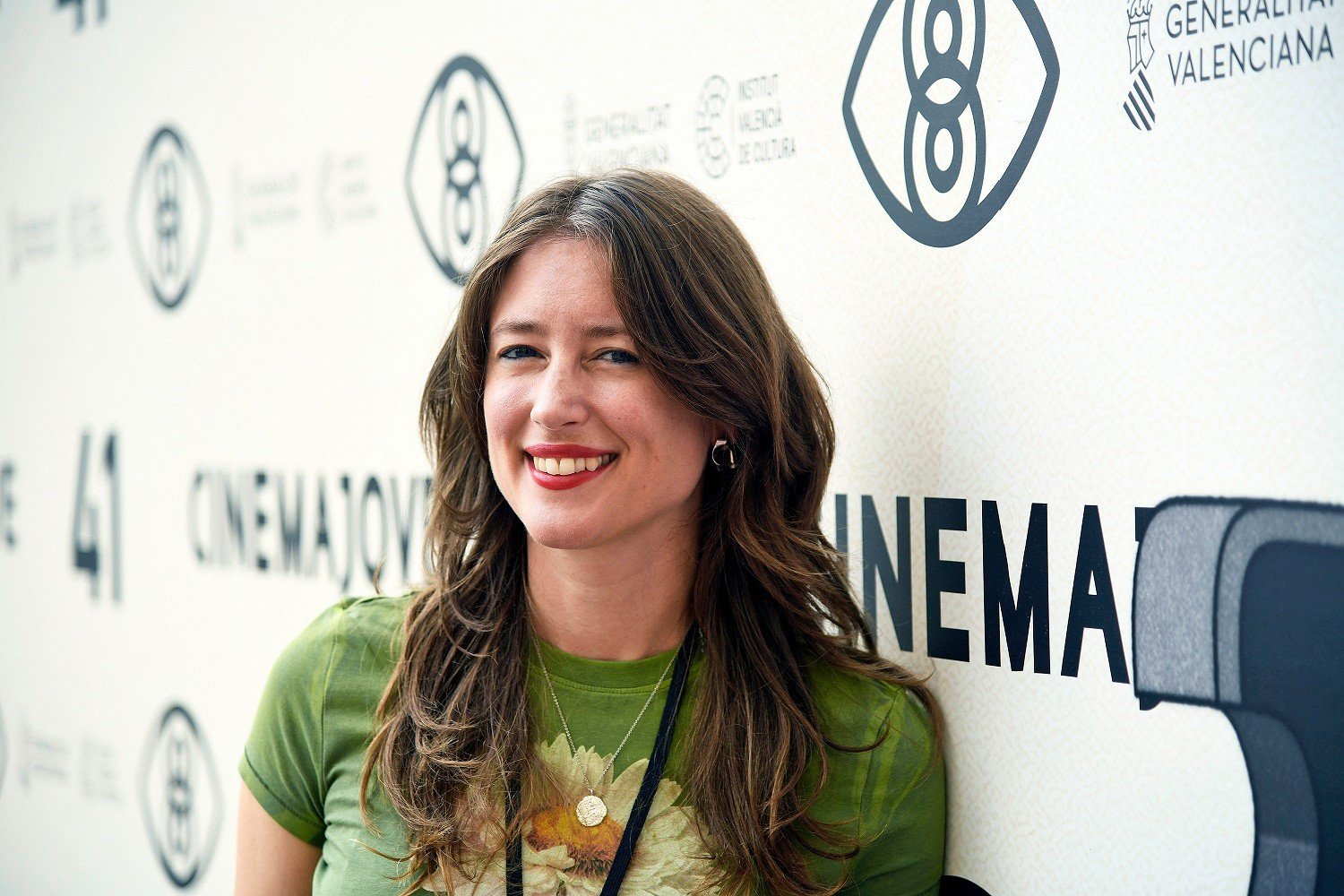
– The Swedish filmmaker talks about her debut film, in which she explores the art world, the dynamics of submission and the need to step outside oneself
(© Cinema Jove)
The 41st edition of the Cinema Jove film festival in Valencia opened with The Patron, the debut feature by Julia Thelin, who visited the city to present the film and, among other things, give this interview.
Cineuropa: The Patron is your first feature film. Was it easy to make it, find a producer and attract people interested in your first film?
Julia Thelin: I already had producers I’d worked with on my short films. The initial idea for the film was also quite easy to explain: a woman convinces two young men that she is a famous, powerful and wealthy art-gallery owner, and takes them to a house to live out that fabricated persona. As a thriller premise – wondering when they’ll discover the truth – it was something that people grasped quickly. But the film’s depth was more difficult to develop in the script, because I wanted to convey so many things. The film is full of ideas, perspectives and different ways of seeing reality. There are no clear-cut answers, and it creates unease because it doesn’t always offer the viewer a sense of security. The audience often wants to feel protected, but when you shake the ground beneath their feet just a little, a certain discomfort arises.
Why did you decide to write about human beings, their capabilities and their limitations?
I’m interested in how we limit one another through our need to control and assert ourselves in relation to others. That need to position ourselves in a way that ensures we’re seen and heard causes certain behaviours. I’m interested in human psychology and why we do certain things. But I also found it beautiful that, most of the time, we trust other people and believe in them. Creating a little illusion is easy, and most people don’t lie. I think that naivety can be a positive thing — something beautiful. I wanted to make an intense film and challenge myself on how to bring the story to a close and tie up all those loose ends.
Are you familiar with the world of contemporary art? The film takes a rather critical view of that, at times elitist, atmosphere.
I did some research into the art world and, certainly, it’s very much like the film – it might even be worse. It’s a place where, if you don’t have a good standing, nobody seems to care about you. When there are worlds that many people want to enter, elitist hierarchies emerge. But the art world is also beautiful because it’s a place where ideas, forms of expression and different ways of perceiving reality are taken seriously.
The protagonist plays on other people’s hopes and dreams in order to manipulate them.
Yes. If I say to you, “I want to pay you 500 million euros for that t-shirt because I’ve been looking for it for years”, even if it’s a joke, part of you wants to believe it. We want to embrace that fantasy. It’s important to live in our dreams a little. I’m not saying we should lose ourselves in them, but they’re also a form of freedom. We’re trapped in our bodies, in our age and in the decisions we’ve made, so imagination becomes escape route.
There is a certain sense of psychological violence in the film. How did you ensure that it wasn’t excessive and that the main character didn’t turn into a monster?
In the script, some parts were more violent and others less so. While working with the actors, we struck a balance because they needed to understand the characters’ motivations and why the violence occurred. It was also a process for me: figuring out when it was necessary and when it wasn’t. That happened during filming.
It’s interesting that you work with just three actors and a house as the setting. Did you rehearse a lot?
Yes, I pushed for rehearsals because it was important. The film depends on the chemistry between the actors. We needed time to discuss each scene and explore it together. We didn’t have much money for the shoot, but we decided to prioritise time over technical equipment. Filming lasted 25 days.
Did you have any mentors or teachers?
I thought about Yorgos Lanthimos’s early films, particularly in terms of how a story can unfold within a house and the dynamics between characters. I also liked Lars von Trier’s The Idiots and Jane Campion’s The Piano. I was interested in female strength, power struggles and violence. I was also inspired by a documentary called The Ceremony by Lina Mannheimer, about a woman who explores different ways of giving or receiving power. Then I watched Funny Games, by Haneke, which was also useful. And I’m fascinated by Polanski’s Knife in the Water, which taught me how to create tension with just three characters.
(Translated from Spanish)
