
“Queerness is accepted in the mainstream only in the context of specific connotations”
– We chatted with the Slovenian filmmaker about his short animated film, which has become a hit on the festival circuit
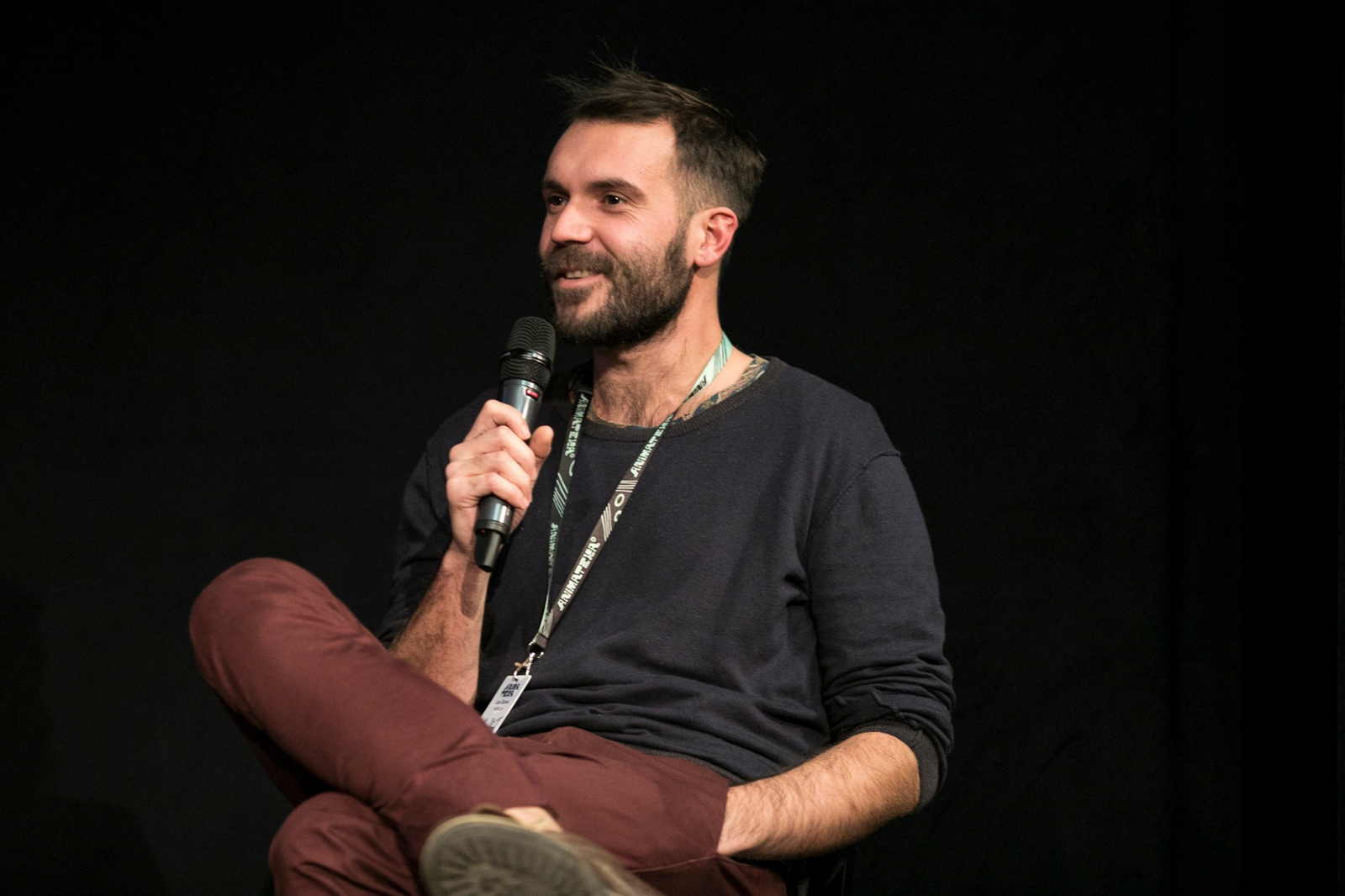
(© Andrej Firm / Animateka)
Slovenian filmmaker Leo Černic’s second short film, Cosmonauts, is an animated sci-fi comedy about an intergalactic singles cruise where lonely passengers search for love, connection… and sex. Lots of sex. Following its premiere in the Berlinale Shorts Competition, the film screened in Animafest’s Grand Competition – Short Film. We chatted with the director about the making of Cosmonauts, finding the balance between comedy and emotion, his visual style and the universal search for connection.
Cineuropa: What inspired you to become an animator in the first place?
Leo Černic: The joy of moving images. I discovered it pretty late in my life. It started with film, live action and documentary, but then somehow I was writing stories that were a bit too ambitious to make them as live action. And then at the same time, I was just starting to draw, and it just went hand in hand.
How long did it take you and your team to make the film, and how did this idea come to you?
From the initial concept, it took us about three and a half years. I’m just obsessive and personally in love with love and all these love mechanisms. That’s why I started with this film, and I was asking myself a lot if love is a consequence of loneliness or if loneliness is a consequence of love.
Can you tell us more about your technique and the editing process?
It was made on a computer as a 2D animation in a traditional way, so it’s hand drawn even though it’s not on paper. The editing process was quite interesting because it was my first time working with an editor. Usually in animation you work horizontally. So that’s why we started editing the film even before producing it with the animatic, which is really, really the first draft of your film. And it was so nice because we had three rounds of editing.
We noticed that the colouring of the film feels rich, but the shadowing also adds to it. How did you decide on that approach?
It’s my style, I guess. I’m so much inspired by modern, underground Italian comics and authors like GP or Zuzu. In general, I just really like this more underground-ish art and what it brings. But I also think this dirtiness is somehow connected with the theme of the film: I thought that the visual form of the film had to be dirty too.
Your story takes place in space. How did you decide on that? Are you into Star Wars or something like that?
No, I’m not at all into Star Wars. I’m much more into Italo Calvino and his Cosmicomics. I think this obsession with space started from him. But it’s also because I can give a creative answer to some questions that I don’t know how to answer scientifically. I really like space because I have no clue about space, but I also really like the melancholy that it brings.
Sound is very important in your film because there’s not a lot of dialogue in it, and there is one Italian song that stands out. Can you tell me more about it?
I’m super happy with the song because I think music is always important and it gives some additional layers to the film. It’s an original song, made just for the film. I really wanted this kind of a nostalgic Sanremo-like ballad that we all know in this region where I come from. So that’s why I chose an Italian song, and also because maybe we have some archetypes in our mind with Italian female singers. I really like the idea of a drag queen cow on a space cruise having their version of a Sanremo song.
Cosmonauts is obviously a queer film. What do you think about the portrayal of queerness in cinema?
I have the feeling that queerness in the mainstream, even though we think that we have reached a level of freedom in being queer and in expressing queerness in filmmaking, is accepted only when it’s somehow polished out and presented in the context of some specific connotations. You know, all this is love rhetoric. Which is OK, it’s true. Love is love, but there is much more if you speak about just the pleasure of having sex and about the bodies. That is something that is still not accepted even in queer mainstream films. I think we have to work on that.
Who would be the target audience for your film? Do you think that queer characters and topics have a place in children’s animation?
I think the target audience is mainly young adults and adults leaning towards the independent scene. But I’m quite happy when the film is screened outside of this context, to people who are not that used to it, because it’s nice to get our stories out of our circles. But I’m honestly curious how this film would be perceived in a super far right-wing context. About the children’s animation, of course – it’s a delicate thing, sometimes too delicate if you ask me, but children can see way more extreme things on the Internet than some queer stories.
Thank you, that’s a great answer. We have one more question before we wrap it up. What are you working on right now? Do you already have ideas for another project, or are you already working on something?
Let’s say that I finished the film not that long ago, and I need a little break right now. I was teaching a bit in the last few months in Turin, mainly in the animation school where I studied. I did some workshops over there. Hopefully I will start developing something new soon. I have some things in mind but I’m more focused on promoting the film right now.
