

Whether designing a pair of robot pants or a prosthetic limb or a healthcare app, it’s important that people feel they’re getting a personalized upgrade—not just a solution.
Consider prosthetic limbs. While this century has seen huge advancements in design and functionality, the not-so-distant future will deliver individualized, customized limbs that very much resemble and function like natural limbs for people, says Jeremy Brown, an associate professor at the Whiting School of Engineering at Johns Hopkins University.
“I think a prosthesis is sort of one of the most intimate human-robot interaction scenarios,” Brown said speaking at a Fast Company World Changing Ideas Conversation at the Johns Hopkins University Bloomberg Center. “You’re actually building a device that’s supposed to replace the biological counterpart, and so how does someone look at this device and think about it as being their own limb?”
While 3-D printing will help craft appendages that look more lifelike, the technology inside these prosthetics is also getting much smarter, Brown said. The physical interface between brain and machine is also improving such that information is passed more seamlessly between the two.
“Because of all the AI and data that we can get from these devices now, you can train this limb to do exactly what you want it to do,” he said.
THE FUTURE OF EXOSKELTONS
Retaining that human element is also important when designing wearable powered exoskeletons, like the assistive devices that Skip and Arc’teryx launched in 2024. The MO/GO (short for mountain goat) pants are like an e-bike, but for walking or hiking, said Anna Roumiantseva, chief product officer and co-founder of Skip, a wearable tech company that spun out of Google’s moonshot “X” division in 2023.

Though not designed for medical purposes, the device is designed to amplify the “incredibly well-optimized machine” that is the human body, by providing almost 40% more power to wearers when going uphill and then supporting their knee joint when coming downhill, Roumiantseva said. “It’s a product that’s designed to help with elevation, and elevation can mean standing up out of your chair or going up a steep hill or going up a steep staircase or coming down.”
Technological advancements will see the pants—and other exoskeletons—get lighter and smaller in the future so that people want to wear them, Roumiantseva said. “If you want people to adopt it, it needs to feel like an upgrade, not an intervention.”
GAMIFYING HEALTHCARE
On the surface, there didn’t seem to be much of a connection to Stephen Gillett, CEO of Verily, when he was tasked with this question while working on what was then Google Life Sciences, another moonshot project that spun out of the Alphabet-owned tech giant earlier this year. But considering his own experience as a gamer and past stints at Starbucks and Best Buy, he saw how gamification mechanics could be used to motivate or nudge behavior.
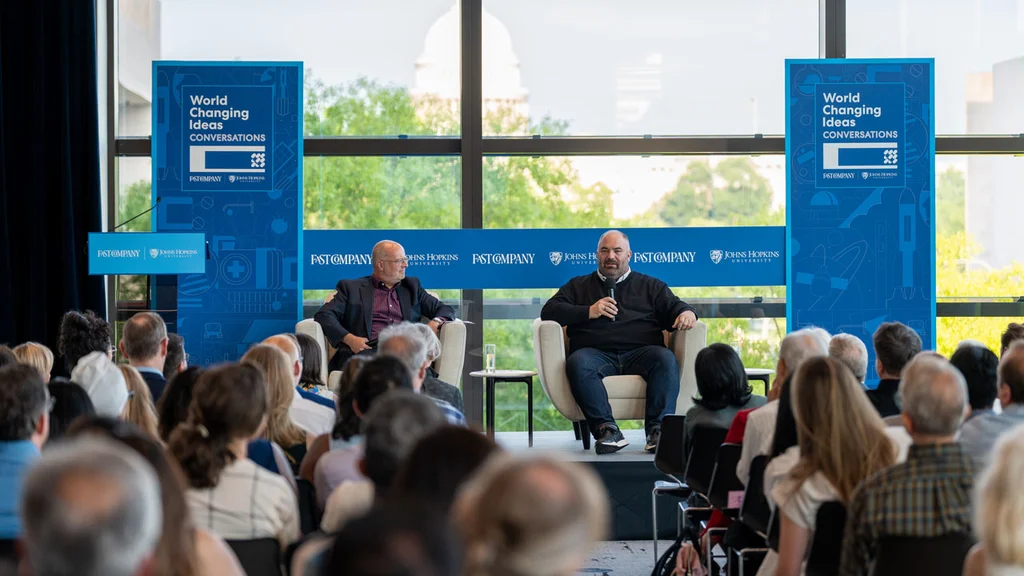
But if you want people to care about their health, is also there something to be learned from the popularity of airline or retailer loyalty programs?
Elements of both gamification and a rewards system are now incorporated into the company’s Verily Me app, which is designed to help people manage their lifelong health. “You need to recognize, you need to nudge, you need to achieve, you need to acknowledge forward progress, you need to steer them in a direction based on their personal medical records and our clinician intervention, what they should do, where they should get a follow-up, and you should reward that and recognize that,” Gillett said.
This type of nudging could also transform the future of clinical trials, from the current randomized model to one that draws upon higher-quality matching candidates, Gillett said. “We can bring technology and we can bring understanding of how to engage people to expose them and consent them into the clinical research side of the house that allows a lot of these things to be more sustained and to have a much higher quality engagement.”
