
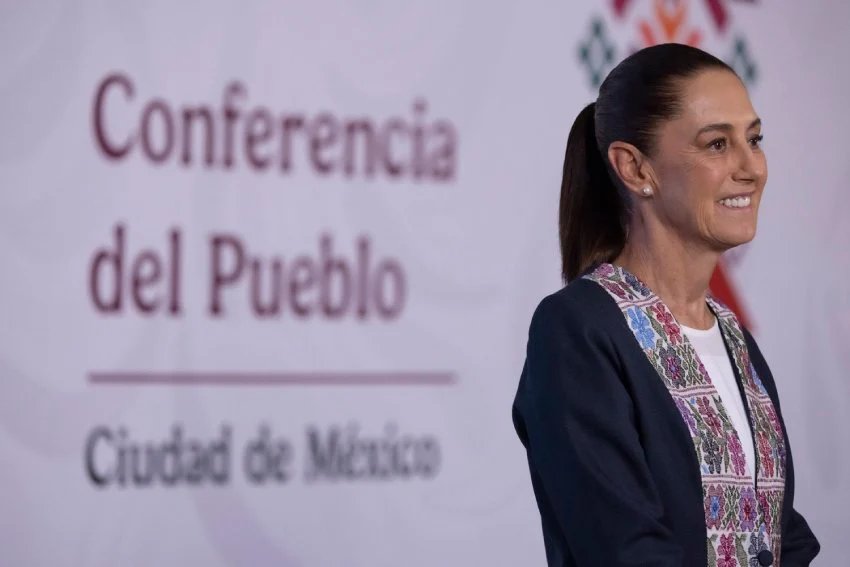
Sheinbaum’s mañanera in 60 seconds
- 🤝 USMCA “remains in force”: A day after the U.S. said it wouldn’t renew the USMCA for an additional 16 years, Sheinbaum and Economy Minister Marcelo Ebrard emphasized the trade pact remains valid until 2036, subject to annual reviews. Ebrard said the treaty “hasn’t been modified” and that Mexico’s main goal in upcoming bilateral talks is to reduce Section 232 tariffs on steel, aluminum and vehicles.
- 📈 Investor certainty, despite the news: Sheinbaum argued the USMCA’s continued validity offers “certainty” for investors, pointing to a record US $23.6 billion in foreign direct investment in Mexico during Q1 2026. She noted any of the three countries could withdraw from the pact with six months’ notice — but the U.S. hasn’t done so.
- 🔄 Door left open for 2042 extension: Sheinbaum said Mexico, the U.S. and Canada could still agree “at any time” during the next decade of annual reviews to extend the USMCA for an additional 16 years, framing the U.S. push for reviews as reflecting a broader protectionist stance.
- 🚗 Olinia moves to production: Sheinbaum announced the government’s home-grown EV, the Olinia, has completed its design phase and entered production, with a tendering process planned to bring in private companies. She said demand for the vehicle — priced from 150,000 pesos (US $8,575) — is strong among both governments and individual buyers.
Why today’s mañanera matters
President Claudia Sheinbaum’s Wednesday morning press conference came a day after the U.S. government advised its Mexican and Canadian counterparts that it didn’t want to renew the USMCA free trade pact for an additional 16 years.
At today’s mañanera, Sheinbaum and Economy Minister Marcelo Ebrard sought to put a positive spin on the development, highlighting that the Trump administration didn’t decide to withdraw from the USMCA and thus the trade pact that superseded NAFTA in 2020 remains in force — and will remain in force for the foreseeable future.
Despite the United States’ decision against extending the USMCA until 2042, the president claimed that the ongoing validity of the agreement will increase certainty for investors in Mexico.
Also of note at today’s mañanera was Sheinbaum’s assertion that there is high demand for the Olinia electric vehicle, which is expected to go on sale next year.
Ebrard stresses that the USMCA remains ‘in force’
At the start of the press conference, Ebrard acknowledged that the U.S. government decided not to extend the USMCA until 2042.
However, he stressed that the three-way trade pact “remains in force from now until 2036,” although it will be subject to annual reviews.
Ebrard noted that both Mexico and Canada were in favor of extending the USMCA until 2042. However, the Trump administration declined to extend the pact and opted for annual reviews as it has “great concern” about the trade deficits the United States has with Mexico and with Canada and wants to “correct” various aspects of the USMCA, he said.

Ebrard told reporters that his virtual meeting on Wednesday with U.S. Trade Representative Jamieson Greer and Canadian Trade Minister Dominic LeBlanc was the first USMCA review meeting at which all three countries — Mexico, the United States and Canada — were represented.
Mexico and the United States are set to resume bilateral talks later this month when a U.S. delegation comes to Mexico City. During those talks, officials will aim to resolve concerns of both parties regarding the USMCA, Ebrard said.
He said that Mexico’s main concern is the tariffs the United States imposed on some Mexican exports — i.e., steel, aluminum and vehicles — in accordance with Section 232 of the U.S. Trade Expansion Act. Mexico is seeking the reduction of those tariffs, Ebrard said.
The economy minister subsequently highlighted that the USMCA hasn’t changed from yesterday to today.
“It’s the same treaty, it hasn’t been modified,” he said.
“We don’t expect substantial changes [to be made] in the upcoming talks,” Ebrard added.
Sheinbaum: USMCA can be extended for additional 16 years ‘at any time’
Sheinbaum told reporters that “at any time” in the next 10 years — the period in which annual reviews of the USMCA are slated to take place — the governments of Mexico, the United States and Canada can decide to extend the trade pact for an additional 16 years.
“The annual reviews are reviews that are related to this U.S. vision of greater protectionism,” she said.
“We’re seeking the best [trading ] conditions for our country and to contribute to the strengthening of regional content [in manufacturing] and reduce the content that comes from other parts of the world,” said Sheinbaum, whose government this year imposed new and higher tariffs on imports from China and other countries with which Mexico doesn’t have trade agreements.

The president subsequently asserted that there is “certainty” for investors in Mexico and that the ongoing validity of the USMCA will create “more certainty.” She cited foreign investment inflows as evidence of the current existence of certainty. Indeed, foreign direct investment in Mexico hit a record high of almost US $23.6 billion in the first quarter of 2026.
Sheinbaum highlighted that the United States hadn’t taken the decision to withdraw from the USMCA, which any of the three countries can do by providing six months’ notice to their trade partners. She reiterated her view that the trade pact — which governs annual trade of around US $2 trillion — has benefits for all three signatories.
Ebrard asserted that investment in Mexico could increase given that the USMCA remains in force and that Mexico and the United States have a “common agenda” to reduce the reliance on imports from outside North America.
He also said that 85% of Mexico’s exports to the United States enter the country tariff-free as they comply with USMCA rules.
Sheinbaum says there is high demand for Olinia, Mexico’s home-grown EV
Sheinbaum told reporters that the government has completed the design phase for the Olinia EV — a prototype of which was unveiled last month — and is now in the production stage.
“The objective is for there to be mixed investment, that it isn’t a vehicle made only by the Mexican state,” she said, explaining that there will be a “kind of tendering process” to find private companies to assist the production, distribution and sale of the Olinia, which is slated to have a starting price of 150,000 pesos (US $8,575).
Sheinbaum asserted that there is “a lot of demand” for the Olinia, “not just from governments, but also from people who like the vehicle.”
By Mexico News Daily chief staff writer Peter Davies (peter.davies@mexiconewsdaily.com)
