
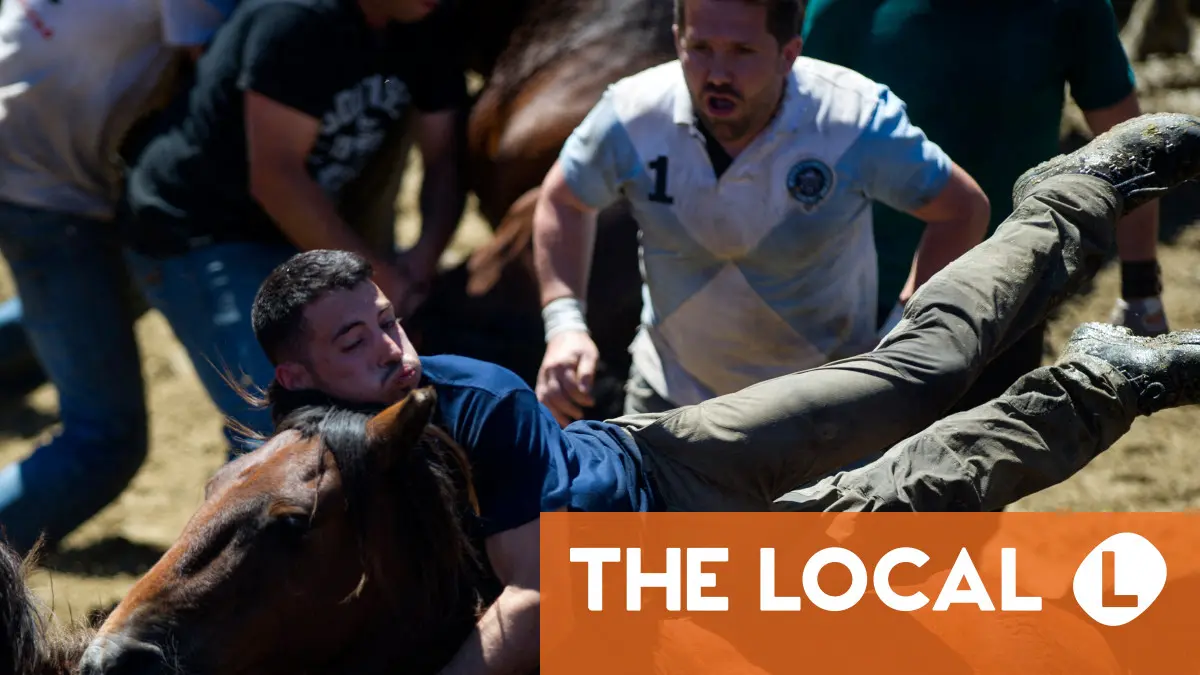
The Galician town of Sabucedo plays host this weekend to its dramatic ‘Rapa das Bestas’, or Shearing of the Beasts, a spectacle which is exhilarating for some and controversial for others.
Held in Sabucedo (Pontevedra province) every year on the first weekend of July (July 3rd to July 6th in 2026), this is perhaps the most famous of a number of ancestral events across Spain’s northwestern Galicia region.
The 400-year-old festival first sees hundreds of wild horses rounded up from the surrounding mountains, where they live semi-wild for most of the year, and driven down into the village.
Then the animals are herded into a packed amphitheatre known as the curro, and bedlam ensues.
“Aloitadores” pin down a wild horse in the “curro” (arena) during the “Rapa Das Bestas”. (Photo by MIGUEL RIOPA / AFP)
The shearers, known as aloitadores (wrestlers), are strictly forbidden from using ropes, sticks, or mechanical restraints. They rely entirely on body weight, leverage, and adrenaline.
Subduing a wild horse requires usually three strong men to work in synchrony. Two aloitadores position themselves at the horse’s head to hold it still, while a third leaps onto its back or grabs the tail to throw the animal off balance.
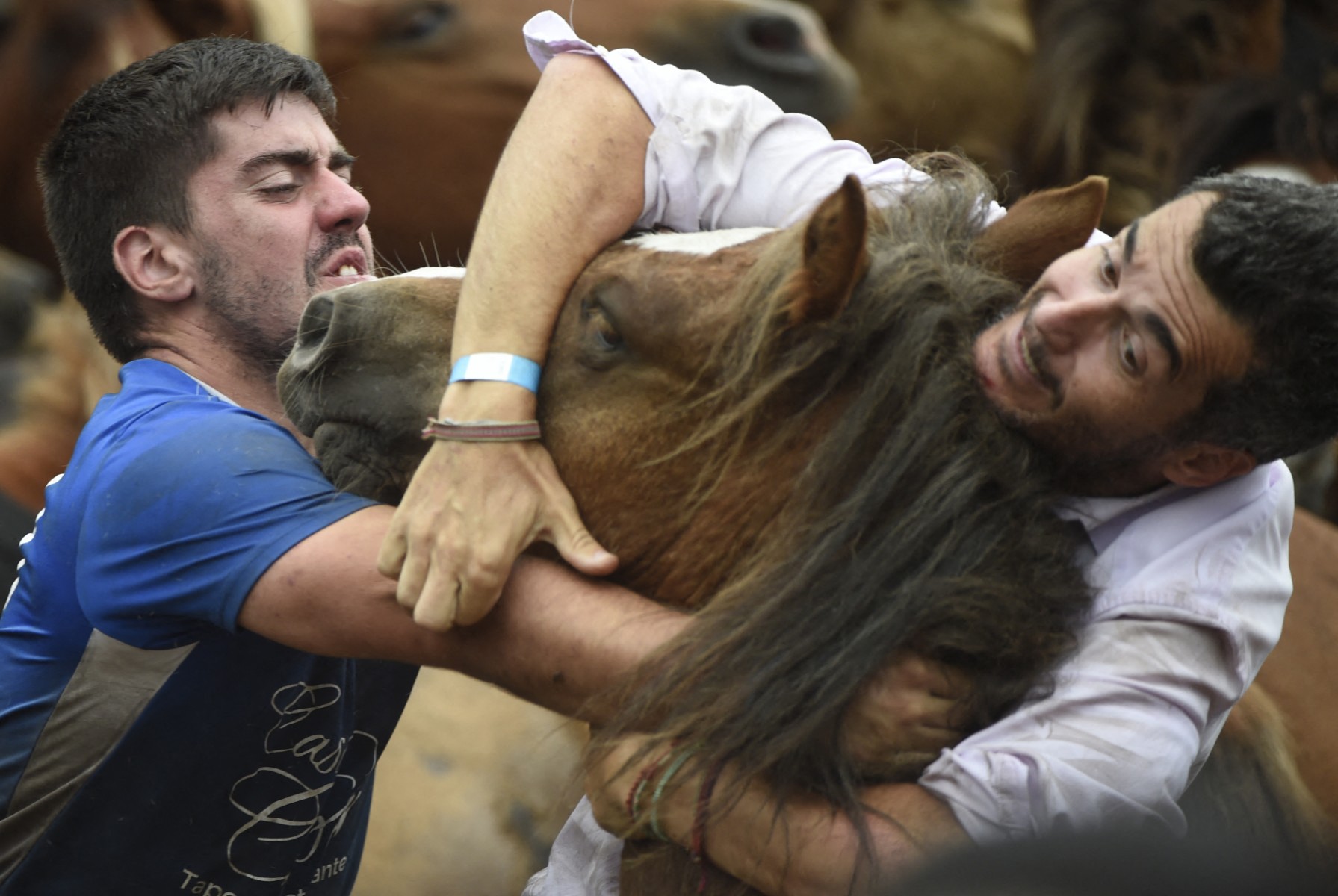
During the festival, wild horses are rounded up from the mountains to be marked and to have their manes trimmed. (Photo by MIGUEL RIOPA / AFP)
Becoming an aloitador is a badge of honour passed down through families. Children in Sabucedo practice the techniques from a young age on smaller foals before earning their right to face full-grown stallions.
While the spectacle looks like chaotic wrestling, the Rapa is fundamentally an ancient form of community veterinary care.
Once a horse is subdued, the aloitadores work quickly to trim the manes and tails. According to locals, this prevents the horses from getting tangled in the thick mountain brambles during the winter.
The horses are then cleaned of ticks and treated for any hidden infections or wounds sustained in the wild.
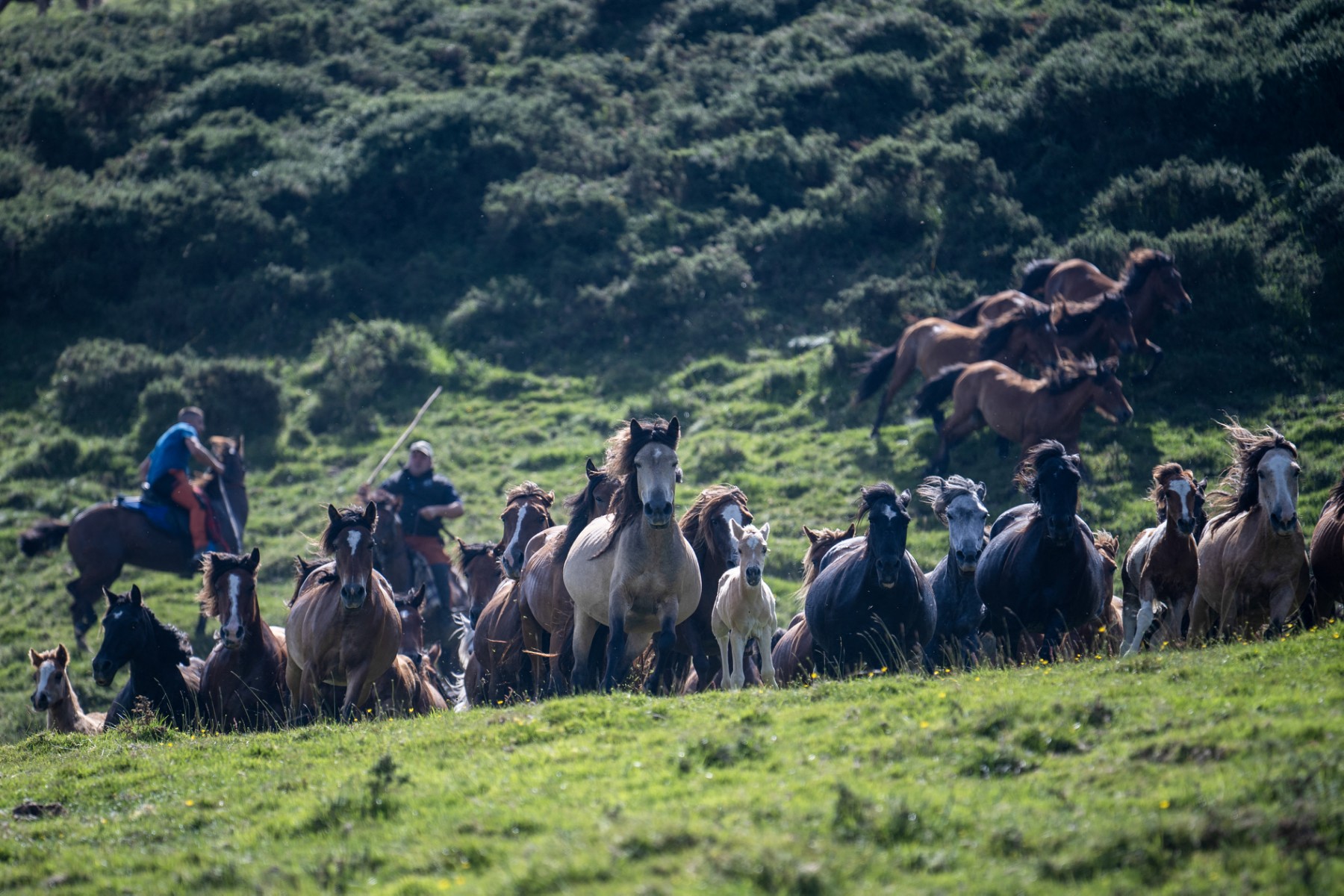
Wild horses are first rounded up and brought down from the mountains before the ‘Rapa das Bestas begins. (Photo by MIGUEL RIOPA / AFP)
Historically, this meant branding; today, it is often paired with modern microchipping to track the health of the population.
The horses featured in the festival belong to an ancient, hardy Celtic breed known as the Galician Mountain Horse (or Garrano). They are perfectly adapted to the rugged, damp terrain of the northwestern Iberian Peninsula.
Oral tradition says the festival can be traced back to the outbreak of a plague several centuries back.
Two sisters appealed to the village’s patron saint, San Lorenzo, for protection, promising two “beasts” as offerings if their prayers were answered. When the village was spared, they fulfilled their vow, sparking a ritual that survived centuries.
Historical sources suggest there was indeed such a plague outbreak in the area in the 16th century, according to local newspaper Faro de Vigo.
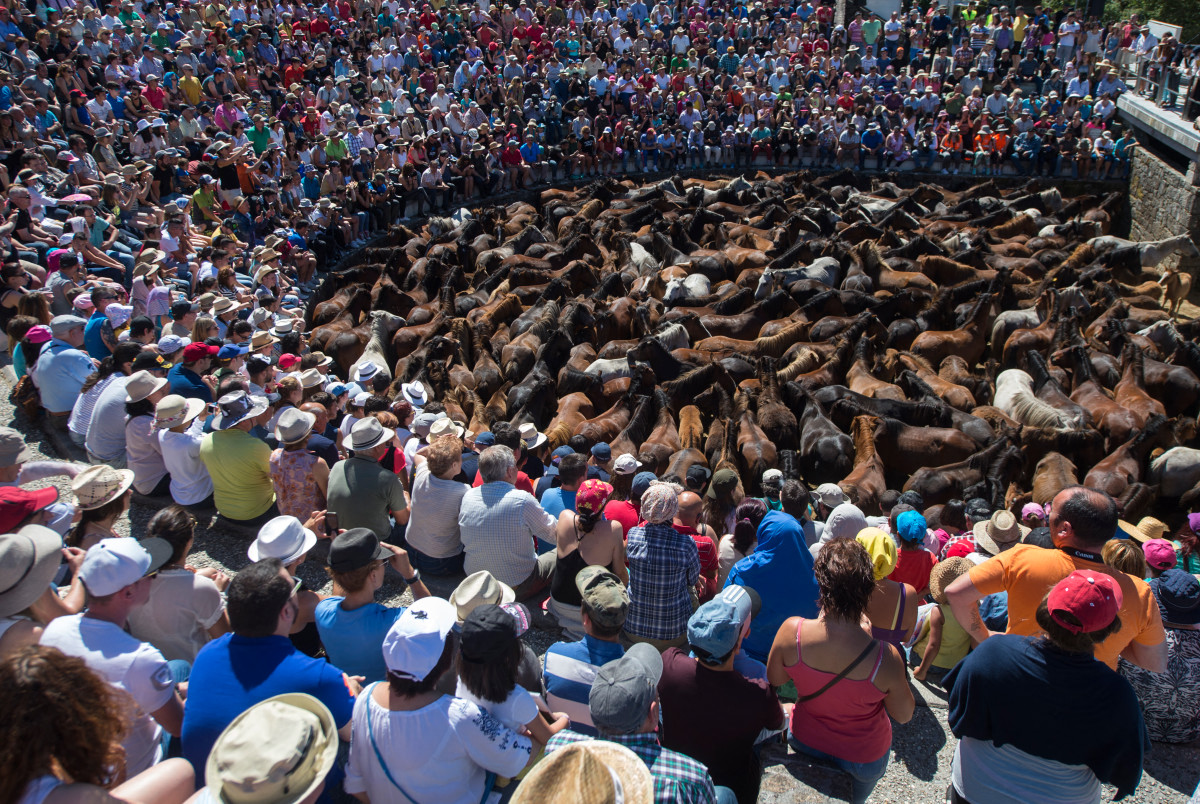
People in the ‘curro’ watch the wild horses arriving at the ‘Rapa Das Bestas’. (Photo by MIGUEL RIOPA / AFP)
The event is now considered an International Tourist Interest, drawing thousands of spectators from across the globe who gather to witness one of Europe’s oldest, most visceral celebrations of human-animal coexistence.
However, animal rights groups such as PACMA have spoken out against Rapa das Bestas, labelling it a cruel and outdated spectacle. They argue that wrestling the animals, pulling their tails, and twisting their necks causes severe, unnecessary stress and injury.
In 2019, British comedian Ricky Gervais took to social media to express his disgust at footage of the Rapa das Bestas.
On the other hand, local ranchers and participants defend the practice, arguing that the roundup is essential for managing the semi-feral herds, keeping them free of parasites, and maintaining the local ecosystem.
They also claim that activists unfairly lump their cultural tradition in with controversial events like bullfighting, where the animals are killed.
What do you think? Let us know in the comments section below.
