
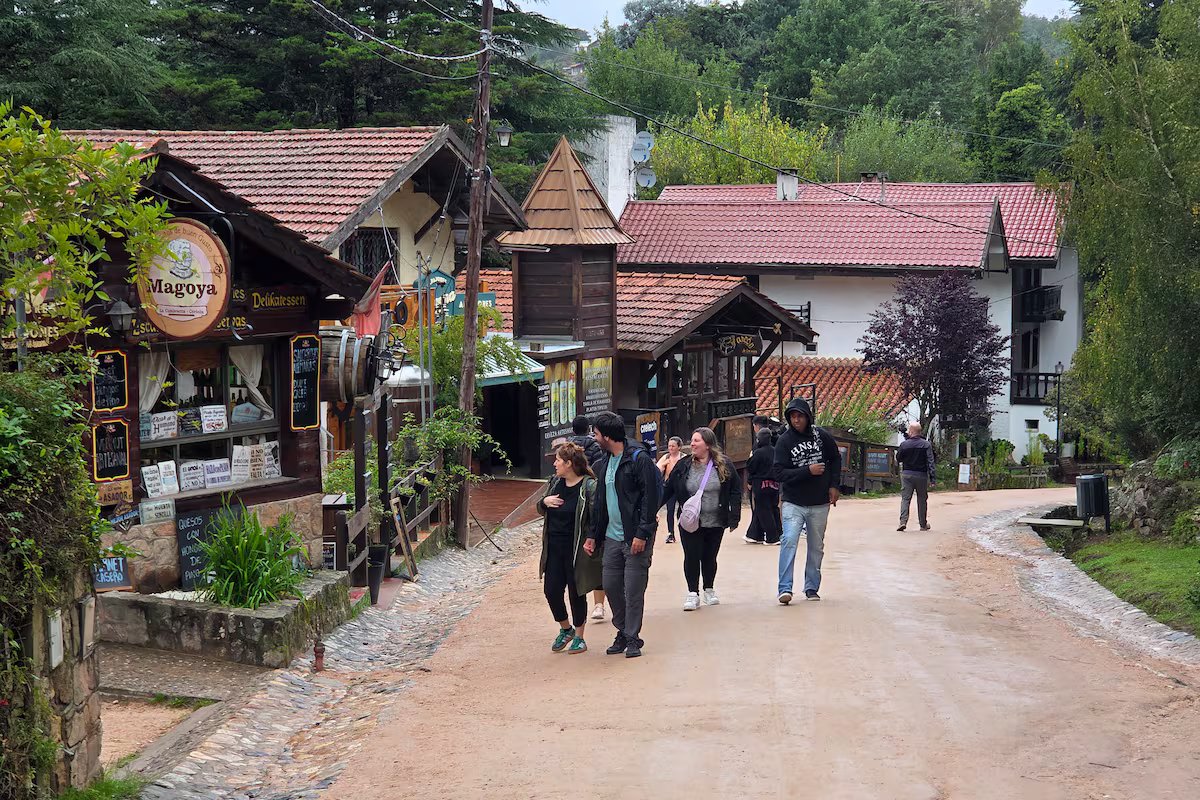
Elvira González has spent 35 years of her life in La Cumbrecita, and it makes her happy that in this town, everyone knows each other. It’s a community tucked into the Sierra Grande, in the Argentinian province of Córdoba, amid forests, canyons and waterfalls. In addition, three decades ago, it became the country’s first pedestrian town, a place where her 14-year-old daughter goes to school on foot.
Besides the ban on the circulation of cars in the urban core and restrictions on the use of plastic bags, many residents separate waste and make their own compost, and renewable energies like solar panels are on the rise. But not everything is perfect in this community of 1,300 inhabitants, even if it often seems to comes straight from a fairy tale. “We are a tourist town and being pedestrian is great, but I feel like we haven’t grown or perfected the model,” says Santiago Nogueira, owner of local cafe E!n Kaffee.
“Dear visitor: we remind you that our town has been declared an environmental protection area, meaning that camping, setting fires, hunting local animals or birds, riding horses, littering outside of garbage cans, fishing in the off-season, and cutting or uprooting any kind of plant, bush or flower is not allowed within city limits.” With this long message carved into a gigantic wooden sign, the community welcomes visitors before they cross the bridge over the Río del Medio.
The instructions are strict because La Cumbrecita is a multi-use nature reserve within the Pampa de Achala Water Reserve, created to protect the environment and biodiversity of the area. Its history began in 1934, when the Cabjolsky family, who were of German heritage, bought some 500 hectares.
That first wave of the town’s construction includes what today is the La Cumbrecita Hotel, a white building with wooden accents that is hard not to see from the dirt streets that snake through the community. “It started out being an estanzuela (small, historic rural property), then an inn and then a hotel. My great-uncles bought it at the end of the 1930s and since then, it’s stayed in the family,” says Pedro Navarro, who stands in front of the building.
Why pedestrian?
“Given the topography in which the town of La Cumbrecita is located, it makes the passage of cars difficult in the tourist high season,” states Resolution 10 of the municipality of La Cumbrecita, signed July 9, 1996. For that reason, “the entry of vehicles with mechanical or organic traction is prohibited from 10 a.m. to 6 p.m.,” it adds.
Though precisely who hit upon the idea remains unknown, “the decision was a no-brainer,” says Juan Manuel Busaniche, director of tourism in La Cumbrecita. In addition to encouraging both locals and tourists to walk, the declaration brought with it other benefits, like low levels of noise. “You hear the birds, the canyon. There’s a different interaction with the river,” says Navarro.

The town has attracted millions of tourists in the last 30 years, their numbers peaking in the 1990s and at the start of the 2000s. Today, it is estimated to receive a half million people a year, despite the fact that after the Covid-19 pandemic, the number of visitors stopped increasing. But during key times of the year, like Holy Week, the line of cars waiting to park outside the town can reach up to nearly four miles. “It’s a good thing that tourism slowed down, because we have to take care of our resources, to improve service and quality,” says Busaniche.
More environmental protections
In recent decades, La Cumbrecita has been making additional changes to protect the environment and quality of life for residents, some more effective than others. Among them is a plastic bag ban, waste separation and treatment systems, at-home compost production, and the installation of solar panels.
“We put together a homemade version that is like a gigantic radiator, which reduces our gas consumption between 20% and 30%,” says Martín Santillán, who manages La Cumbrecita Waldhuetten cabins. La Cumbrecita Hotel’s Navarro says that guests bathe in the summer with hot water that is 100% heated by solar panel. “We store the energy,” he says.
Another significant change was the installation of a sewer system 50 years ago: a pioneering project for a high-altitude town that sits atop the Achala batholith, a gigantic, 1,550-square mile rock that is around 350 million years old. The municipal government also regulates construction and public signage, prioritizing materials like wood and limiting environmental impact and light pollution.
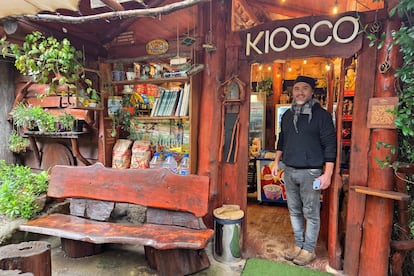
The words “The beauty of ellipses is that they tickle the imagination” are carved into one of the walls of a picturesque kiosk that sits nearly at the end of town and even features a library in one of its corners. Cabin administrator Martín Santillán is the owner. He came to La Cumbrecita 15 years ago and declares that he’s here to stay. “I found my place in the world,” he says, as he tells how he fell in love with the calm, the vegetation, the view, and with chatting with the tourists who visit the kiosk.
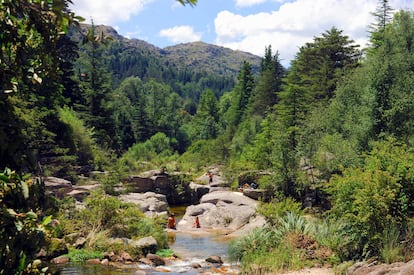
In October 2012, a huge storm significantly reduced La Cumbrecita’s tree population. One of the trunks was transformed into Santillán’s kiosk library. Others served as the raw material of inspiration for several sculptures that today represent a large part of the town’s identity. In addition, the community installed totems with plaques that point to tourist sights, like La Olla, a lagoon of natural water that trickles through the canyon and is flanked by rocks.
Critics of the model
The town’s expansion also brought changes, and some loosening of regulations. “We kept the pedestrian town slogan,” says Busaniche. But today, that restriction is focused on the tourist zone, while vehicles are allowed to circulate in the outer areas.
In the urban center, where visitors and locals are known to walk calmly down steep, irregular streets, the silence prized for so many years no longer reigns. The sound of motorcycles and the increasingly frequent passage of cars worries residents.
Many agree that coexistence is the biggest challenge in such a small community that is exposed to constant tourism. “It’s like The Truman Show,” says Busaniche. “It’s a display case with 1,300 people playing all the roles. And there are people who do things well, and those that do them poorly.”
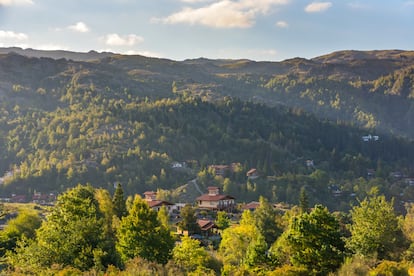
Cafe owner Nogueira thinks that there’s a lack of self-analysis in the town and among its administration. “If we don’t grow in infrastructure and services, we’re hurting our own resources and attractions. They’re killing the goose that laid the golden egg,” he warns.
Despite criticism and questioning, years of experience as a pedestrian town inspires others who look to imitate La Cumbrecita. Such is the case of La Carolina, in the San Luis province, which is another high-altitude community with some key differences. The two municipalities signed a working agreement to share experiences and develop a pedestrian town model. “I tell them, ‘Learn from what we’ve been doing wrong here. It’s easier to learn from other people’s mistakes,’” says Busaniche.
Sign up for our weekly newsletter to get more English-language news coverage from EL PAÍS USA Edition
