
The chief of Aamjiwnaang First Nation says the community looks forward to engaging constructively on a proposed new pipeline between Hardesty, Alta., and Sarnia.
But Chief Janelle Nahmabin said there’s been no consultation with Aamjiwnaang on the project, and engagement should have started sooner.
“It seems to be that once again, the concerns of the Aamjiwnaang First Nation and our rights and jurisdiction that we hold here … is not being considered,” Nahmabin said.
“Aamjiwnaang is still in an ongoing benzene crisis since 2024. … And we’re still dealing with the results from a pipeline spill that is directly adjacent to our land and into the St. Clair River in March 2026. So let’s not lose sight of the things that already need to be rectified before we even consider having something else added to the mix of it.”
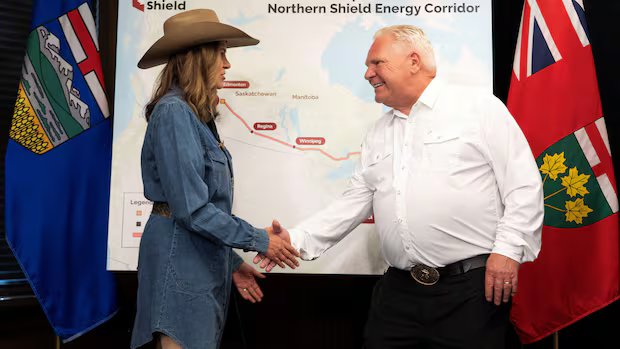
Alberta Premier Danielle Smith and Ontario Premier Doug Ford unveiled plans for the proposed pipeline on Monday in Calgary.
The proposed 3,300 kilometre project would transport an estimated 500,000 barrels of oil per day from Western Canada to refineries in southern Ontario, with possible expansion to 800,000 barrels per day.
Project must begin with free, prior, informed consent, grand chief says
Much of Ontario’s oil already comes from Western Canada but it travels through pipelines that cross the border into the United States. The proposed Northern Shield pipeline would be situated entirely within Canada.
Three of Ontario’s refineries are in Sarnia; the other is in Nanticoke near Lake Erie.
The Grand Chief of the Association of Iroquois and Allied Indians, which includes Caldwell First Nation and Eelūnaapèewii Lahkèewiit (Delaware Nation), said his reaction to the announcement isn’t an automatic yes or no.
Any project the size of the pipeline proposal needs to begin with First Nations rights; free, prior and informed consent; environmental protection and a discussion about whether First Nations will share in the benefits of the project or simply carry the risks, Grand Chief Joel Abram said.
“Free, prior, informed consent has to mean something real, and it means that First Nations are not brought in after the route is already selected and after the political announcement is already made,” Abram said.
“It means full information, enough time and resources to review it, respect for our own laws and decision-making processes, and the ability to say yes, no or yes with conditions. And I don’t think that has been done yet.”

Sarnia—Lambton—Bkejwanong MP Marilyn Gladu — who crossed the floor from the Conservative Party of Canada to the governing Liberal party in April — said she knew there had been discussions at the provincial level about a newly proposed all-Canadian oil pipeline.
She says she was excited to hear about the route and that it would land in Sarnia.
“This is great news and it’s the kind of nation-building project that we’ve wanted here … for a long time,” Gladu told CBC News.
‘It means jobs’: Area MP reacts to pipeline
“It means jobs, it means certainty for the refineries here and it means sovereignty from the threats that Line 5 has experienced here.”
Gladu said Sarnia has ideal access through the Great Lakes to get oil through the St. Lawrence River and out to European markets.
Word of the proposed all-Canadian pipeline is something the Ontario border city’s mayor said he’s been advocating for.
“It’s long overdue,” Mike Bradley told CBC Radio’s Afternoon Drive host Matt Allen.
“We have 26 pipelines that come into Sarnia from the west. All basically go through the U.S. and including [Enbridge] Line 5, which has been a source of frustration and difficulties over the last five years with the Michigan and American governments. This should not be a surprise to people.”
Bradley said it’s gratifying for his community that’s been through a lot of uncertainty around the oil and gas industry.
“It’s a win-win-win,” he said. “A win for Ontario, a win for Alberta and a win for all of Canada.”
Bradley said the project sends a message that the people of Canada can do things as Canadians instead of being dependent on other nations.
“Even if the administration changes in the U.S., we cannot let up on becoming more Canadian and our focus on our economic development and protecting our … energy security,” he said.
The feasibility study for the project has cost $11 million so far, according to Ford’s office. The study is expected by the end of the year.
An opportunity for energy security, business leader says
The project still has no concrete timelines or a projected price tag. It follows a previous agreement from Saskatchewan, Alberta and Ontario to pursue an energy corridor.
The CEO of the Sarnia-Lambton Economic Partnership said the new pipeline provides an opportunity for energy security in Canada.
“This provides a necessary redundancy to reduce feedstock uncertainty currently created by the pipelines moving through the United States on their way to the Sarnia-Lambton area,” said Matthew Slowinski.
It creates supply chain resiliency, he said.

“Secondly, it creates an opportunity for additional capacity for future development, future refining production capacity and the potential for export as well,” he said.
“Cars don’t drive, airplanes don’t fly and manufacturing doesn’t take place without the fuels and without the production that’s initiated early on in the supply chain out of the Sarnia-Lambton area.”
Steve Crozier, interim CEO of the Sarnia Lambton Chamber of Commerce, said the proposal plays into the region’s pre-existing infrastructure, skilled workforce and industrial expertise.
“We are encouraged to see our region identified as a key destination for a proposed major infrastructure investment and look forward to learning more about the proposal and what it could mean for Sarnia-Lambton as the feasibility study progresses,” said Crozier.
A civil and environmental engineering professor said the sketched out path of the pipeline suggests it would pass through different types of terrain.
The University of Alberta’s Alireza Bayat also serves as the director of the Canadian Underground Infrastructure Innovation Centre.
“Canada has done this before,” he told CBC News. “We have built long pipelines. This won’t be the first one.”
Bayat said even in the project’s infancy, nailing down a specific construction timeline can be difficult.
“I think proper engineering has to be done. Proper planning has to be done to get to the right schedule,” he said.
“We are not talking months; probably it’s years, but I doubt it will be decades.”
