
“The film’s documentary feel represents an aesthetic choice, not a lack of control“
– The Slovak director reflects on how her film looks to reframe serious social and generational concerns through an accessible romantic form
(© Film Servis Festival Karlovy Vary)
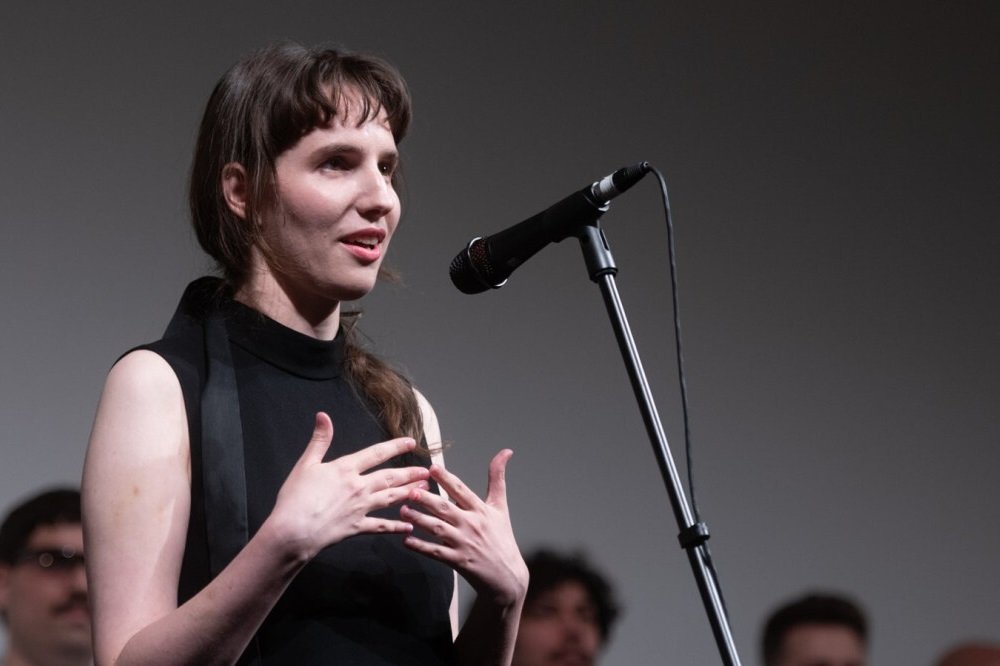
Emerging Slovak director Martina Buchelová introduced her first feature-length film, Lover, Not a Fighter, in the Karlovy Vary International Film Festival’s Proxima competition.
Cineuropa: How did your film come about?
Martina Buchelová: I wrote the screenplay during Covid. I didn’t specifically write about that time in the story, but there was an undertone of desperation in the film. My main intention was to make a film people could go to the cinema to enjoy and breathe with, without pretending the characters’ world was straightforward. We also wanted to place romance at the heart of the film. At the time, and perhaps it’s still the case now, I felt there were quite a few heavy productions going on around us, in Slovakia and in a wider European context. I wanted to approach serious things through a romantic tragicomedy rather than through pure social drama.

Why was it important to place young people alongside older characters, specifically within an intergenerational setting?
The focus is definitely on the younger generation, but the film is also about intergenerational exchange. I’m interested in how people of different ages, with different views and past wounds, can still try to live alongside one another and seek out closeness. The main characters aren’t teenagers anymore, but they’re not settled adults either. I see them as young adults, around twenty or twenty-one, somewhere near the beginning of university life. They’re at that fragile stage when you’re searching for direction, trying to understand what kind of life you want, and deciding how you want to relate to a world that often feels chaotic.
The film doesn’t only concentrate on the romantic couple. It continually opens out to include clusters of characters and minor events. Why did you structure it in this way?
I never wanted the supporting characters to be mere accessories to the main story. Obviously, Andrej and his relationship are central, but every person around him has a purpose and a life of their own. The film doesn’t have a classical linear narrative that simply moves from one plot point to the next. Characters appear, interact, disappear, return, and change the emotional temperature of the film. Its chapters help to make that possible. They allow the film to become a mosaic of situations through which we gradually understand Andrej through his relationships with others.
The film has a raw, partly documentary-style visual texture, especially when it comes to the smartphone footage. Was that part of your “generational statement”?
Yes, but I wouldn’t reduce it to a documentary approach. The handheld camera and the roughness of some of the images help us stay close to the characters. Smartphones are part of how this generation records and remembers itself, video footage shares our tender moments, important moments, our hard moments. If an image served an emotional purpose, I didn’t want to reject it simply because it was shaky or imperfect. But the film, as a whole, is also tightly reined. Its documentary feel represents an aesthetic choice, not a lack of control.
The intertitles and chapter captions have a dry, slightly ironic side to them. How do they function?
For me, they’re connected both to the storytelling and to the film’s sense of humour. They sometimes evoke the way people communicate through messages, but they also operate as a kind of directorial comment. They sit above the action, adding information or a slight shift in perspective. Captions can disclose something the characters wouldn’t necessarily say about themselves, and they invite the viewer to smile at the gap between what people hide and what the film allows us to see.
Where does the title Lover, Not a Fighter come from?
It’s not inspired by the books or other works that share that phrase. It comes from an earlier project we made about young people in Rimavská Sobota. We met a young man called Andrej there, and at one point he described himself in that way, as a lover, not a fighter. It stayed with us. The phrase has a familiar, almost proverbial quality, although my friend Andrej isn’t like the protagonist; they just share the same name, a degree of coolness, and both are lovers, not fighters.
Your characters could easily have been reduced to stereotypes like the alcoholic or the conspiracist, but the film resists this. Was avoiding archetypes a conscious aim?
I’d say it was definitely part of our approach, even if I didn’t want to make an explicit anti-stereotype manifesto. I don’t want the film to be speak through labels. Some of the characters have problems with alcohol, some believe in conspiracy theories, some move in strange grey-zone circles, but that’s not the total sum of who they are. I’m not interested in a moralising view from above. People are contradictory. Someone might appear rough and then reveal gentleness. Someone might want to seem tougher than they are because they’re desperate to belong somewhere. The film tries to look at these contradictions humanely.
What are you working on next?
I have other projects in development. One of them is a historical project inspired by the work of Božena Slančíková-Timrava, who was one of the most important Slovak prose writers of the late 19th and early 20th centuries. It’s not a straightforward adaptation of one text, it actually draws on several motifs.
