
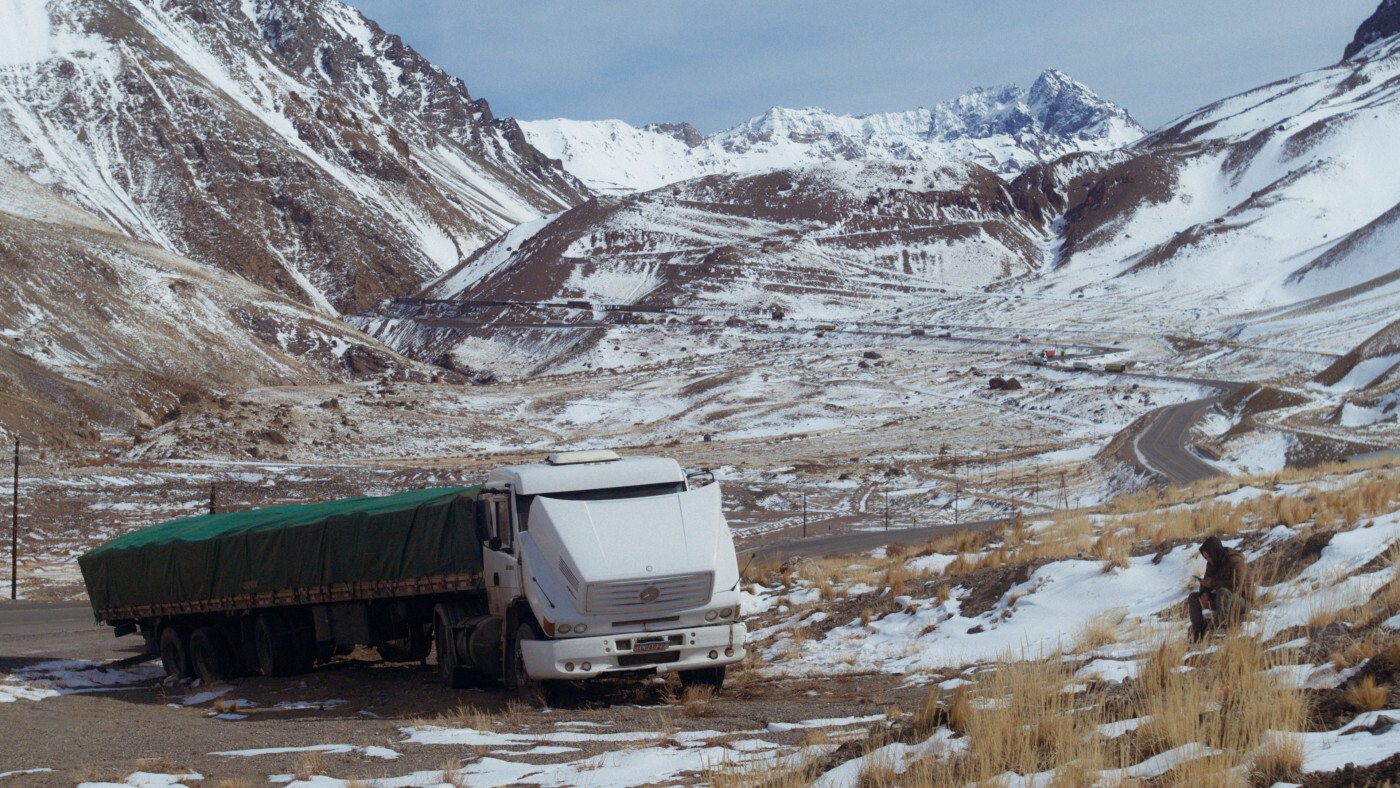
– With his docu-fiction hybrid, Francisco Marise tries to capture every angle of a trucker’s life, while doing so in a new and original way
Roads resemble the blood vessels of the physical world. Most of the things we need, use and accumulate reach us by road, at least in part. Roads also take us places, provide us with adventures and show us the world. There is a whole genre of cinema dedicated solely to roads, travel and all the things that can happen along the way. But is a road movie even imaginable without relying on the road itself, and driving, as its main action? Francisco Marise certainly tries to do just that with his docu-fiction hybrid Truck Driver, which has just premiered in Karlovy Vary‘s Proxima competition.

As the Estonian composer Arvo Pärt famously said, music consists not only of tones, but also of pauses. The same could, in theory, be applied to Marise’s approach to roads, driving and travel: motion is the tone, while stillness is the pause. In practice, this means the filmmaker focuses on the quieter moments and the places truckers frequent when they aren’t driving – places like truck stops, diners, motels, perhaps a mechanic’s garage or a tyre shop, but also the inside of the cabins, where the drivers spend most of their free time, soothing themselves to sleep with videos watched on a phone screen, or speaking to the family members they miss.
The important thing here is that each motivation is individual, whether it stems from past trauma or present-day hardship. The same holds true for fate, with two possible outcomes: surrendering to fatigue, or pressing on because there is no other choice. Marise certainly tries to capture the fuller picture of truck drivers’ lives on the road (specifically in Argentina) but also to highlight particular situations through vignettes.
The way the filmmaker sets his film apart from the bulk of similar work – usually shot in the register of observational documentary – is through a conscious decision to show the road as little as possible, using driving merely as a backdrop to the truckers’ thoughts and musings on the everyday topics that occupy them. In the film’s opening stretch, this decision seems to land like a bullseye: cinematographer Jorge Rojas shoots mostly single-take scenes, always from just the right angle, while the editing duo of the filmmaker and Mayra Morán stitches them together with long, soft crossfades that lend the film an almost experimental quality.
However, once the novelty of this approach wears off – around the one-third mark – the cracks begin to show. The trouble is that Marise aimed higher than he could actually reach, attempting to proverbially reinvent the wheel on a topic that, while possibly fascinating, is still fairly familiar, all while trying to capture a trucker’s life from every conceivable angle. That may be why he settled on a vignette structure that cuts too shallow, with barely any connective tissue between segments, even as recurring “characters” reappear.
In the end, the structure is so loose it borders on non-existent, and the whole thing resembles an arbitrarily assembled mosaic of clichés. Truck Driver ends up as a missed opportunity, albeit with some nice touches here and there.
Truck Driver is a Spanish-Argentine co-production by La Claqueta and Amania Films, in co-production with Amateur Cinéma, Acheron Films and La Cruda Realidad.
