
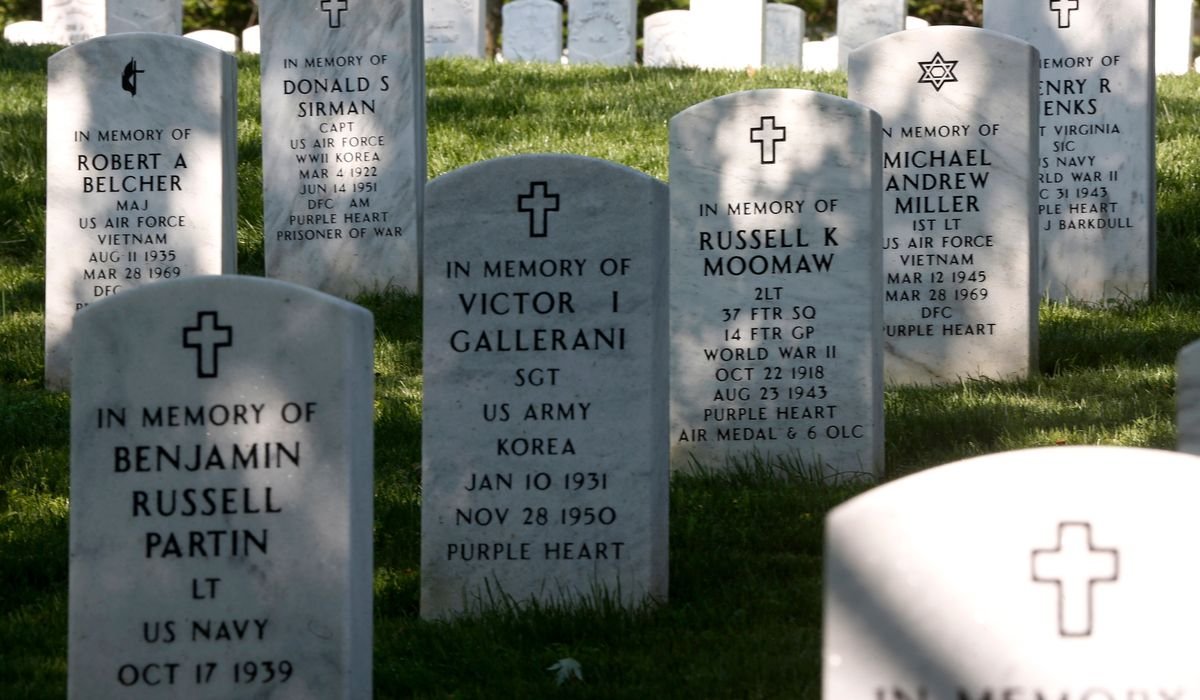
When the Pentagon cut roughly 180 faiths from its religious affiliation codes, shrinking the list from more than 200 categories to 31 in May 2026, it folded “Native American religion” into the broader category of “other religion” – one of many faiths the change pushes out of the military’s view.
As a scholar of Native American and Indigenous Studies, I recognize this kind of change as part of a long-running pattern. Native traditions have repeatedly been acknowledged in principle – named, counted, formally recognized – but weakly protected in practice.
What the codes convey
Religious affiliation codes are short entries in a service member’s record in the Pentagon’s central demographics database. They are separate from dog tags, the metal identification tags worn around the neck, on which service members can still list any religion they choose.
A Pentagon spokesperson said the change was meant to fix a bloated system, noting that 82% of religious service members used only a handful of the codes.
The codes serve a real purpose. They let the military estimate how many service members practice a given faith, assign chaplains trained in that tradition, and plan for religious holidays, dietary restrictions and burial rites. Most service members fall into a few large categories, the various Christian denominations, along with Judaism and Islam, that are numerous enough to have their own trained chaplains.
The service members outside those categories are the least likely to have a chaplain who knows their tradition. For them, a distinct code is often the only thing that makes their needs visible to the institution at all.
Removing the small codes does not consolidate a scattered population. It makes that population harder to see and therefore harder to staff for, plan around and justify spending on.
The Army’s roughly 1,300 active-duty chaplains represent five faith groups – Catholic, Protestant, Jewish, Muslim and Buddhist. For a service member whose faith falls outside those categories, distinct code is often the only thing that tells the military they are there at all, and without that count, there is no trigger to train a chaplain or plan for their ceremonies. None serve Native traditions.
A history of restriction
For much of U.S. history, federal policy did not merely misunderstand Native religious life, but suppressed it. The Religious Crimes Code of 1883 restricted ceremonies such as the Sun Dance, a dayslong ritual of prayer, fasting and sacrifice central to communal renewal among tribal nations including the Lakota, Cheyenne and Arapaho. The code criminalized traditional healers, who could be jailed for offering spiritual guidance. That ban held for over 50 years.
Boarding schools pursued the same goal. From the late 19th century, the government sent Native children to schools built to replace Indigenous languages and belief systems with English and Christianity.
The explicit goal, as officials described it, was to dissolve Native nations’ distinct religious identities into a single American, and largely Protestant Christian, mold.
Why U.S. law struggles to see Native religion
That project shaped which traditions U.S. institutions recognize as religion. American law absorbed a Protestant assumption about what religion looks like: individual belief, voluntary worship, clergy, congregations and sacred texts. That framework eventually extended to accommodate other traditions built on similar terms, including Catholicism, Judaism and Islam.
In practice, courts have read the First Amendment to protect what you believe and say far more robustly than where or how you practice, or rights that belong to a group.
For many Native peoples, sacred places are not interchangeable settings for worship, the way a Christian might enter any church of their denomination and find familiar liturgy. They are part of the practice itself. A mountain, river or village site may be central to a ceremony, and if destroyed, the practice tied to it can become impossible.
Congress appeared to recognize this in the American Indian Religious Freedom Act of 1978, which made it U.S. policy to protect the right of Native Americans, Alaska Natives and Native Hawaiians to exercise their traditional religions, including access to sacred sites.
Its limits became clear in the Supreme Court’s 1988 decision in Lyng v. Northwest Indian Cemetery Protective Association, a case over a proposed federal road through California’s Six Rivers National Forest, an area used for religious practices by Yurok, Karuk and Tolowa people. A government study found the road would seriously damage that use.
Yet the court held it did not violate the First Amendment’s free exercise clause, which protects the right to practice one’s religion freely, reasoning that the government was not coercing anyone; it was acting on its own land. But for the peoples who worshipped there, that land was the church.
What disappears when a category does
The Pentagon’s coding change is not the same kind of case as Lyng – no bulldozer threatens a sacred site. But it turns on the same question of visibility – whether an institution can identify a religious tradition, understand what its practice requires and plan for those needs well enough to protect it.
Native American and Alaska Native people serve in the military at a higher rate than any other ethnic group. About 19% have served, compared with roughly 14% of the overall population. That pattern has held since the Revolutionary War, from the Navajo Code Talkers of World War II to today’s active-duty ranks, even as Native nations endured broken treaties, dispossession and federal violence at the hands of the government.
Without a distinct code, the institution has no data on how many service members observe Native traditions.
Native religious identity isn’t a matter of one or the other – many practitioners also observe Christianity. A service member counted under a Christian code has the tribal dimension of their practice rendered invisible. The consequences are concrete.
In August 2024, the Army held what it called the first officially sanctioned Native American worship service in its history, a sage-smudging ceremony at Fort Gregg-Adams in Virginia, led not by a chaplain but by a soldier, Sgt. Jacob James, who first had to educate the post’s chaplains himself.
The Chief of Chaplains office then had to create a new accounting line just to fund it. Without a chaplain trained in the tradition, a lay leader can only do so much: No one can formally advise a commander on an accommodation or offer confidential counsel.
The result is a system that does not plan ahead; it responds only when someone is persistent enough to ask.
Restoring the category would not solve the larger problem. Native religious freedom requires more than paperwork. It requires institutions to recognize Indigenous traditions on their own terms, including those tied to land.
