
– In her charming tale of learning to cope with loss, Rebekah Fortune sends a father-and-son duo on a fantastical, bittersweet journey
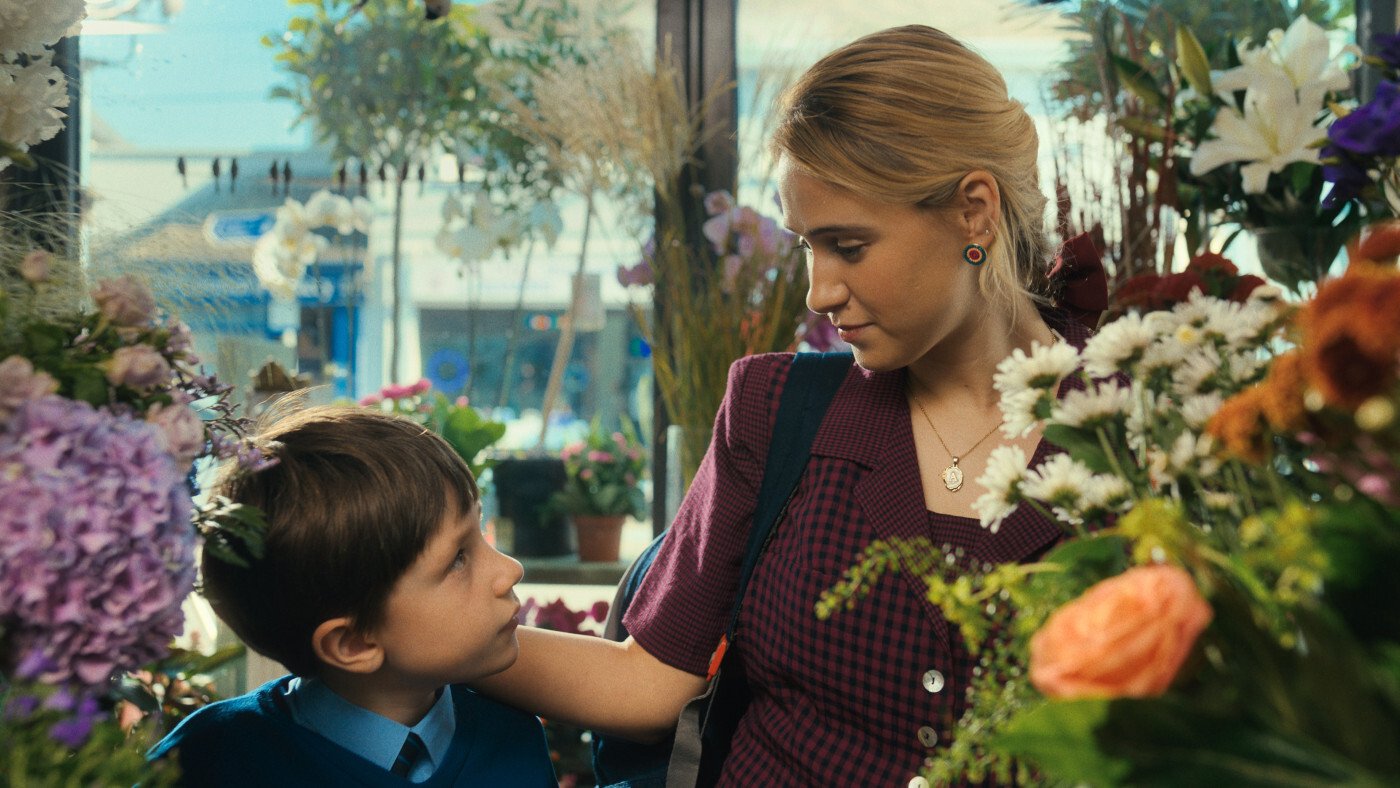
Ezra Carlisle and Maria Bakalova in Learning to Breathe Under Water
Yes, there is a metal shark in the roof. And no, don’t ask why he put it there. For Peter (Rory Kinnear), the past five years haven’t been easy to bear. Ever since his wife died, the quiet, withdrawn man has retreated ever further into himself, much to the chagrin of his son, eight-year-old Leo (Ezra Carlisle). Instead of having fun, or talking about his mum, Peter repaints walls, builds internal body systems in the garage, makes a life-size puppet in his own likeness, or constructs the aforementioned shark. The shark, though, according to Leo, is great: he can share his secrets with it and talk to it when things aren’t right.
That is the premise of director Rebekah Fortune‘s tragicomedy Learning to Breathe Under Water, which had its world premiere in the Special Screenings section at the 60th Karlovy Vary International Film Festival. Soon enough, all of this begins to change. After an intervention by Leo’s teacher, au pair Anya (Maria Bakalova) moves in with the pair, taking charge of the household, offering up healthier meals and the occasional much-needed nudge to get Peter out of the house. Friends don’t have to be objects, Peter himself muses, though he’s rather unwilling to follow his own advice. Leo, meanwhile, starts opening up to Anya and his schoolmates, finally feeling seen and heard.
Fortune sets the tone with childlike wonder, expressing Leo’s often subdued childlike fantasies with drawn animations and surrealist sequences. Learning to navigate a world of adults is hard and the movie thankfully opts to meet its small protagonist at eye-level. It is his view of the events around him that provides the road map to this story. Rarely do we ever switch to an adult-only scene, or get to feel more of the heavy grown-up gravitas.
Leo observes that his new housemate laughs easily, and wonders what she’s like watching cartoons. Being a cheerful beam of light amid a sea of dark moods is Anya’s role in this set-up; sometimes her modus operandi tips a little too far into bubbly, sappy positivity for its own good. But Richard Brabin‘s script, thankfully, doesn’t make her the key to everyone’s happiness. Forget classic notions of female caretaking: while she does try to lift everyone’s spirits, healing her landlord’s fractured mental state is never made her job. Nor does she need to become a mum-replacement to fill some void.
Rather, the film cleverly asks what it takes to overcome one’s own demons, to keep tragedy from weighing quite so heavily on the mind. That said, the final third is almost too eager to find a tidy resolution for Peter and Leo’s discomfort, flirting with the rather dangerous idea that all it takes is discipline. But these hiccups don’t come close to ruining the experience. What can he do to be a better father, Peter once asks his son. Live less in your head is the honest answer; one that should resonate with anyone in the room.
Learning to Breathe Under Water was produced by Wildcard (Ireland), Shudder Films (UK) and KeyFilm (Netherlands). It is sold internationally by Bankside Films.
