
– The Swedish director frames a queer Syrian love story spanning Damascus and Córdoba, exploring exile, displacement and the search for home
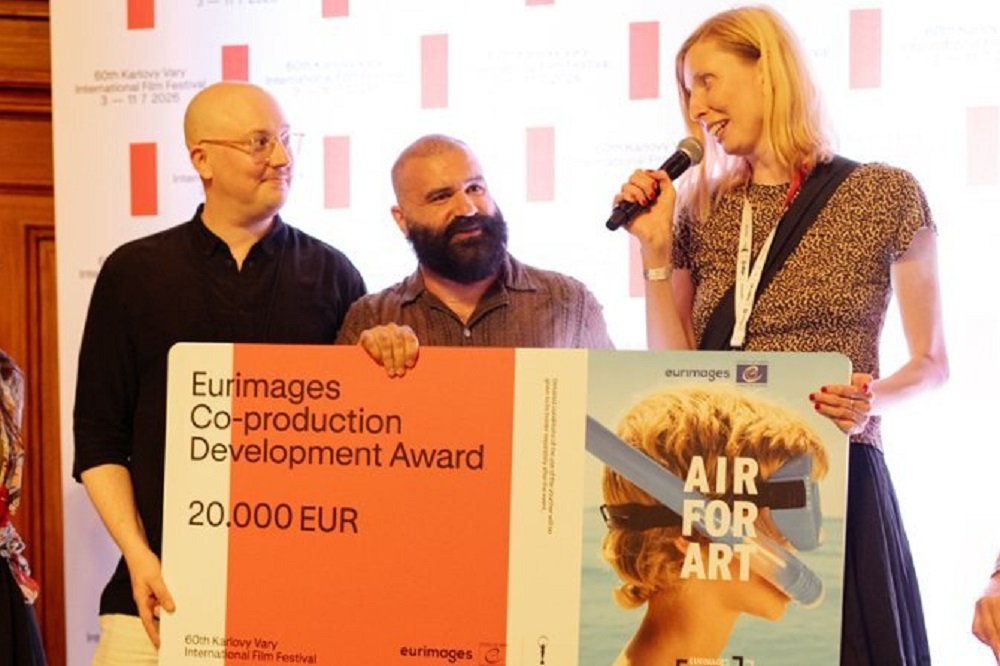
l-r: Jerry Carlsson, Khaled Alesmael and Frida Mårtensson (© Film Servis Festival Karlovy Vary)
Jerry Carlsson’s Swedish-Danish feature debut, Selamlik, written by Khaled Alesmael, is a queer Syrian love story unfolding between Damascus and Córdoba. The project won the Eurimages Co-Production Development Award at KVIFF Promises (see the news). The director and producer Frida Mårtensson, of Verket Produktion, discuss adapting Alesmael’s semi-autobiographical novel, portraying exile and displacement through an intimate queer perspective, and developing the project as an international co-production.
Cineuropa: How did the project originate?
Jerry Carlsson: Khaled Alesmael first approached me about adapting his book, which is inspired by his own experiences. I felt a deep connection to the shared queer experience of searching for love, freedom and a place in the world to call home. As Khaled is both the author and the screenwriter, we have been able to delve deeply into the story and the material to create something that feels cinematic and truly original. The film follows Furat, who travels to Córdoba to reunite with Pierre, the lover he left behind when he fled Syria nearly ten years earlier. Furat hopes to recover what they once had, but Pierre arrives with different intentions. The story unfolds across two timelines: a present-day weekend in Córdoba and their past relationship in Damascus, told in reverse, from their separation before Furat’s escape back to the New Year’s Eve when they first met, full of love, hope and the possibility of freedom. Part of the Damascus timeline is drawn from the book, while the Córdoba storyline was created specifically for the film.
The Arab Spring is present in the background. What themes are you exploring?
JC: The night when Furat and Pierre first meet takes place at the dawn of the Arab Spring. So the characters are hoping for freedom in several ways: political freedom, the freedom to love, the freedom to create a home and the freedom to feel at home. Home is one of the film’s strongest themes. It is also about displacement, about refugees arriving in Europe and trying to build new lives while still carrying what they have lost. It is a universal love story, but it is also about queer people in exile. The queer perspective on war has not often been explored in cinema, and that is one of the reasons we want to make this film. We want to show how queer people survive war, but also what happens afterwards. Even with recent developments in Syria, homosexuality is still illegal, so these characters remain displaced and in exile.
How do you imagine the film visually?
JC: It will be a very intimate film. The relationship is the point of view of the entire story. In the Damascus timeline, Furat and Pierre are mostly confined to their apartment while the war continues outside. The war is portrayed mainly through sound and fragments. This is not a film that tries to give a complete picture of the war itself. We want to show a relationship, and how love can become the thing that helps you survive. The two timelines create a strong contrast. In Córdoba, they are free to walk through the streets, surrounded by tourists and music from a flamenco festival, but they are emotionally trapped. In Damascus, they are physically confined because of the war outside, but their love is alive and their relationship is, in a sense, free. I’m looking for a visual language that is intimate, poetic and playful. The Damascus timeline has the quality of memory, made up of specific moments in time where certain parts are missing, coloured by the characters’ emotional states. In Córdoba, we follow them through every silence and awkwardness.
How far along is the project now?
Frida Mårtensson: The script is in advanced development. Khaled is writing it, and Jerry is collaborating closely with him. Our aim is to have a financing draft by the end of the year, so that we can move into financing in spring 2027. Ideally, we would greenlight the film in 2028 and shoot it that same year. Most of the film will take place in Córdoba. We are also beginning to look at where we could shoot the Damascus scenes. Thanks to the Eurimages Development Award, we can explore that properly. We’re interested in looking at, for instance, Greece, but also other southern European countries.
What is your casting approach?
JC: We want to start casting very soon, and we are looking for Syrian actors in exile across Europe and North America. They may be professionals or non-professionals, but for us it is important that the actors understand the perspective of these characters: what it means to be a gay Syrian experiencing displacement.
What partners are you looking for?
FM: We are looking for European co-producers, and possibly a Canadian co-producer. We are also looking for financing, a sales agent and distribution partners. It is a very international project. The director and writer are already spread across different countries, and we will shoot in more than one country. The film will mostly be in Arabic, English and Spanish, with a little Swedish. It requires partners who can bring not only financing, but also creative input. Finding the right co-production partners is the first piece of the puzzle. Then we will build the production strategy together with them.
