
“Don’t try to understand it. Feel it.”
An iconic and often quoted line from Christopher Nolan’s Tenet. And one I’d often use in defence of it.
It is also a line I would urge people to remember when first watching Tenet.
Tenet has been one of Christopher Nolan’s most divisive films ever since its COVID-19-plagued release. A mixed critical reception and underwhelming box office have made it one of his most underappreciated works. Personally, I have always sung its praises despite its flaws, and it is a film in which Nolan has explored some of his most interesting concepts.
Nolan has always played with time. Memento’s non-chronological structure, Dunkirk’s three converging timelines, and Interstellar’s time dilation. Even Bruce Wayne’s miraculous return to Gotham in The Dark Knight Rises (he’s Batman; he can do what he wants). However, Tenet was the first time Nolan played with time in the most direct sense, merging a time-travel narrative with a spy thriller.
Visceral entropy-bending action
The time travel aspects of the film are what cause the most confusion for many. Perhaps not helped by Nolan’s description of it as ‘forward and reverse entropy’, which arguably overcomplicates it. However, time travel also creates opportunities for some of Nolan’s most creative set pieces.
The plane crash has been spoken about enough. It’s exhilarating and incredibly visceral, especially the moment of impact from the viewer’s POV on the wing. It’s one of Nolan’s best practical effects to date, up there with the truck flip in The Dark Knight.
The first fight ‘The Protagonist’ has with the reversed antagonist is so entertaining. The rhythm is hard to grasp at first, with two combatants who never feel in sync. However, this is in service to a great payoff that peels back the mysteries of the initial sequence. The reverse antagonist is actually the protagonist, which is why the fight feels out of sync. He’s not trying to kill the Protagonist because he IS the Protagonist. His entropy is reversed, and he is instead trying not to kill his past self.
This is not the only instance of entertaining action. Nolan really uses his high concept well. Some buildings implode at the bottom only to explode at the top. Fire in forward entropy becomes ice in reverse. Dead bodies rise back to life to take a reverse bullet. Nolan may spend a little too long trying to explain the fictional science in play. However, it’s all in service of being able to sit and enjoy the spectacle.
The high concept takes many risks, but it allows for some of the best stunts and action work of Nolan’s career.
Tenet’s Protagonist is underappreciated.
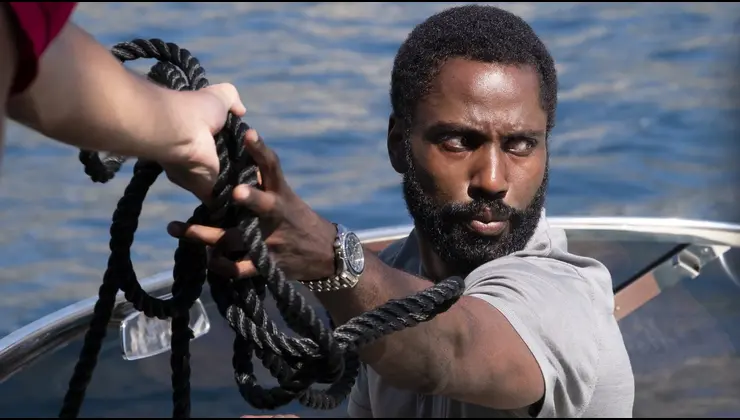
A lot of criticism is directed at the weak protagonist, so weak that Nolan didn’t even name him. However, I think John David Washington’s performance in the role isn’t given enough credit.
First of all, he does what he can with a limited script. There is not a lot of emotion to chew on in the role, but Washington does give us a great fish-out-of-water performance instead. He’s trying to keep up with a game that already has every piece in motion. Those who shouldn’t know much, like Neil, seem to know plenty anyway. Washington portrays him as an agent who is more confident than his years would suggest. He uses his training and experience to learn as much as he can of this new state of play. Would it be nice if he were more three-dimensional as a character? Yes, but I’d argue that if he were, Tenet would begin to crumble even more under its concept and long runtime.
Washington also has a subtly suave energy in his performance. This is essentially Christopher Nolan’s take on a Bond flick. A globetrotting adventure fighting a secret world-ending threat. Washington doesn’t just find himself fighting bad guys, but also infiltrating places he shouldn’t be, extracting information and persuading targets—all very Bond-esque elements. Hell, the bungee jump to Priya’s apartment is straight out of something in Q’s locker for infiltration. I think Washington nails that side of the character. The ‘I am the man that people talk to’ line while he interrogates Priya’s husband typifies this.
Also, the ‘I ordered my hot sauce an hour ago’ line right before scraping a man’s face with a grater is an all-timer moment.
The mysteries of Neil, Tenet’s MVP
Nolan’s supporting cast is often as strong as his leads – Tom Hardy’s Eames in Inception, Cillian Murphy’s Scarecrow in The Dark Knight films. Robert Pattinson‘s Neil is no different. Along with it being one of his best looks (the blonde is fantastic), Neil is a character with an air of mystery that’s really alluring. You’re never quite sure whether to trust him; he always seems to know too much despite feigning ignorance. He’s charming and mystifying, and the moment the score swells as he sits next to the Protagonist always gets me. It’s a melancholic score, hinting at a long relationship between the pair that is coming to a close.
Where the Protagonist is a flat figure, Neil provides a charming foil. His quaint ‘Britishness’ plays off really well against the Protagonist’s stoicism, and brings an air of levity to a drastic situation. Without Neil, the main cast would feel quite lifeless, and there’s a sad melancholy to his performance. It’s a last ride with a lifelong friend who can’t even recognise him, and you can feel the tenderness he has for the Protagonist.
The reveal at the end that he has been under the Protagonist’s instruction the entire time is a shocking one on first watch. It may be slightly predictable that the Protagonist had sent him back, but realising that his final act would be to save his lifelong friend and the world really hits home. The final utterance of ‘what’s happened, happened’ is a sad acceptance of what Neil has to do for himself. I don’t think Tenet works half as well without Neil or with another actor portraying him.
The Rewatchability of Tenet
Tenet is one of those films that benefits from a rewatch. Not only because the film finally starts to make a little more sense, but also in the minute details you get to find. The callbacks to earlier points in the timeline and the foreshadowing of them hit much harder on subsequent viewings. Additionally, having a sense of the plot already gives you more time to appreciate the smaller moments. Kat diving off the boat, Neil pulling off the inverted Protagonist’s mask, the redo of the Freeport crash. You find yourself looking for the small details, the geography of where every character is at that point in the timeline, inverted or not.
You don’t just get to understand the admittedly confusing parts by rewatching, but also enjoy the reveals with a whole new clarity.
Globetrotting in the best way
I don’t think this film shows enough love for its locales. Mumbai, the Amalfi Coast, Tallinn. Three principal locations were shot so beautifully and with such variety and texture. Tenet was Nolan’s excuse to film anywhere and everywhere, and every location feels so unique. The idyllic Italian vacation hides one of the world’s most dangerous arms dealers. The busy Mumbai streets hide talks of espionage and world-ending threats. The car heist in Tallinn is one of the most exhilarating elements of the film and makes such a strong use of the urban landscape.
The film has such a strong variety of colours and textures, jumping from vibrant sunshine to murky city streets so seamlessly. Every location feels lived-in and well thought out, and helps sell Sator’s plans as a truly global threat. There are connections to his plans everywhere, and the Protagonist has to cover so much ground to keep up.
So many highlights…
Ludwig Göransson’s score is one of my favourites of all time. It’s a pulsating, electronic mix that feels aptly futuristic in a narrative about time-travelling threats. It builds tension perfectly as needed, while also setting the scene for the different vistas. Additionally, it adds so much emotion and tells a lot of the story where the dialogue doesn’t.
Despite Kat being one of the worst-written Nolan women, Elizabeth Debicki‘s performance is quite strong. She shares a good relationship with Washington’s Protagonist, and it is a shame that she’s written to think her child is more important than the entire world. The other supporting players also have great moments to shine, with Himesh Patel in particular during the plane sequence.
Finally, there is something about the uncanny valley of the inverted motion in Tenet that I love. It looks almost as if the world is resisting the reversal of entropy. Everything is upside down and the wrong way around and, while difficult to settle into, once you get used to it, it creates a really interesting visual.
Closing the loop on Tenet
Tenet has its issues; it’s undeniable. The plot is confusing and arguably overcomplicated. Kenneth Branagh as Sator is one of Nolan’s worst villains. It is arguably the film where Nolan just couldn’t kill his darlings. However, it is also a film with so many redeeming qualities. If you go in ignoring the hate and with an open mind, it is a film that will surprise you and likely be very enjoyable. Give Tenet a chance; it doesn’t need to be Nolan’s black sheep of his filmography any longer.
Tenet is out now on home formats and streaming on HBO Max.
SUPPORT INDEPENDENT JOURNALISM!
Discover more from
Subscribe to get the latest posts sent to your email.

