
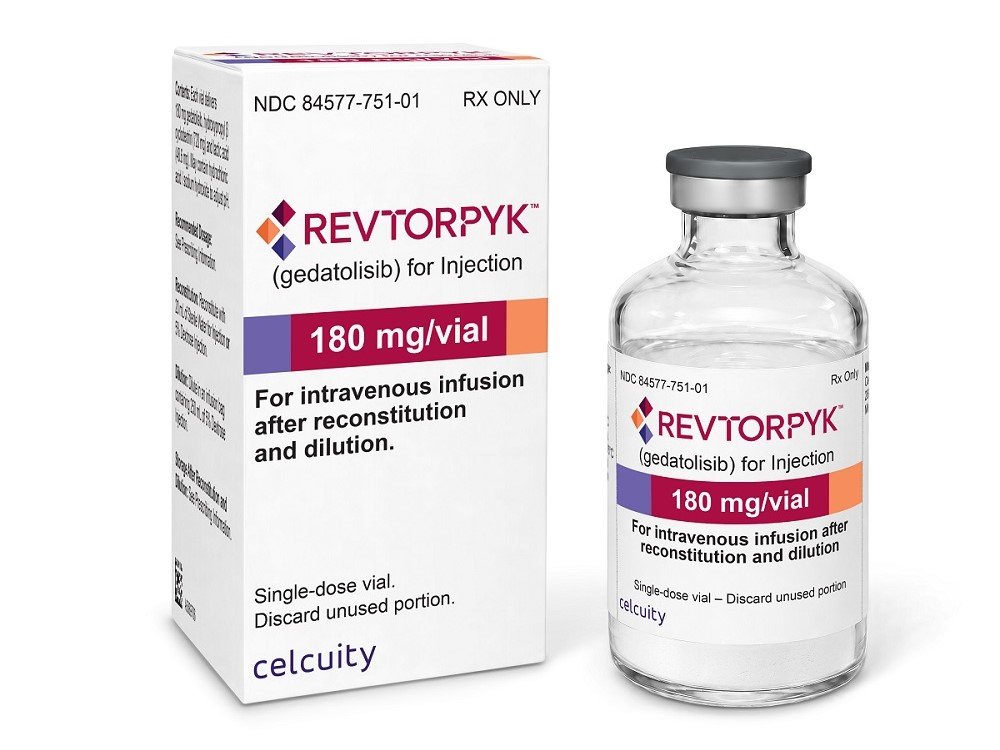
Advanced cases of breast cancer now have a new FDA-approved treatment option, a Celcuity drug whose first-in-a class approach could also have applications in a wider range of solid tumors.
The Tuesday regulatory decision covers use of the drug, gedatolisib, to treat adults with HR-positive, HER2-negative breast cancer that is locally advanced or metastatic. It’s approved as a second-line therapy for such cancers that do not have a PIK3CA mutation. The intravenously infused drug, Celcuity’s first commercial product, will launch late in the third quarter of this year under the brand name Revtorpyk.
HR-positive, HER2-negative breast cancer is the most common breast cancer subtype, accounting for an estimated 70% of all breast cancers. About 60% of these cancers do not have the PIK3CA mutations. Minneapolis-based Celcuity developed Revtorpyk to address cancers driven by the PI3K, AKT, and mTOR (PAM) pathway. Dysregulated PAM signaling leads to uncontrolled tumor growth observed in many types of cancer, including breast cancer.
There are cancer drugs already available that inhibit either PI3K or mTOR of the PAM pathway. Revtorpyk is a small molecule designed to inhibit both targets, a dual approach that also leads to downstream inhibition of AKT. The drug is administered as a 30-minute intravenous infusion on days 1, 8 and 15 of a 28-day treatment cycle.
The FDA decision covers use of Celcuity drug alongside Faslodex, an AstraZeneca drug that is a standard treatment for HR-positive, HER2-negative breast cancer. This combination may also be used alongside the Pfizer breast cancer drug Ibrance. Both combinations were tested in an open-label Phase 3 clinical trial. Results for both showed statistically significant measures of progression free survival. At the time of the data analysis, overall survival data were not mature.
Adverse reactions reported in the trial include stomatitis (inflammation of the mucus membranes in the mouth), skin reactions, and hyperglycemia. In a note sent to investors Wednesday, Leerink Partners analyst Andrew Berens said the 12% discontinuation rate for the triple combination was higher than expected, driven in large part by the mucus membrane adverse effect.
“Once the drug launches, we think the ability of community docs to effectively manage the mucositis and keep patients on drug will be critical to commercial success,” Berens said.
That’s not the only thing that was unexpected. Based on management’s prior comments, Berens thought Celcuity would be ready to launch the drug soon after approval. During a conference call to discuss the approval, executives said the delay to late in the quarter was to ensure adequate drug supply.
The Phase 3 test of Revtorpyk included a cohort of patients whose HR-positive, HER2-negative breast cancer has PIK3CA mutations. Data for this group were presented in June during the annual meeting of the American Society of Clinical Oncology. Based on the results, Celcuity said it plans a supplemental new drug application seeking to add this group to the product’s label. Following that FDA submission, the company plans to submit applications seeking regulatory approvals around the world.
Celcuity is reserving pricing details for Revtorpyk for the product’s launch. But in an investor presentation, the company said that it engaged with all of the top payers prior to the drug’s approval, which could smooth the way for securing insurance coverage of the new product. In advanced breast cancer, Celcuity estimates the drug’s U.S. market opportunity tops $10 billion across the first- and -second-line settings. Plans for this drug go beyond bringing the therapy to more breast cancer patients. A Phase 1b/2 study is evaluating the drug in prostate cancer. Early clinical research has also been conducted in ovarian cancer among other types of solid tumors.
Photo by Celcuity
