
– Giovanni C Lorusso turns a Cambodian land grab into a compelling, visually rigorous study of colonialism surviving long after the colonisers themselves have disappeared
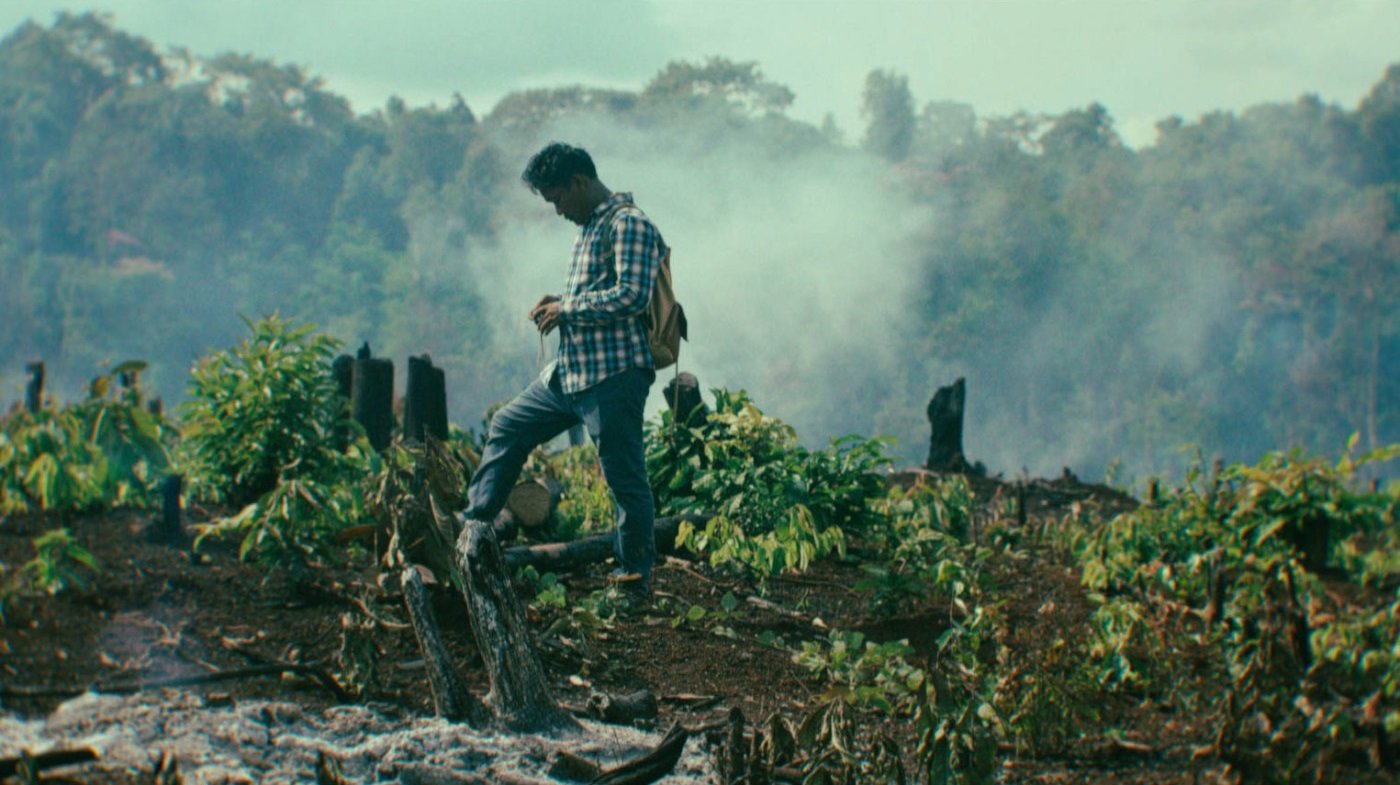
Mony Ros in Homo Sive Natura
An unnamed businessman (Mony Ros) arrives in the forests of Ratanakiri presenting himself as a harmless tourist, eager to encounter an Indigenous community he sentimentally describes as his “brothers”. His real task is considerably less benign: he has been sent from Phnom Penh to gather information that might facilitate the expropriation of their land. Rather than building this premise into a conventional tale, Giovanni C Lorusso‘s Homo Sive Natura, which world-premiered in Karlovy Vary’s Proxima competition, observes how his mission gradually alters both his relationship with the community and his understanding of his own position within a larger economic machine.
Lorusso’s non-fiction background is evident throughout, and it’s largely to the film’s benefit. The camera observes before interpreting, allowing gestures, routines and physical spaces to carry much of the narrative weight. The dialogue is sparse but effective, with silences often proving more revealing than explicit exchanges. This approach also prevents the local community from functioning merely as an exotic backdrop to the protagonist’s moral crisis: their everyday existence retains a dignity exceeding his limited perspective, even as the film remains primarily attached to the businessman’s journey.
The careful cinematography, handled by the helmer himself, is dominated by greens and greys in exterior sequences. The forest is neither idealised as an untouched paradise nor reduced to threatening wilderness; it appears humid, material and resistant to easy possession. Indoors, dimly lit rooms and pronounced chiaroscuro create a more constricted atmosphere, suggesting spaces in which intentions are obscured and power is exercised indirectly. At its most contemplative, the film finds a productive tension between the landscape’s apparent permanence and the impending violence of its commodification.
The sharpest idea in Lorusso’s work revolves around a kind of internal colonisation. The protagonist is undoubtedly an exploiter, but he is also being exploited by the company employing him. He may serve as the human face of dispossession, but he is neither its architect nor its ultimate beneficiary. The former colonisers may have abandoned the territory, but their mechanisms have been absorbed into contemporary society, reproduced through corporations, local intermediaries and the language of development. Lorusso wisely avoids turning this contradiction into either a straightforward redemption arc or a simplistic exercise in assigning blame.
At 116 minutes long, Homo Sive Natura can be demanding. Its deliberate pacing occasionally dilutes the dramatic pressure, and certain passages risk reiterating already clearly established ideas. Nevertheless, its naturalistic, slow-cinema register is fundamentally suited to a story about intrusion, observation and gradual moral corrosion. The film’s duration encourages the viewer to inhabit a rhythm profoundly at odds with the extractive logic threatening the community.
Realistically speaking, this is a curious and uncompromising cinematic work, one whose limited narrative momentum and austere form may complicate its circulation far beyond festivals or specialised venues. Yet restricted commercial prospects should not be confused with minor artistic value: Lorusso has made a thoughtful, visually accomplished work which understands colonialism not as a concluded historical episode, but as a system capable of endlessly changing hands.
Homo Sive Natura was produced by Revok (Italy) in co-production with Labo GCL (Italy). Sweden’s Antidote are selling the movie internationally.
