
– Christopher Nolan’s highly anticipated adaptation of the Homeric epic delivers the grandeur he promises while also making an unexpected but rewarding metatextual commentary
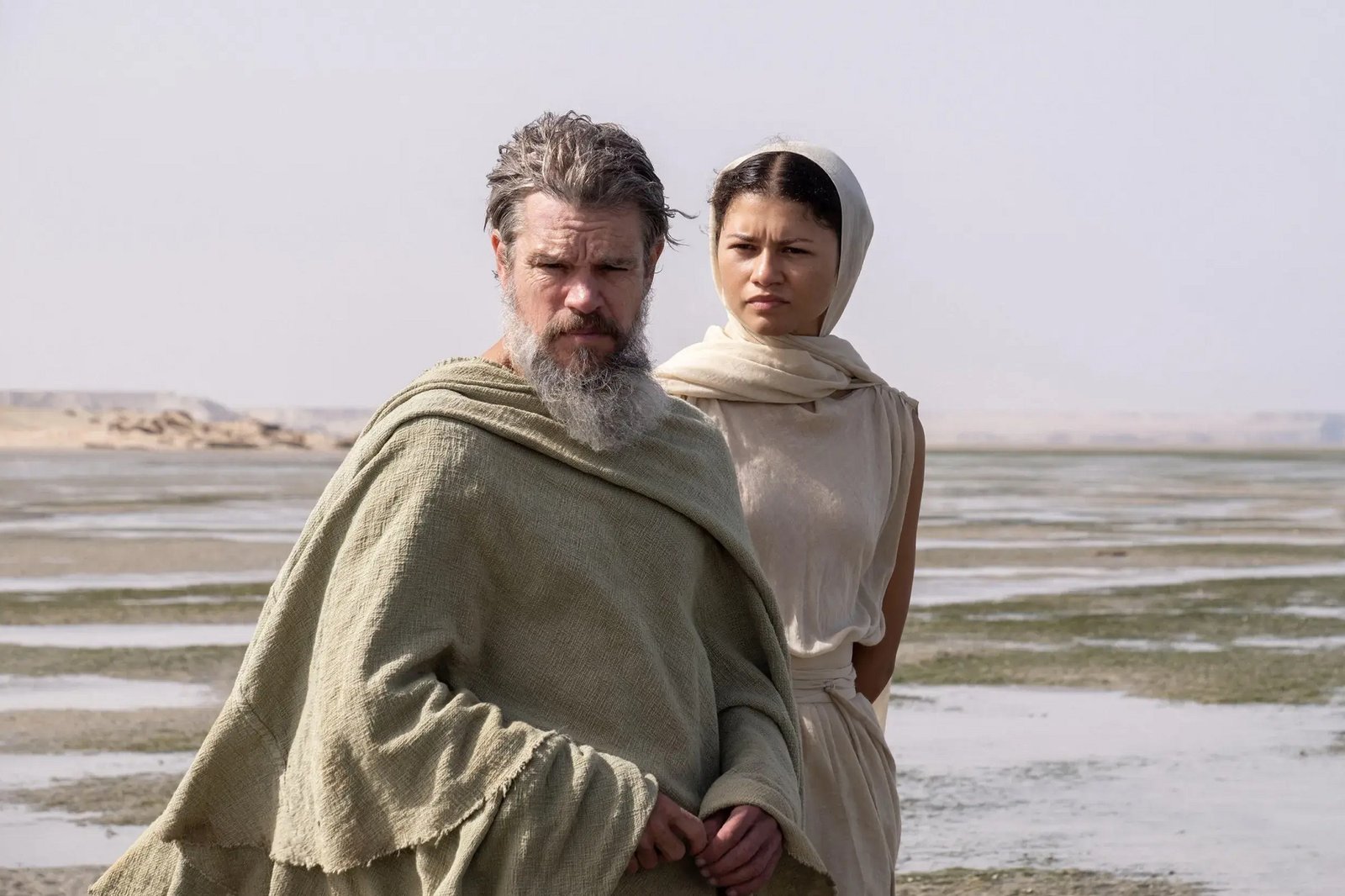
Matt Damon and Zendaya in The Odyssey
This is not a hero’s journey. In his long-awaited Homer adaptation, The Odyssey, which Universal starts rolling out in theatres worldwide today, 15 July, Christopher Nolan dreams of poetic beauty, stretching towards and trying to scrape the heavens with his fingertips and his all-IMAX 70mm cameras. The film captures a pinch of that godly glow when it manages to remind us of a mythology whose grandeur can only be fully conjured in the mind. These moments onscreen are more about arousing unbridled emotion in the viewer than showing it through the film’s mortal, earthbound characters.
“Give up the fight, give up control and live,” suggests the nymph Calypso (Charlize Theron) to Odysseus (Matt Damon) as he continues his journey back to Ithaca. This becomes an apt summary of the moments when the film truly aspires towards cinematographic greatness, guided by DoP Hoyte van Hoytema – at its most primal and earthy, overtaken by the elements. Nolan reaches the epic achievement he promised during a few fleeting moments of torrential, tormentuous sublime: when horrible waves shake the screen and the frame is filled with strange geometries of contorted bodies and gnashed earth.
The auteur lets the internet discourse about casting choices and informal language (hello, “Daddy”!) quickly wash away in the wine-dark sea. Yet, for those who know the text well, his trimming choices may be a set of tough pills to swallow. Several potentially show-stopping situations are relegated to shorter sequences of heading to shore, encountering an obstacle and then quickly fleeing. Nolan’s signature intermittent flashbacks occasionally feel like over-explanation in a tale already told non-chronologically.
The biggest eyebrow-raiser, perhaps, is Damon’s Odysseus, whose iconic intellect and cleverness are oddly underwritten. If he is to be more of an action star in the film, he is also arguably unconvincing; as a pensive and determined leader, he succeeds. Anne Hathaway emerges as the real scene-stealer as Odysseus’s wife Penelope, making good use of dry, expository dialogue in the first half-hour, later becoming the film’s most intriguing figure. It takes a while for Robert Pattinson to settle into his role as Penelope’s sneering, snivelling suitor Antinous – but eventually, he blossoms, despite the one-track-minded character. Tom Holland also satisfies as Telemachus, whose frantic boyhood as Odysseus’s son emerges in every tiny frown and whine.
Evoking Hildur Guðnadóttir’s technique for creating the Chernobyl series soundscape (the Icelandic composer’s Grammy-winning manipulation of eerie noises captured inside a nuclear reactor), three-time Oscar winner Ludwig Göransson’s score becomes the transcendent beating heart, quite literally, of the film. Rhythms of countless timbres, percussive environmental noises and larger-than-life choral melodies run relentlessly through the work – the credits also point out soloists playing three antique instruments: the aulos, the fyell and the lyre.) The Swedish composer conjures up a score that feels as if the Earth itself is emanating it from within: howling, running, searching and battling alongside Odysseus and his men.
Curiously, the blockbuster of the year is more about the quiet realisations of man – war hero Odysseus brought down by struggle, loss, failure and hubris – after a life lived perhaps largely for the wrong reasons. Adopting a mildly repentant angle, Nolan takes aim at the tale’s patriarchal context through flashes of righteous outrage from his female characters: Penelope’s grief and rage as a queen left unacknowledged and objectified, the witch Circe’s (Samantha Morton) accounts of soldierly rape and pillaging – and even the personified goddess Athena’s (Zendaya) silent screams of terror as Troy burns around her.
For every criticism the filmmaker has received for the place of women in his works, it is pleasantly surprising to see how he spins the back half of The Odyssey in this direction. It might be too interpretive to call it a feminist take, but his inspiration from Emily Wilson’s translation seems apparent. It is Odysseus’s own act of self-recognition of his dastardly wartime deceit – the Trojan Horse – and power over armies committing unspeakable acts that allows the filmmaker to bring down his unexpectedly perspectivist hammer. When Odysseus tilts towards anti-hero, the film finally becomes Nolan’s The Odyssey.
The Odyssey is a US-UK production by Universal Pictures and Nolan’s production company Syncopy.
