
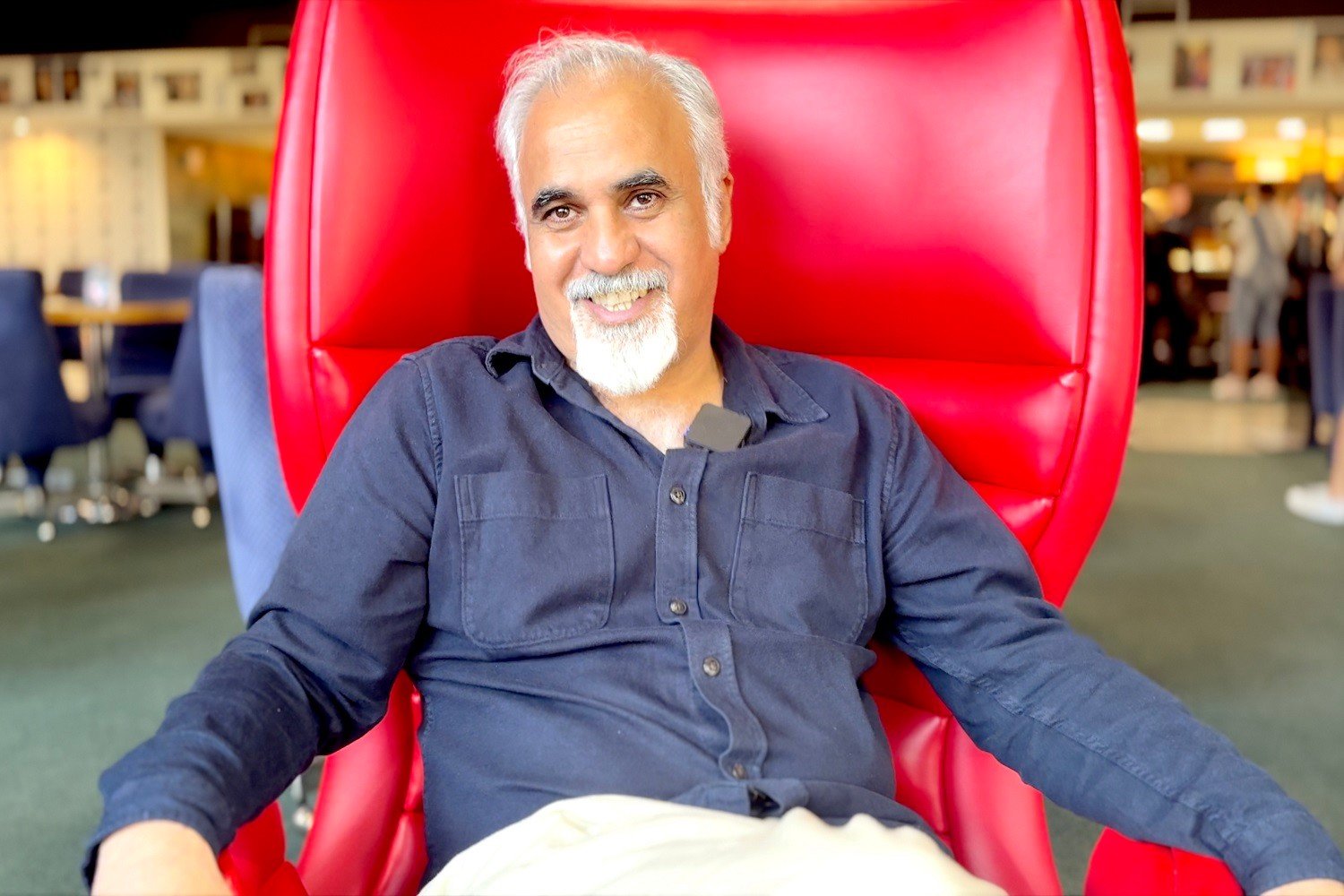
“I wasn’t interested in judging, I wanted to observe how mechanisms continue to shape people’s lives”
– The filmmaker discusses his latest film, centred on a traditional Muslim family and community whose world is shaken when they discover that one of their young members is gay
Iranian-born, Berlin-based filmmaker Nader Saeivar discusses his latest film, Hijamat, screened in competition at the 60th Karlovy Vary International Film Festival.
Cineuropa: Hijamat brings together Turkish, Arab and German communities in Berlin. The city itself almost feels like another character in the film.
Nader Saeivar: I’m an Iranian Turk myself, so I knew this community very well before making the film. That wasn’t something I had to research. But when I moved to Berlin, I discovered another layer. What fascinated me was that the city didn’t feel German to me. It felt like the whole world had gathered there. I wanted to tell a story rooted in people I know, while bringing together the different communities that coexist in Berlin. Through Turkish friends I’d worked with in Iran, I became close to both the Turkish and Arab communities here. Those relationships allowed me to build the world of the film from the inside rather than looking at it as an outsider.
There is a line that stayed with me long after the screening. Leyla tells Karim, “It’s not hard to kill one part of yourself.” In different ways, almost every character seems to be doing exactly that.
Everyone carries their own pain. Perfect happiness doesn’t exist anywhere. But if you look closely enough, you realise that the roots of our grief are very similar. When people share those sorrows, they begin to recognise themselves in one another. That’s why Margot can love Murat almost like her own son. Their backgrounds are completely different, but suffering doesn’t recognise nationality. Sometimes the colour of our skin is different, but the colour of our sorrow is exactly the same.
The film never feels like it’s trying to represent a community. It simply feels lived in. Even the casting carries that sense of authenticity.
That was essential for me. I wanted actors who genuinely belonged to these communities because audiences immediately recognise when something feels true. If these words are spoken by someone who carries that culture within themselves, people believe them differently. For the German part of the story, I worked closely with filmmaker Behrooz Karamizade, who was born and raised in Germany by Iranian parents. He helped me shape the dialogue and emotional nuances. Authenticity isn’t only about language. It’s about whether people believe in the world they’re looking at. Nastassja Kinski also became part of that idea. For me, she represents a certain memory of Europe, its beauty and confidence, and I wanted that presence in the film.
Your mise-en-scène feels entirely character-driven. How much freedom do your characters have to shape the world around them?
Everything begins with the character. The mise-en-scène, the camera movement, even the production design – all grow out of who they are. I only do what the character allows me to do. If the character doesn’t experience something, then neither should the audience. I told my cinematographer on the first day that I wasn’t going to tell him where to move. The actor would decide that. Wherever the actor goes, the camera can follow. Wherever the actor doesn’t go, the camera has no right to go. The same principle applies to every department. Murat tells us what his world looks like. I don’t.
One of the most frightening things about the Imam is that he rarely appears openly violent. He manipulates through certainty, through trust and through the promise of protecting the family.
That’s exactly how these structures work. I lived under a religious dictatorship in Iran for fifty years. I know how power functions inside those systems, how money moves through them and how people are controlled without always recognising it. Even when people leave that environment, those structures don’t disappear overnight. They travel with them. I wasn’t interested in judging anyone. I wanted to observe how those mechanisms continue to shape people’s lives.
For all the tension surrounding Karim and Murat, one of the happiest moments in the film is simply two brothers driving around Berlin, laughing like children again. It almost feels as though, for a few minutes, they’re allowed to exist without everyone else’s expectations.
Perhaps the film is also about the feminine side of men. But it’s certainly about freedom. Every character is searching for a place where they can simply be themselves. Sometimes they find it only for a few moments before reality catches up with them again.
Jafar Panahi is credited as both producer and editor on Hijamat. What has stayed with you most from working alongside him over the years?
Before I met Jafar, I had directed several television series. I thought I knew filmmaking. Then I met him and realised I didn’t know cinema at all. We’ve been working together for many years now. While I was making my own films and assisting on his, he taught me everything. He’s also an incredibly demanding teacher. In all the years we’ve worked together, I don’t think he’s ever looked at one of my films and simply said, “It’s good.” Usually, he says, “It was terrible.” Then he sits down next to me and starts helping me make it better.
