
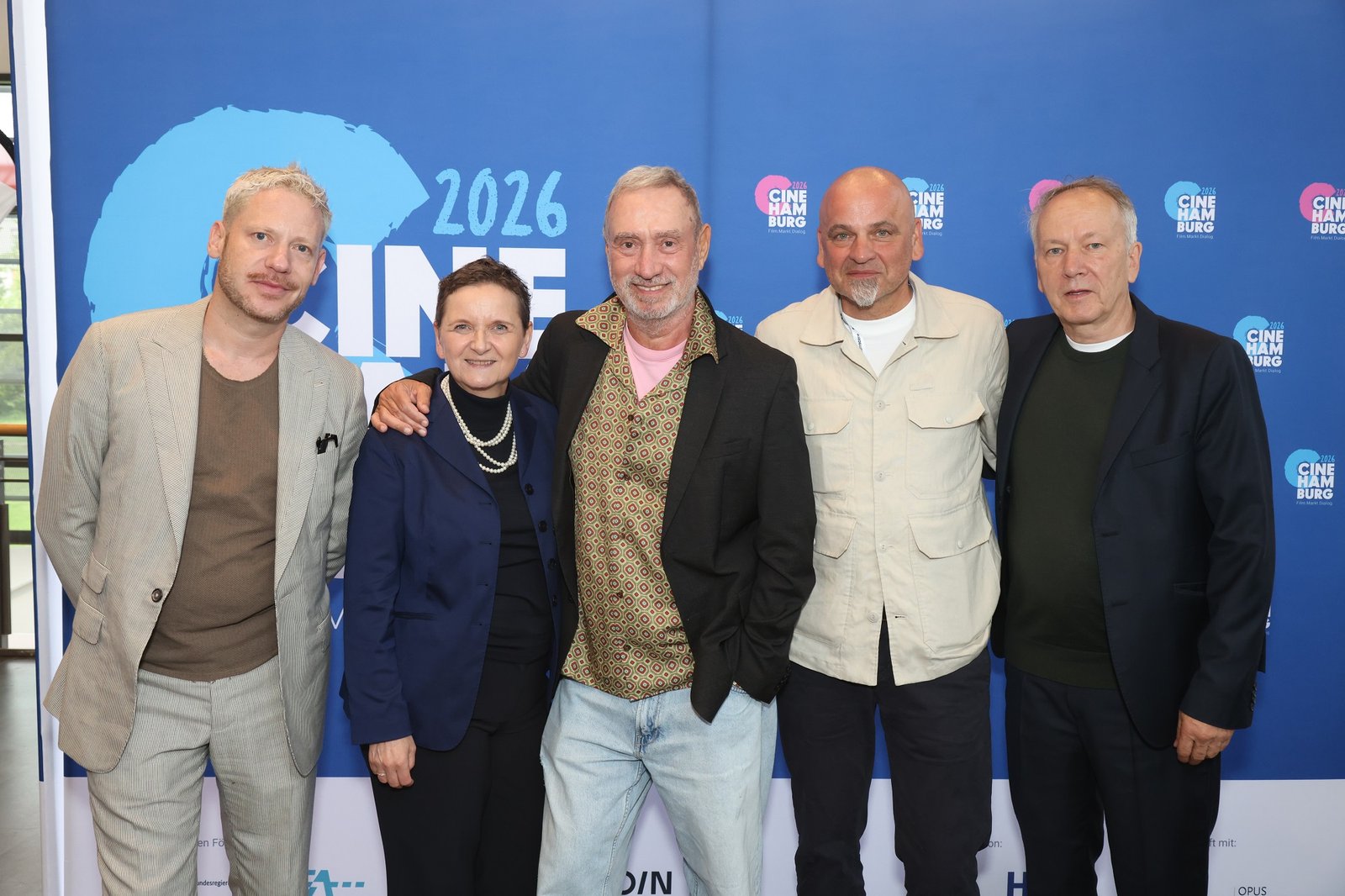
– Cinema attendance, theatrical windows, immersive cinema experiences and AI were key topics at the new industry event
l-r: Director Marco Kreuzpaintner, HDF Kino’s Christine Berg, director Roland Emmerich, AllScreens’ Peter Schauerte and producer Thomas Wöbke (© Stephan Wallocha/ZKM)
Cinema attendance, theatrical windows, immersive cinema experiences and artificial intelligence were the key topics that industry representatives discussed at CineHamburg. Launched by the AllScreens Association for Film Distribution and Audiovisual Media and the German Cinema Association HDF KINO, the new industry event attracted around 1,700 industry representatives from all across Germany and abroad.
“The first CineHamburg exceeded our expectations”, revealed Christine Berg, HDF KINO, and Peter Schauerte, AllScreens. “High attendance figures clearly demonstrated its relevance to the German film industry.” Thanks to over seventy exhibitors, exclusive trade shows and screenings by distributors, not to mention panels and workshops, the wide-ranging trade show provided plenty of opportunities for meaningful conversations and exchanges between peers.
“We’re very optimistic about the theatrical market”, emphasized Nick Rush, senior vice president of Studio Distribution for The Walt Disney Company EMEA. Tim Richards, founder and CEO of VUE Entertainment, pointed out that audiences have never stopped going to the movies. “Studios are continuing to invest heavily in production and marketing in order to reach audiences even more effectively.”
According to Toby Tennant, SVP of Theatrical Distribution for Warner Bros. Entertainment EMEA, international ticket sales have significantly increased over the past year. “The movie theatre market has lost none of its appeal”, Tennant underlined. “This is also evident from the fact that Amazon is now setting up its own movie distribution service for all markets worldwide.”
Exclusive theatrical release windows are very important. Usually, The Walt Disney Company and Warner Bros. plan a theatrical window of 54 to 60 days, and in some cases 90 days. “Meanwhile, US studios are talking about a theatrical window of 46 days, which is too short for theatrical releases”, explained Gregory Theile, CEO of Germany’s largest family-run cinema company, Kinopolis. “We need a clear commitment from distributors to a window of at least 60 days.”
In recent years, the movie theatre industry has invested heavily in its future. “This has enhanced the movie theatre experience, particularly in the premium segment”, Theile stressed. An increasing number of exhibitors offers a variety of technical solutions to enhance the movie-going experience. “We set up an IMAX cinema in an XL-Large format“, revealed Leonie Günther, CEO of the Filmpalast Group in Kassel. “When visitors enter our cinema, they find themselves in an immersive experience.”
Alexander Rusch, CEO of Kino Gruppe Rusch, installed the ICE (Immersive Cinema Experience) theatre system, which aims to fully immerse viewers in films through lighting, sound, and projection. Developed by the French movie theatre chain CGR Cinemas, the system provides LED panels which are mounted on the side walls of cinemas. These display dynamic colours and shapes which expand the viewer’s peripheral field of vision and visually mirror the action on screen. Meanwhile, in Europe’s largest cinema, Cinecittà, in Nuremberg, images are projected onto the 600 square meter Cinemagnum screen by way of four connected Sony Quad 4K projectors with a total output of 60,000 lumen.
The four-day event saw distributors presenting trade shows which gave exhibitors a first glimpse at upcoming theatrical releases scheduled for the next twelve months. Moreover, CineHamburg awarded the Gläserne Leinewand (Crystalline Screen) Award to internationally acclaimed German director, producer, and screenwriter Roland Emmerich, whose films (Independence Day, The Day After Tomorrow) have grossed more than four billion US dollars worldwide.
The Hollywood-based filmmaker spoke about his plans to bring his next projects, involving artificial intelligence, to life. Emmerich has a whole list of scripts that he wants to bring to the big screen. “I’m going to make them all now, because I’m relying entirely on AI”, Emmerich explained. The use of artificial intelligence isn’t just limited to script writing and film production: movie theatres are also working with AI applications which accelerate their workflows. In the UK, Vue Entertainment is using AI for programming screenings and as a tool for reacting faster to individual guest requests.
“The positive feedback we’ve received on this diverse programme encourages us to continue developing this joint industry gathering”, concluded CineHamburg hosts Christine Berg and Peter Schauerte. “We look forward to building on this successful debut in the coming years and we’re already looking forward to the next edition in Hamburg.” The second edition of CineHamburg is scheduled for 13 July 2027.
