
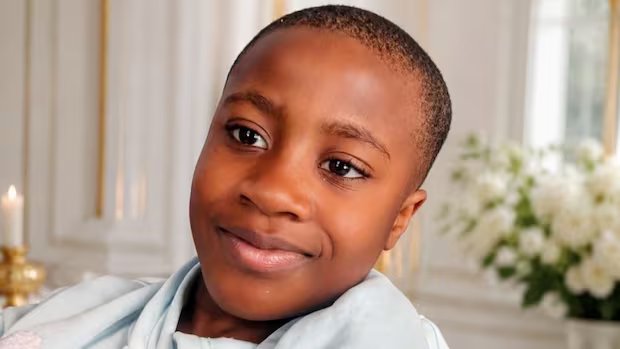
Nathanael Selambi, known as Nathan to his family, had been in Canada for two years after emigrating from Cameroon.
The move was jarring for the seven-year-old francophone, who started school in English at Hamilton’s Cathy Wever Elementary School, before transferring to Notre Dame, a francophone Catholic school near Gage Park.
“It was hard for him, but he was happy because he loved basketball and he had access to a basketball court, and also a soccer field,” his mother, Vanessa Innocenta Lonlac Magolac, told CBC Hamilton this week.
She said the family moved here for access to better education, reliable electricity and clean water. “He said that he didn’t want to move back to Cameroon anymore.
“Nathan was very proud to be here in Canada. He said, ‘thanks, Mom, for bringing me to Canada,’ and then he died on Canada Day.”
Nathan was among 200 people from the local Cameroonian community celebrating Canada Day on July 1 at Binbrook Conservation Area when he went missing that afternoon. His body was found in the water the next day, leaving his parents and two siblings crushed at the loss of a boy who, his mom says, was thoughtful, pious and mature beyond his years.
“My heart is broken forever,” she said in an interview in French on Tuesday, through tears. “My life will never be the same.”
Nathan told to stay on the beach, says mom
That day, Nathan was playing with many other children in the water of Lake Niapenco, and was seen wandering off from the group, says Lonlac Magolac.
“I told him not to go in the water anymore,” she said, then turned her attention to her two-year-old, who had been fussy that day. “I was not worried because he is a child who listens… Then a child came to tell me that Nathan had lost his goggles. That’s when I started to worry because I know my son. If he loses something, he will do anything to find it.”
Nathan was last seen at about 3 p.m. that day. Police said he was seen heading towards an inflatable structure called the FunSplash Sports Park, a floating playground in the lake run by a private business. FunSplash told CBC Hamilton that Nathan would have had to purchase a pass, get a risk test and take a safety briefing before going on the inflatables, and that did not take place.
A group of about 50 people searched for him that day and the next, an effort complicated by severe thunderstorms that rolled through the area that evening. A 61-year-old kayaker was found dead in the lake following the storm during search operations for Nathan.
When the Peel Region dive team arrived to assist police on July 2, they saw Nathan’s body submerged near the inflatable park before divers even went into the water.
“We had quite inclement weather around 5 p.m.,” said Hamilton police Const. Adam Kimber. “It did create some waves and create some disturbance in the water there. So, from where he was located [July 2] to where he became deceased is not clear.”
‘Always wanting to help others’
Lonlac Magolac, who was a teacher in Cameroon and is a supply teacher in Hamilton, remembers her son as extremely considerate. He was the oldest of three children in the family, leaving behind siblings who are four and two years old, as well as his parents. The family lives near Stoney Creek, said his mom.
“He was too nice, always wanting to help others, always wanting to care for me when I got home tired. He’d say to his siblings, ‘Don’t bother mom, she is tired, let her rest.”
She says Nathan was aware of the family’s challenges as new Canadians and did not want expensive things that would strain their budget. She says he worked hard at school and tried to make her proud by getting good grades.
“He would say, ‘Mom, I’m going to bring you all As,'” she said. “I was very proud of him.”
45% of water-related deaths happen in a lake or pond: Lifesaving Society
Lifesaving Society Canada data shows that the number of water-related deaths in Ontario has gone up slightly since 2013, from 1.2 deaths per 100,000 residents to 1.4 per 100,000 in 2022, the most recent year of data provided.
The organization says 45 per cent of deaths happen in a lake or pond, by far the most common location, and that only 1 per cent happen in a setting supervised by a lifeguard.
Stephanie Bakalar, Lifesaving Society Ontario’s senior communications officer, says that, unlike for pools, there are no legal safety requirements in Ontario for operators of waterfront space, except for summer camps.
“Not everybody realizes how important wearing a lifejacket is, especially in an open water situation,” says Bakalar, whose organization offers up to nine free lifejackets to groups starting a lifejacket lending program. Her organization strongly recommends lifejackets for kids playing in open water.

Mom wants lifejackets to be available at Binbrook Conservation Area
In honour of her son’s memory, Lonlac Magolac is hoping to bring access to lifejackets to Binbrook Conservation Area. She’d like to contribute money she saved for Nathan’s education to help buy lifejackets there, and would also like their use to be mandatory.
She’d also like to see other safety measures such as lifeguards, security cameras, and underwater thermal cameras, as well as a safety sign in French, in addition to the one currently there in English.
“I don’t want another parent to live through what I have lived through,” she said. “This isn’t the first time a child has died there.”
Three-year-old Zahra Ousmane drowned at the conservation area while there with her family and a larger group in 2022.
Bakalar, from the Lifesaving Society, said that when lifejackets are made available, people tend to use them.

“Having those lifejacket stations and having those tips and information posted and available at public beaches will go a long way to supporting people in being able to recognize that this is a choice I should be making, or this is something I can do to add a layer of protection,” she said.
The Niagara Peninsula Conservation Authority, which runs Binbrook Conservation Area, says it has been in contact with Nathan’s family and is working with them privately to honour his memory.
“Out of respect for the family, we will not be commenting publicly on those discussions,” said spokesperson Sofia Zavarella in an email. “We regularly review our operations and procedures supporting the visitor experience at our conservation areas, including those related to health and safety, and will continue to do so.”
