
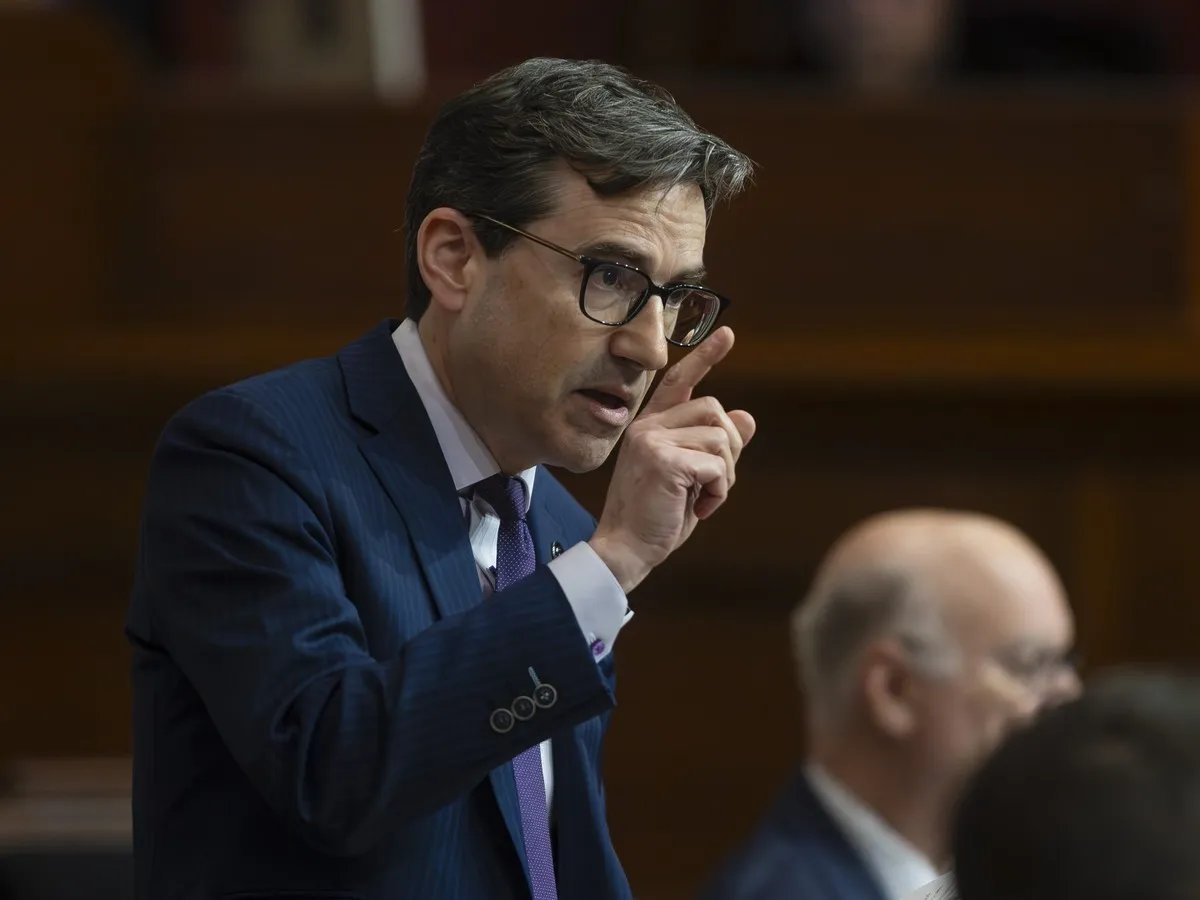
If the Parti Québécois is elected this fall, it says it will try to redraft a pending energy deal with Newfoundland and Labrador to further develop Churchill Falls. But only if it involves compensation for Quebec’s loss of Labrador nearly a century ago.
In an interview with National Post, the party’s energy critic Pascal Paradis said a PQ government would be willing to sit down and discuss new terms to update the 1969 energy deal that is loathed in Newfoundland and Labrador, but only with the “right approach” for Quebec.
“The right approach is not to substantiate the theory according to which the 1969 deal for the development of Churchill Falls is an illegitimate or unjust deal,” he said.
The power contract signed between Hydro-Québec and the Churchill Falls Labrador Corporation ensured that hydroelectricity produced at the Churchill Falls site would be sold to Hydro-Québec at a very low price until 2041.
The deal has caused generations of resentment in Newfoundland and Labrador, where citizens feel their resources have been taken advantage and enriched Quebec’s hydroelectric cash cow.
But Paradis said Quebec took “enormous financial risks” to develop Churchill Falls at a time when Newfoundland and Labrador did not have the means to do so itself, noting that subsequent legal challenges to change the terms of the contract failed.
That deal was later ripped up — literally — by former Newfoundland and Labrador Premier Andrew Furey in 2024 when he signed a memorandum of understanding (MOU) with Quebec which would have replaced the contentious 1969 agreement.
That MOU would have seen billions more flow to the province, as Hydro-Québec is looking to double its electricity production by 2050 to keep up with demand.
A new Progressive Conservative government was elected in 2025, promising to review the deal. An independent review ultimately concluded the MOU was not in Newfoundland and Labrador’s best interests, and negotiations with Quebec restarted last month.
Paradis said the “real injustice” on this file was the 1927 decision of the Judicial Committee of the Privy Council in London to grant the disputed territory of Labrador to Newfoundland, then a British Dominion.
He said the province should be compensated for it.
Paradis said that while the decision did take place nearly a century ago, the PQ does not intend to abandon the province’s “historic position” on the matter.
“Given this injustice, compensation should be negotiated,” he said. “And that of course has a direct link with the negotiations on Churchill Falls.”
The boundary between Quebec and Labrador has been a longstanding irritant for Quebec governments for decades, but the PQ took it a step further in its “blue book” released last month, which fleshes out what an independent Quebec would look like.
The PQ’s 524-page document states that the “only way to repair this injustice would be to propose a political settlement, or even financial compensation.”
Newfoundland and Labrador Premier Tony Wakeham outright dismissed the idea when asked by reporters last week. “This issue was settled a long time ago,” he said.
Gregory Kelley, natural resources critic for Quebec’s Liberal party, said that while he agrees most Quebec governments have never officially accepted the border with Labrador, picking up a fight with another province should not be a priority.
“I just sort of see it as the classic Parti Québécois finding ways, on a file that is really between two provinces, to maybe try and bring in a whole question of the history of Canada and the injustices of Canada,” Kelley said in an interview.
He added it is more important, at the moment, to come to an agreement to help produce more energy that businesses can rely on moving forward in the future.
Wakeham met on Tuesday with Quebec Premier Christine Fréchette at the Council of the Federation in Charlottetown to discuss the status of negotiations on a new energy deal.
Representatives of Hydro-Québec and N.L. Hydro were not in attendance at this meeting, according to Wakeham’s press secretary Ashley Jackson-Politi.
Time is running out for Fréchette to come to a deal, as she will soon be facing an uphill battle in the provincial election slated for Oct. 5. Her party, the Coalition Avenir Québec, is currently in third place in the polls, while the PQ is poised to form government.
Despite this, her team believes it is possible for Quebec to arrive at a revised MOU with Newfoundland and Labrador that will benefit both parties.
“Discussions are ongoing; we remain confident to arrive at an agreement,” said Fréchette’s press secretary, Élodie Masson, in a written statement.
Hydro-Québec echoed that statement, adding: “ Our focus is on continuing those discussions, and it would be premature to comment on subsequent steps,” said spokeswoman Lynn St-Laurent in an email.
Opposition parties in Quebec agree that Fréchette should not rush into an agreement on Churchill Falls with an election fast approaching. Or, if she does, they believe it should be submitted to the National Assembly of Quebec for review.
“We would ultimately like to see an agreement go through on Churchill Falls, but it’s important also to put things into context that Madame Fréchette doesn’t have carte blanche to sign anything either,” Kelley said.
“We’re of the view that the original offer made by Hydro-Québec and the government of Quebec was extremely generous,” he added.
Paradis said Fréchette simply does not have the “legitimacy” to sign an agreement in the dying days of her mandate and fears she might make too many concessions to wrap up the negotiations quickly.
“The first ones to judge will be Quebecers during the elections in October.”
National Post
calevesque@postmedia.com
Our website is the place for the latest breaking news, exclusive scoops, longreads and provocative commentary. Please bookmark nationalpost.com and sign up for our politics newsletter, First Reading, here.
