
OTTAWA — Westerners might be experiencing a sense of déjà vu as Ontario’s premier is once again suggesting an embargo on oil exports to the U.S. to retaliate against tariffs.
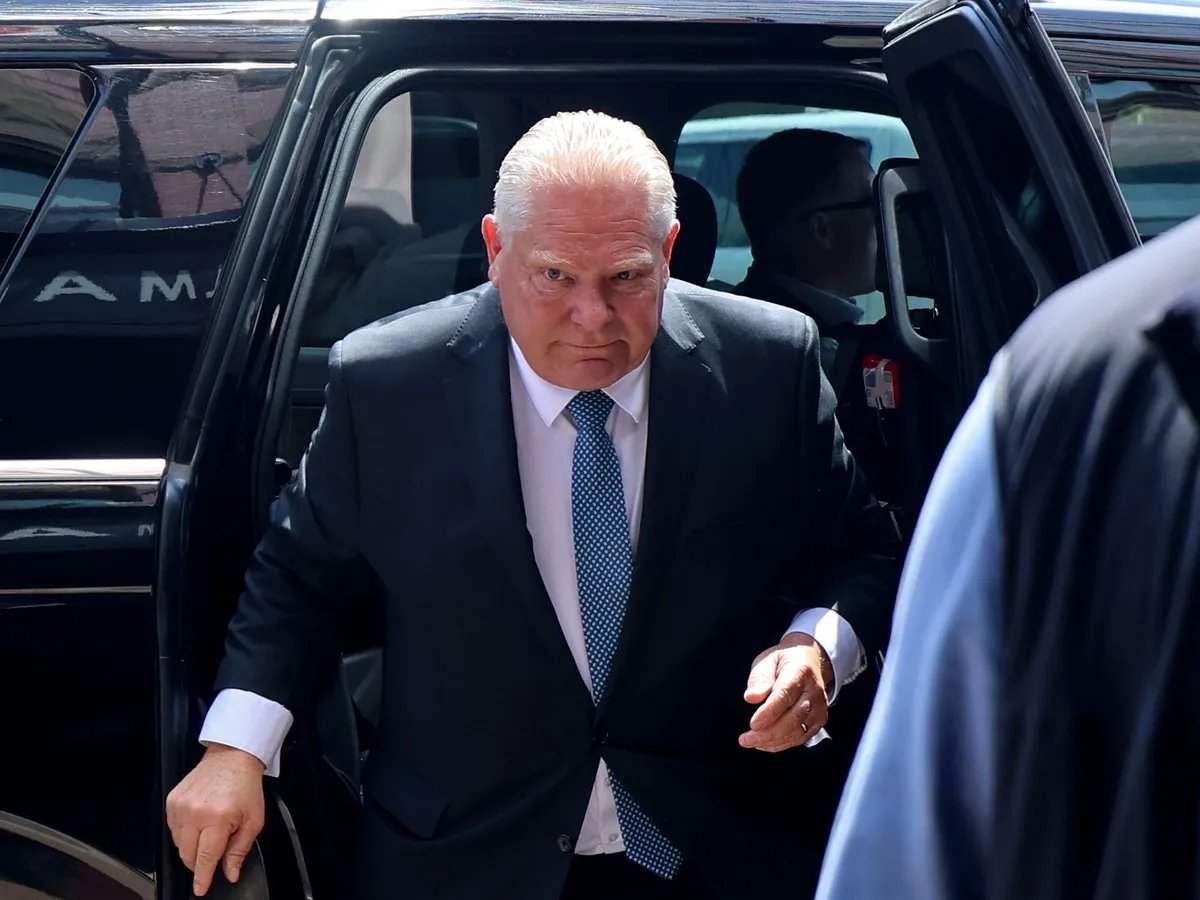
Ontario Premier Doug Ford told reporters at the first ministers’ meeting in Charlottetown on Tuesday that Canada should leverage its most valuable resources to hit back at the U.S. after the White House announced plans for new tariffs this week.
“No matter if it’s the electricity — and I’m not speaking for the other provinces, I’m going to be very clear — the potash, the oil … they need to feel the pain,” said Ford. The Ontario premier had last year suggested restrictions on oil and potash exports in response to President Donald Trump’s first round of tariffs, but met immediate resistance from Alberta Premier Danielle Smith and Saskatchewan Premier Scott Moe.
The new 50 per cent tariff is expected to hit Ontario, Quebec and British Columbia the hardest, while leaving Alberta and Saskatchewan relatively unscathed.
When the then Trudeau Liberal government briefly floated the idea of putting an export tax on oil exports to the U.S., Smith refused to sign a joint federal-provincial statement voicing solidarity against the Trump administration’s tariffs.
Smith repeated again on Tuesday that she did not support Ford using western resources as a weapon.
“That’s not going to happen,” Smith told reporters in Charlottetown.
Earlier this month, she and Ford announced a proposal for a west-to-east Northern Shield pipeline from Alberta’s oil sands to refineries in Sarnia, Ont. to circumvent the U.S. route that western oil currently takes to reach Ontario.
Alberta and Saskatchewan produce nearly all of roughly 4.3-million barrels of oil Canada sends to the U.S. per day. Saskatchewan is the country’s sole producer of potash , a critical mineral used to create fertilizer, and supplies 85 per cent of the potash used on American farms.
Crude oil is Canada’s top export to the U.S. and potash is its top mineral export.
One early estimate of the impact of the latest Section 338 tariffs, calculated by University of Calgary economist Trevor Tombe, forecasts that the new tariffs will negatively impact 13.7 per cent of B.C. exports, 10.8 per cent of Quebec exports and nine per cent of Ontario exports.
Tombe calculates that just one per cent of Alberta exports and 1.2 per cent of Saskatchewan exports will be impacted.
But some analysts say there are much better ways to leverage Canada’s oil and potash than with blockades.
Jack Mintz, an economist and chair of public policy at the University of Calgary, said that the two commodities will be an indispensable source of revenue as Canada deals with the broader dislocation of its trade relationship with the U.S.
“If Alberta and Saskatchewan continue to have the relatively stronger provincial economies, versus Ontario and Quebec, there’s going to be more transfers to those parts of the country as they deal with the effects of the tariffs,” said Mintz.
Mintz added that workers displaced from the auto sector and other affected industries in Central Canada could eventually find work in Alberta, noting that the province is already attracting a large number of interprovincial migrants . In the late ’90s and early 2000s, many workers from Newfoundland found work in Alberta’s oil sands after the closure of the cod fisheries put tens of thousands of people out of work.
He said there is already a mechanism to help balance the differential impacts of the new tariffs. “The last time I checked, Ontario and Quebec are already collecting equalization payments, and they could end up with more equalization payments,” said Mintz.
Mintz added that federal tax revenues from Alberta and Saskatchewan will also help fund targeted supports for workers in tariff-affected industries.
Former Saskatchewan natural resources minister Tim McMillan, says that Ford seems to have an incomplete understanding of potash.
“What (Ford) gets right is that potash is a phenomenal resource… what he gets wrong is that it should be sacrificed to defend industries where, arguably, he and the federal government haven’t put into a position of strength,” said McMillan.
“By killing the golden goose, you aren’t saving the country. You’re just making the country worse,” he added.
McMillan noted that Canada’s uncompetitive business climate is already pushing producers to look south of the border for opportunities, pointing to potash giant Nutrien’s recent announcement to locate a major export terminal in Washington State rather than Vancouver.
Heather Exner-Pirot, director of energy research at the Macdonald-Laurier Institute, said that using oil and potash to retaliate against the tariffs would just create further trade uncertainty.
“The resilience of energy and minerals in the past year, and their exclusion from tariffs, has been a huge net positive for the Canadian economy … It’s not helpful to inject uncertainty into these sectors by floating the idea of using them as retaliation,” she said.
National Post
rmohamed@postmedia.com
Our website is the place for the latest breaking news, exclusive scoops, longreads and provocative commentary. Please bookmark nationalpost.com and sign up for our daily newsletter, Posted, here.
